Mobile County Approved $45,000 for Gulf Coast Classic in 2009
The Mobile County Commission approved $45,000 for the 2009 Gulf Coast Classic as officials sought to stabilize the long-running football event after prior management concerns.
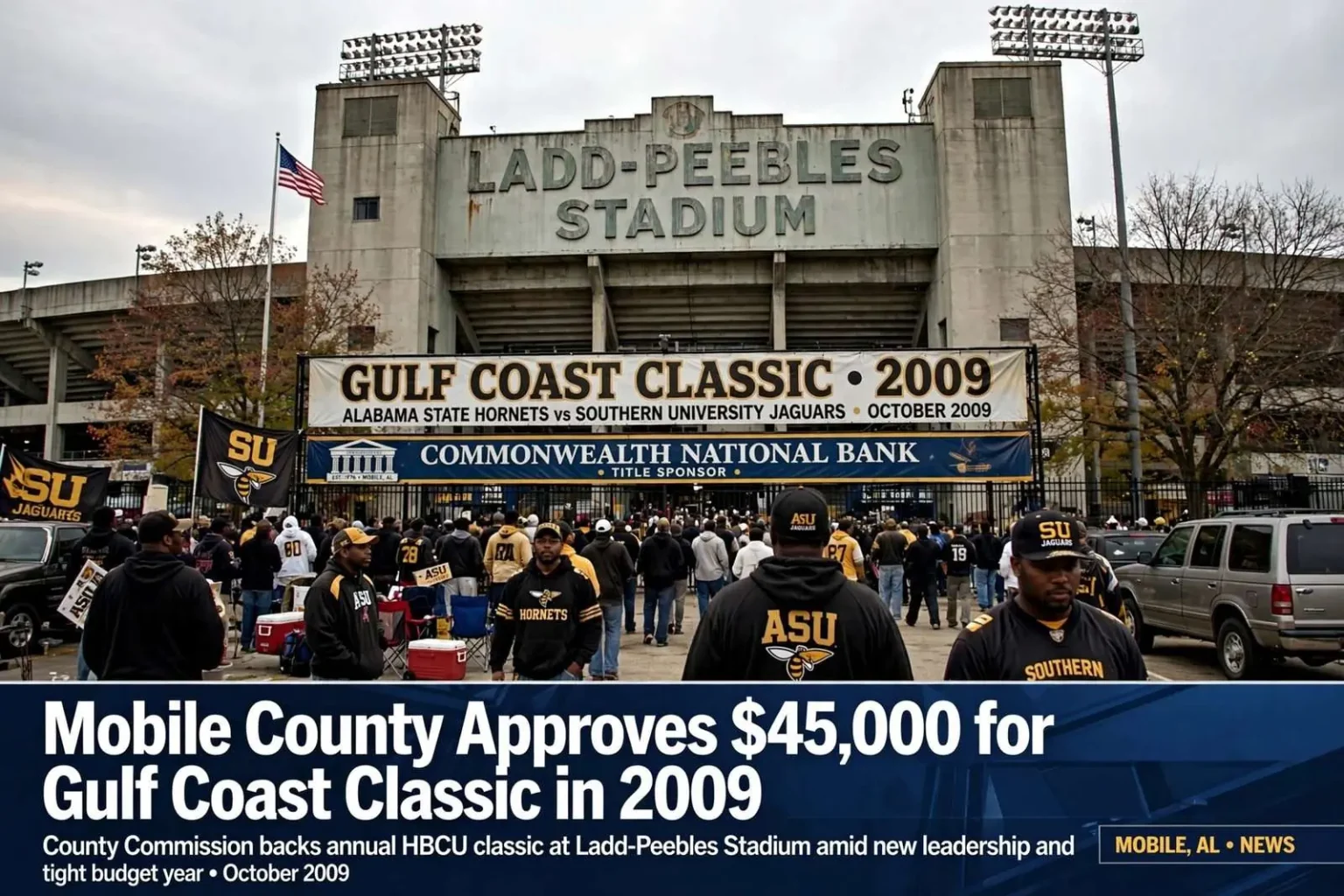
The Mobile County Commission approved $45,000 for the Gulf Coast Classic in October 2009, supporting the annual football event at Ladd-Peebles Stadium. The appropriation kept one of the city’s most anticipated fall sporting traditions on the schedule at a moment when the game’s finances and leadership were under more scrutiny than at any point in its recent history.
The game was scheduled to match Alabama State University and Southern University, two historically Black institutions with football programs that have anchored the college’s homecoming celebrations for generations. A matchup between the Hornets and the Jaguars carried obvious appeal for Mobile fans: thousands of alumni of both schools live along the Gulf Coast, and the Classic gave them a chance to see their teams without traveling to Montgomery or Baton Rouge.
Ladd-Peebles Stadium has long served as Mobile’s principal venue for football events of every scale, from high school championships to college bowl games. Hosting the Classic fit a pattern for the stadium, whose capacity and central location off U.S. 45 have made it the default choice for events expecting a regional crowd.
A Smaller Check in a Tight Budget Year
The county’s appropriation was slightly lower than the prior year’s contribution because officials had reduced county appropriations to balance the budget. The 2009 fiscal climate was difficult for governments across the country, and Mobile County was no exception — commission leaders spent that budget season trimming allocations across the board, from economic development programs to community organizations.
That the Classic still drew a five-figure county commitment in a lean year said something about how the commission viewed the event. County leaders described the Classic as a long-standing community asset and said they wanted to help ensure its future, framing the money not as charity but as an investment in a tradition that draws visitors, fills hotel rooms and anchors the fall social calendar for thousands of Gulf Coast families.
The Mobile City Council had also approved support for the 2009 game, meaning the Classic entered the season with backing from both major layers of local government. Split municipal and county support is common for events with regional draw, and the dual commitment signaled that city and county officials alike saw the game as worth preserving.
New Leadership and Accountability
Commissioners praised the Classic’s new executive director for securing Commonwealth National Bank as title sponsor and for addressing debts from the previous year’s event. A title sponsor is more than a name on the ticket — it is the financial backbone that covers guarantees, band appearances and game operations — and landing a hometown institution like Commonwealth National Bank gave the 2009 game a stability it had lacked.
The praise for debt cleanup was pointed. Officials said the 2008 game had faced management problems, including questions about payments to participating schools, and those unresolved obligations had cast a shadow over the event’s future. For a Classic built on relationships with two universities, paying what was owed mattered less as bookkeeping than as reputation: schools do not return to an event that leaves them wondering whether the check will clear.
The commission’s public discussion in October 2009 reflected that tension. Members wanted to support a community institution, but they were candid about the need for the game’s new management to demonstrate financial discipline before public dollars could be justified at the levels of prior years. The $45,000 appropriation — real support, trimmed from the year before — struck the balance the county was looking for.
The History Behind the Classic
Black college football classics have deep roots across the South, and Mobile’s Gulf Coast Classic is part of that tradition. Classic games — neutral-site matchups staged in cities with large alumni and fan populations — grew out of the era when historically Black colleges and universities built celebrated football programs outside the mainstream of college athletics. The games became as much social gatherings as sporting events, complete with battle-of-the-bands performances at halftime that often rivaled the football itself.
For Mobile, the Classic delivered exactly that blend. Alumni groups from Alabama State and Southern University organized tailgates and reunion events around the game, gospel choirs and marching bands filled the stadium concourse, and churches and civic organizations across the Gulf Coast built weekend plans around the date. A football game between two schools is scheduled in the fall; a classic is scheduled in the culture.
Ladd-Peebles Stadium, opened in the late 1940s and long the anchor of Mobile’s sports calendar, had hosted high school playoff games, the Senior Bowl’s college all-star showcase, and a string of college matchups over the decades. The Classic’s annual date gave the venue a consistent October or November attraction and gave local HBCU football fans an event of their own.
Why Public Funding Entered the Picture
The commission’s involvement followed a pattern familiar in mid-sized Southern cities: events that generate tourism traffic and civic pride frequently seek public support, and local governments weigh the economic return against competing priorities. A football classic filling Ladd-Peebles with thousands of spectators brings spending to restaurants, hotels and service businesses across Mobile County, and supporters of the appropriation argued the county’s investment would circulate through the local economy several times over.
Critics of public funding for private or nonprofit events ask harder questions, and the 2009 debate over the Classic touched on them directly. If the event’s prior management had left debts unpaid — including obligations to the participating schools — then public dollars carried a responsibility to be matched by sound stewardship. That was precisely the case the new executive director made in securing the title sponsor and clearing the old obligations before returning to the commission for support.
The county’s approach — a reduced but meaningful appropriation, paired with public praise for demonstrated accountability — offered a template for how local governments can support community events while insisting on financial discipline.
What the October 2009 Decision Covered
This account documents the commission’s October 2009 funding decision and the public discussion surrounding it. It does not establish later attendance, final event finances or current public funding for the Gulf Coast Classic. Readers researching the game’s later history should consult records from subsequent years, as event management, matchups and funding arrangements evolved after the period described here.
What the 2009 record does show is a snapshot of a community institution at a turning point. A beloved game had stumbled through a mismanaged year; a new director had arrived, secured a hometown title sponsor in Commonwealth National Bank, and begun paying down the debts that threatened the Classic’s credibility; and the county commission, working through a tight budget, chose to keep its support coming at a moderated level while the turnaround took hold.
For the schools, the stakes were straightforward. Alabama State University and Southern University each gained a Gulf Coast showcase for their football programs, marching bands and alumni networks, in a city whose Black college football fan base had sustained the Classic through nearly two decades of fall weekends at Ladd-Peebles Stadium.
For Mobile County, the decision preserved an event that officials described as a long-standing community asset — one whose value was measured not only in ticket sales but in the reunions, recruitment visits and civic gatherings that formed around it each year. The October 2009 appropriation of $45,000 stands in the record as the moment local government chose continuity over caution, betting that new leadership could restore the Gulf Coast Classic to solid ground.
The Wider Classic Circuit
The Gulf Coast Classic also competed in a crowded regional market for Black college football. The State Farm Magic City Classic in Birmingham, the Bayou Classic in New Orleans and the Turkey Day Classic in Montgomery all drew Gulf Coast fans each fall, and every classic that wanted a piece of the Mobile market had to offer more than a football game — it had to offer a weekend. Events along the circuit had learned that concerts, alumni mixers and fan fests were as important to attendance as the matchup itself.
That competitive reality informed the 2009 turnaround effort as well. A classic that paid its bills, honored its obligations to Alabama State and Southern University, and entered the season with a named sponsor was a classic that schools would schedule and fans would trust. The commission’s discussion made clear that county support was tied to exactly that kind of professional management taking root.
Commonwealth National Bank, a minority-owned institution founded in Mobile in 1976, was itself a community landmark, and its sponsorship of the Classic joined two institutions with deep roots in the city’s Black community. The pairing was praised by commissioners as a natural fit — a hometown bank standing behind a hometown game — and it gave the event a marketing identity for the 2009 season.
The Human Side of the Story
Behind the budget debates and sponsor negotiations, the Classic’s significance was always personal for the people who attended. Families planned reunions around the game. Students from Alabama State and Southern University looked forward to performing for Gulf Coast crowds who treated the halftime shows as the main event. Local vendors booked spots around Ladd-Peebles Stadium, and churches, fraternities and sororities filled their fall calendars with Classic-week activities.
A community event of that kind generates value that no attendance figure fully captures, and Mobile County’s leaders of both parties and all districts have historically recognized as much — which is why the Classic, like the Senior Bowl and the area’s high school showcase games, has been able to count on public support during difficult years.
The October 2009 vote was one of those difficult years met with a measured response. With the new executive director demonstrating accountability, a title sponsor secured, and city and county governments both contributing, the Gulf Coast Classic entered the 2009 season with its debts addressed and its future discussed openly in public session — the kind of transparency that community events need to survive their setbacks and keep their place on the local calendar.