Murder Trial Opens for Theodore Man in Fatal I-65 Bridge Crash
A Theodore man goes on trial for murder in the 2012 deaths of a Citronelle couple killed when their truck struck a crane on the I-65 bridge.
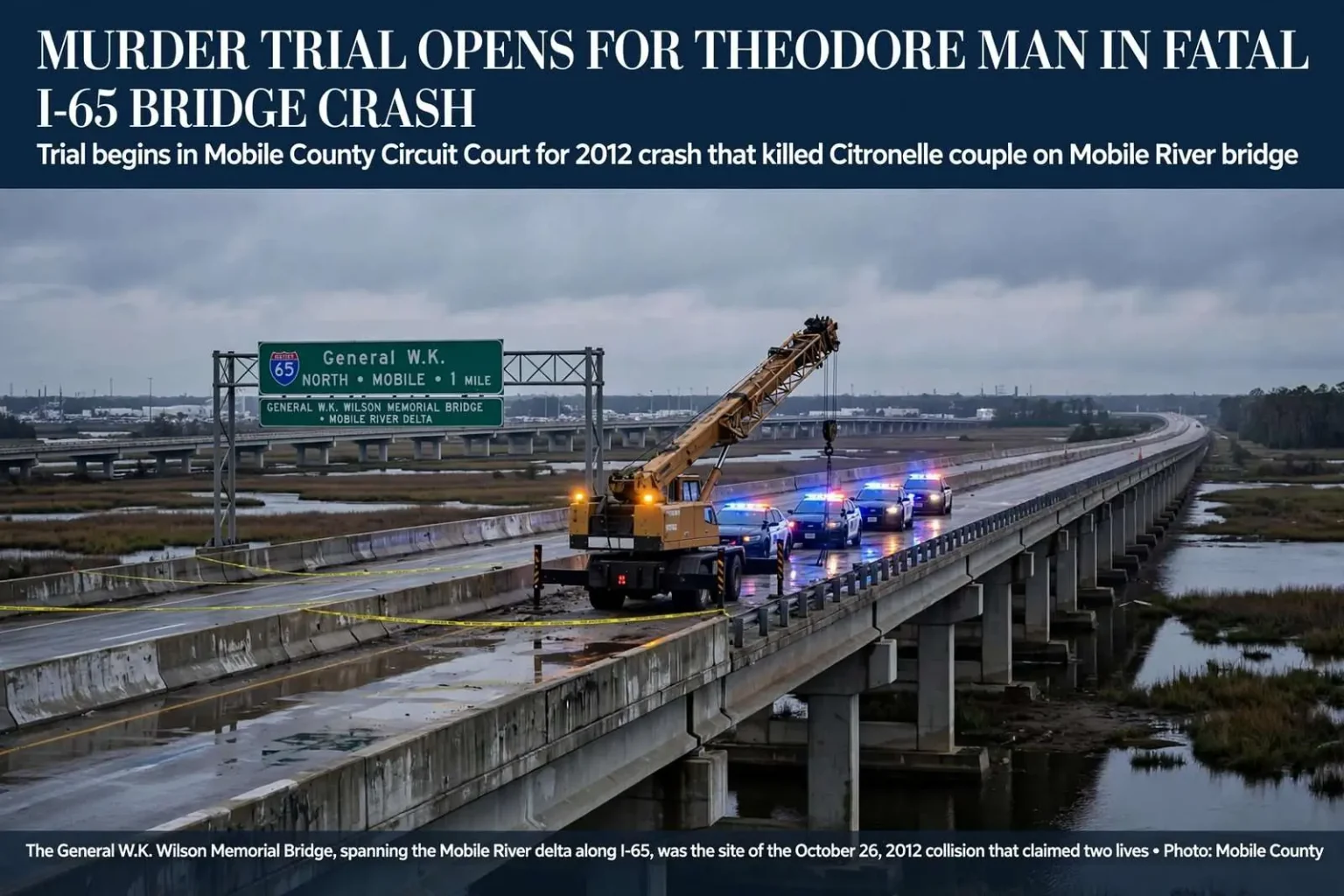
A Theodore man is set to stand trial in Mobile County Circuit Court on murder charges stemming from a 2012 crash on Interstate 65 that killed a Citronelle couple, according to court records.
John Derek Anthony Lopez, 39, faces two counts of murder in the Oct. 26, 2012, deaths of James Barber, 74, and his wife, Lorine, 65, both of Citronelle. The couple died when the Ford F-150 James Barber was driving struck the back of a crane Lopez was operating on the General W.K. Wilson Memorial Bridge, the stretch of I-65 that spans the Mobile River delta.
According to an accident report, investigators determined Lopez had used methamphetamine before beginning his trip that day. The report states he showed several indicators of impairment during field sobriety testing and initially refused a chemical test of his blood, though a sample was later obtained. A state trooper testified to those findings during a 2013 court hearing.
Investigators said the crane, traveling around 15 mph, began slowing as it climbed an incline on the bridge. A separate vehicle traveling between the crane and the Barbers’ truck had to swerve into another lane to avoid a collision. The crane came to a stop just off the roadway, and as the Barbers’ truck approached, its driver attempted to brake and swerve around the stopped crane but was unable to avoid the collision, according to the accident report.
The report states Lopez told investigators he was having trouble shifting gears and that his vehicle rolled to a stop on the bridge. Inspectors found no mechanical defects with the crane that would have contributed to the crash.
The case has moved slowly through the court system in the more than two years since the crash, with pretrial hearings addressing evidence including the blood sample taken from Lopez. His trial is now scheduled to proceed in Mobile County Circuit Court, where prosecutors will attempt to establish that his impairment directly caused the fatal collision.
The General W.K. Wilson Memorial Bridge carries heavy commercial and commuter traffic across the Mobile River delta as part of I-65, and fatal crashes involving stopped or slow-moving vehicles on the span have periodically raised safety concerns among regular commuters.
The outcome of the Lopez trial is expected to bring some resolution for the Barber family and the broader Citronelle community more than two years after the couple’s deaths.
The crash that killed a Citronelle couple
The circumstances described in the accident report trace a chain of events that unfolded in seconds on a span built for fast-moving traffic. A slow-moving crane, laboring up an incline at around 15 mph on a bridge where surrounding vehicles travel at interstate speeds, created a hazard that other drivers had to detect and react to with almost no margin for error.
One driver between the crane and the Barbers’ truck managed to swerve into another lane in time. James Barber, approaching the stopped crane in his Ford F-150, tried to brake and steer around it, but the distances and speeds involved left him no way out.
For the Barbers’ family and neighbors in Citronelle, a rural community in northern Mobile County, the details of that October evening have been part of a long wait for the case to reach a jury. The couple’s deaths removed two longtime members of a close-knit community, and the slow pace of the legal process has kept the questions of that night open for more than two years.
Why the case is charged as murder
Under Alabama law, a traffic death caused by a driver under the influence of a controlled substance can be charged as murder rather than manslaughter, reflecting the state’s position that getting behind the wheel while impaired knowingly puts others’ lives at risk. That legal framework is what allows two counts of murder to arise from a collision that involved no weapon and no apparent intent to harm.
For prosecutors, the path to a conviction runs through causation. They must establish not only that Lopez was impaired, but that the impairment directly caused the crash, connecting the toxicology findings to the decisions he made behind the wheel that day.
The evidence at trial is expected to center on the accident report’s findings: the methamphetamine use before the trip, the indicators of impairment observed during field sobriety testing, and the blood sample obtained after an initial refusal. The state trooper who testified to those findings at a 2013 hearing is likely to figure prominently in the prosecution’s case.
The blood sample fight
Much of the pretrial litigation in the case has centered on the blood sample taken from Lopez after the crash. He initially refused a chemical test, and the steps investigators took to obtain a sample anyway became a point of contention that defense attorneys and prosecutors argued over through a series of hearings stretching across two years.
Blood evidence is often the scientific backbone of impairment prosecutions, because it documents what substances were in a driver’s system at the time of a crash. When that evidence is challenged, courts must sort out whether it was lawfully obtained before a jury is allowed to hear about it, which is a major reason cases like this one move slowly before trial.
With those issues addressed in pretrial hearings, the trial itself is positioned to focus on the core factual dispute: what happened on the bridge, and whether impairment made the difference.
The bridge and its safety record
The General W.K. Wilson Memorial Bridge, known to many locals by its unofficial nickname, is one of the most recognizable structures on the Gulf Coast’s interstate network, carrying I-65 high across the wetlands of the Mobile River delta. Commercial trucks, commuters and vacation traffic bound for the beaches all funnel across the same narrow ribbon of roadway, and there is little room for error when something slows on the span.
Crashes involving stopped or slow-moving vehicles on the bridge have periodically raised safety concerns among regular commuters, and the Lopez case underscores why. Heavy equipment such as cranes moves at speeds far below the flow of interstate traffic, and drivers approaching from behind have only the visible roadway ahead to alert them that something has slowed or stopped.
Investigators found no mechanical defects with the crane, closing off one possible explanation and sharpening the focus on the operator. Lopez told investigators he was having trouble shifting gears and that his vehicle rolled to a stop, an account that conflicts with the impairment findings in the accident report and sets up the factual dispute the jury will weigh.
Methamphetamine and driving
Impairment cases involving methamphetamine turn on the drug’s well-documented effects on behavior and perception. The stimulant is associated with agitation, distorted judgment, delayed reactions and an inability to accurately assess speed and distance, any of which can be catastrophic when combined with the demands of operating heavy equipment on an interstate highway.
For first responders and troopers who work the I-65 corridor, drug-impaired driving has been a persistent problem across south Alabama, and cases like this one become reference points in the broader conversation about how the courts treat drivers whose choices turn a routine trip into a fatal crash.
The trial’s outcome will not change what happened on the bridge in October 2012, but for the Barber family and the Citronelle community it represents the step they have waited more than two years to see: a jury hearing the evidence, weighing the charges, and delivering a verdict that formally closes a long and painful chapter.
What to expect from the trial
A murder trial arising from a traffic death follows the same structure as any other felony trial, but the evidence that fills the courtroom is drawn almost entirely from the road. Jurors are likely to see photographs of the bridge, hear from accident reconstruction analysis, and listen to troopers describe the field sobriety testing conducted in the aftermath of the crash.
The defense is expected to probe the gaps that exist in every impairment case: the timing of the toxicology evidence, the conditions on the bridge that night, and the account Lopez gave investigators about mechanical trouble with his shifting. The finding that inspectors discovered no defects with the crane will make that account harder to sustain, but defense attorneys will work to plant reasonable doubt about whether impairment, rather than circumstance, caused the deaths.
Two counts of murder mean the jury will consider each death separately, and convictions on both counts would expose Lopez to a substantial prison sentence. Judges in such cases weigh the facts of the offense, the defendant’s history and the impact statements of victims’ families before imposing punishment, and sentencing typically follows a separate hearing after a verdict.
However the jury rules, the trial’s conclusion will mark the end of a case that has hung over two communities since the autumn of 2012, in Theodore, where the defendant lives, and in Citronelle, where the Barbers raised their family and where their absence is still felt.