Mobile Police Demonstrate Body Cameras Ahead of Council Vote
Mobile Police Chief James Barber hopes the City Council will vote on a new body camera program for uniformed officers by the end of January 2015.
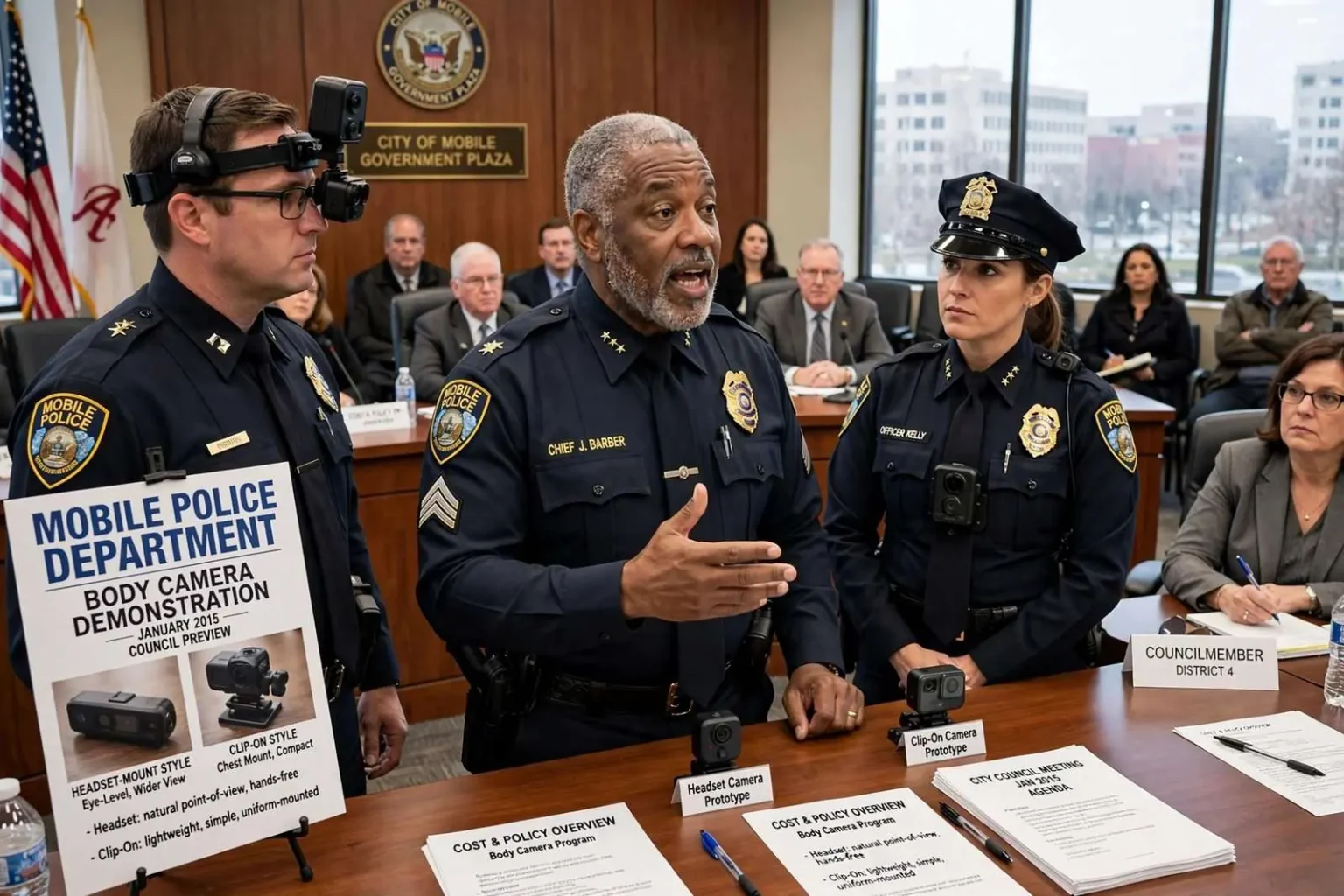
Mobile police officials demonstrated two styles of body-worn cameras ahead of a planned City Council vote, as the department moves toward outfitting uniformed officers with the recording devices. The pre-meeting demonstration gave council members and the public a hands-on look at the equipment before the city commits to a purchase, a level of preview that major public safety buys rarely receive.
Police Chief James Barber told council members he hopes the council will have the chance to vote on funding for a citywide body camera system by the end of January 2015. The timeline places Mobile among a wave of American cities moving from pilot programs to full deployment in the years after public scrutiny of police encounters intensified nationwide, and it sets up one of the more consequential public safety decisions of the city’s budget year.
During a demonstration held before a council meeting, officers modeled two camera options: a headset-style unit that can also be mounted on glasses or an officer’s shoulder, and a smaller clip-on camera that attaches directly to a uniform. The two styles represent the leading designs then on the market, each with distinct tradeoffs in weight, battery life, and where the lens sits relative to the officer’s line of sight.
Barber said feedback from officers so far favors the headset-mounted design, which offers a wider field of view and a more natural vantage point similar to what the wearing officer sees during an encounter. That matters more than it might appear: footage that captures what an officer actually saw is more useful both for reviewing use-of-force decisions and for defending officers against unfounded complaints than a lens angle pointed wherever a chest clip happens to face.
Transparency Is the Goal
The chief said the technology is expected to serve two main purposes: giving the department an objective record of interactions between officers and the public, and building trust between police and the community they serve. “I think it’s going to increase transparency of the police department and certainly going to build public trust,” Barber said, addressing council members and members of the public who attended the pre-meeting demonstration.
Body-worn cameras have become an increasingly common tool for police departments nationwide, driven in part by public demand for greater accountability in encounters between law enforcement and citizens. The movement accelerated as departments that adopted early programs reported declines in complaints against officers, a pattern credited to the simple fact that everyone behaves differently when a recording is running. Mobile’s interest in the technology arrived in the middle of that national shift, as city leaders weighed how a department serving Alabama’s second-largest city should respond.
Advocates argue the devices can protect both officers and civilians by providing video evidence in disputed incidents, resolving swearing contests between an officer’s word and a citizen’s that once came down to credibility alone. Prosecutors value the footage as evidence that arrives with a timestamp and chain of custody, while officers who wear the cameras often cite the same benefit from the other side of the lens: a recording that shows what really happened ends arguments before they start.
Critics have raised questions about storage costs, public records access, and privacy protections for footage captured inside private homes or involving crime victims. Those concerns are not abstract. Hours of video from hundreds of officers add up to terabytes of data that must be stored for years, much of it capturing people at the worst moments of their lives who have never been accused of anything. Departments adopting cameras must simultaneously write policies on retention, release and redaction, or the technology’s transparency promise collapses under its own volume.
City officials have not yet detailed a total cost estimate for outfitting Mobile’s police force with the cameras, though comparable programs in cities of similar size have run into the hundreds of thousands of dollars annually once storage and maintenance are counted. The hardware itself is often the smallest line item; cloud storage contracts, docking stations at precincts, software licensing and staff time to manage footage requests routinely outpace the price of the cameras over the life of a program.
That cost picture is why the council vote Barber sought by the end of January carries weight beyond a single budget line. Once Mobile signs on to a camera system, the city commits to a recurring expense that grows with the department’s size and the length of its retention policy, and to a technology refresh cycle that will bring the question back before future councils. Cities that rushed early purchases without pricing storage found themselves choosing between deleting footage sooner than intended and paying for emergency capacity.
What Officers Experience Wearing Them
The demonstration’s head-to-head format reflected a practical reality of camera programs: officers are the ones who wear the devices for entire shifts, and their buy-in shapes whether the cameras are actually running when it matters. Departments that deployed cameras without officer input saw compliance problems and devices left turned off; departments that let officers test competing models, as Mobile did, tend to see smoother rollouts. The headset-mounted design favored by Mobile officers in early feedback sits closer to eye level, records more of what the wearer looks at, and leaves both hands free, advantages officers weigh against comfort over a ten-hour shift.
The clip-on alternative trades some of that field of view for simplicity, since a chest-mounted camera requires no headset and stays with the uniform rather than a separate piece of gear. Departments nationally have split between the two approaches, and the choice often comes down to how much a city is willing to pay for a wider angle of view. Mobile’s decision, when the council takes it, will effectively settle that tradeoff for every uniformed officer in the department.
Mobile’s move follows a pattern seen in cities across the Gulf Coast and the Southeast, where departments sized between large metros and small towns have adopted body cameras in stages, starting with pilot units on selected shifts before scaling to full deployment. The staged approach lets commanders work out policy questions, such as when recording must start and how footage is tagged, before the cost of a mistake multiplies across hundreds of officers.
Policy questions remain open even as the hardware decision approaches. When cameras record, whether officers can review footage before writing reports, how long video is kept, and who can obtain a copy under Alabama’s public records law all require written rules. Civil liberties groups have pressed departments to answer those questions in public rather than leaving them to internal memoranda, and Mobile’s rollout will be judged in part on how visibly the city settles them.
For residents, the most immediate effect of a camera program shows up in complaints and their resolution. Departments that equip officers with recording devices typically see the number of misconduct complaints fall, and the complaints that do arrive get resolved faster because footage exists. Citizens disputing an officer’s account gain a record, and officers disputing a citizen’s account gain the same. The technology does not decide who is right, but it replaces memory and credibility with a video file in a growing share of encounters.
The Mobile City Council’s decision will also ripple through the department’s relationship with the community organizations that have pressed for accountability measures. Police leadership framing the cameras as a trust-building tool, as Barber did in addressing the council, signals a department treating the change as more than equipment procurement. Whether that framing holds will depend on the policies that follow the purchase and how consistently they are applied.
Mobile’s scale shapes the project in ways that smaller cities never face. The department patrols a port city of roughly 195,000 residents spread across a land area larger than many entire counties, with precincts from Toulminville to Tillman’s Corner generating thousands of recorded encounters a month. Every one of those encounters becomes a video file that must be stored, categorized and made available when courts, defense attorneys or journalists ask for it. The demonstrations before the council were the visible tip of a procurement process that also has to price that entire pipeline.
The demonstration itself was a deliberate choice by the department. Rather than presenting a budget request built on vendor brochures, Barber brought working equipment to Government Plaza and let council members see officers wearing both styles before a single dollar was requested. The format mirrored how the technology works in the field: on an officer, in motion, in front of the public whose trust the cameras are meant to serve.
By the time the council votes, members will have seen the two camera styles worn, heard the chief’s timeline, and weighed the recurring cost against the expected benefit. The end-of-January target gives the city roughly a year’s end window to decide, and Mobile’s uniformed officers will know by then which device, if either, will be riding with them onto calls across the city’s neighborhoods, from downtown to West Mobile, in the months that follow.