Mobile Woman Charged in Theodore Sexual Assault Case in 2008
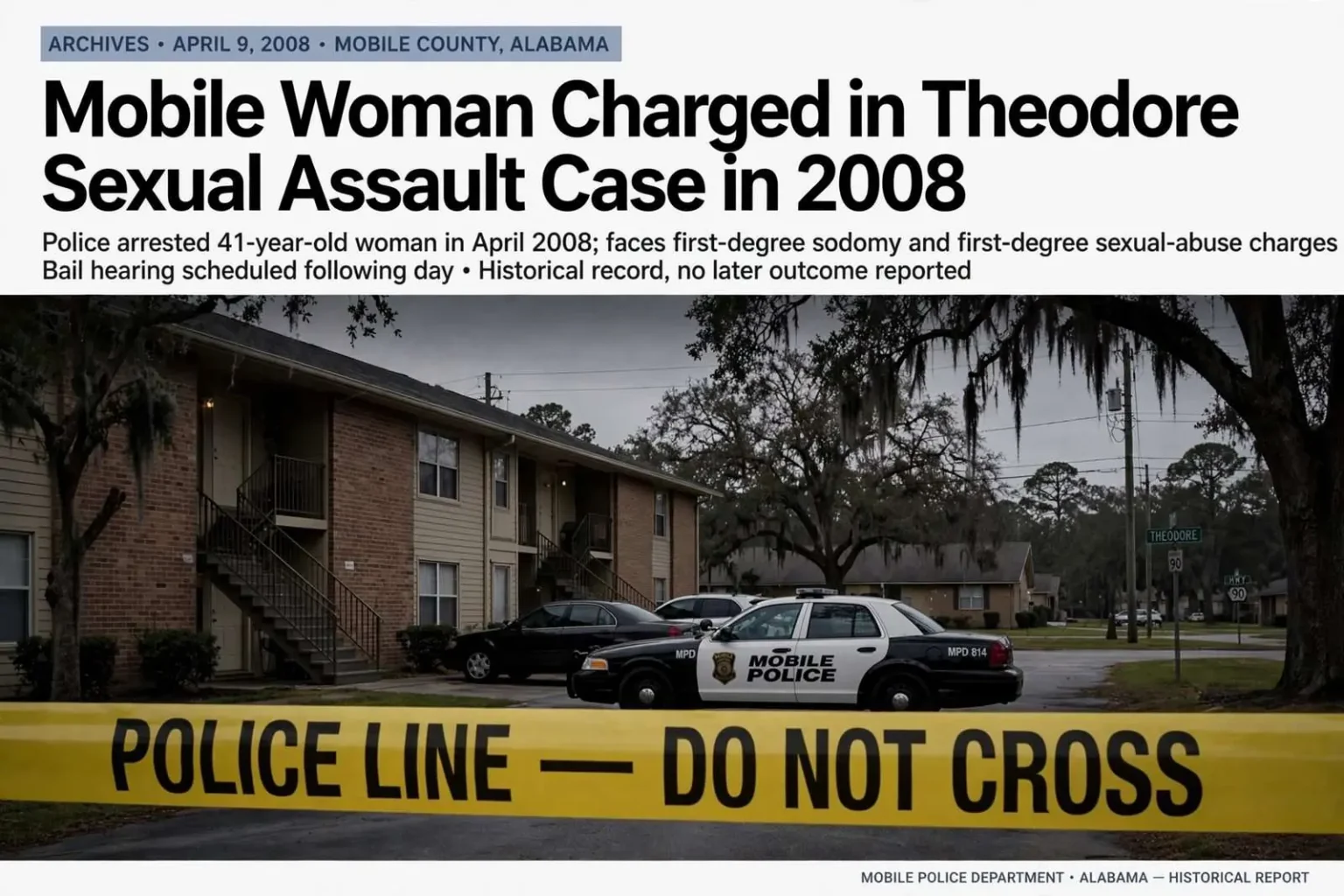
An archived WKRG report said Mobile Police arrested a woman in April 2008 after an alleged sexual assault at a Theodore apartment complex.
Originally reported April 9, 2008.
Mobile Police arrested a 41-year-old woman in April 2008 after an alleged sexual assault at an apartment complex in Theodore, according to an archived local news report. Police said the alleged victim was someone the accused knew. The woman was held at the time on first-degree sodomy and first-degree sexual-abuse charges, with a bail hearing scheduled for the following day. This historical article intentionally omits names, identifying details and explicit information to protect the alleged victim and avoid needlessly repeating sensitive material. It records allegations and charges reported in 2008 and does not state any later court outcome.
The arrest was handled by the Mobile Police Department, which provides law enforcement for the city of Mobile and, under Alabama’s police jurisdiction structure, responds to incidents in surrounding areas tied into the city’s service footprint. Theodore lies along U.S. Highway 90 in southern Mobile County, a community of residential neighborhoods, apartment complexes and commercial strips between Mobile and Tillman’s Corner. Calls to apartment complexes there are routine work for MPD patrol units, but reports of sexual assault trigger a distinct response: specialized investigators, medical examination protocols and coordination with prosecutors that ordinary calls never require.
The charges themselves carry serious weight under Alabama law. First-degree sodomy and first-degree sexual abuse are felony offenses classified among the most serious crimes on the state’s books, and a first-degree sodomy charge is designated a Class A felony in Alabama — the same classification as murder — when committed under qualifying circumstances. Convictions at that level can carry sentences measured in decades. Because the accused faced both charges, prosecutors at the Mobile County District Attorney’s Office would have reviewed the evidence, the examination findings and the statements involved before presenting the case to a grand jury, the standard path to a felony indictment in Alabama’s court system.
How Sexual Assault Cases Move Through the System
From the moment of the initial report, a sexual assault case follows a structured path designed to balance two obligations: pursuing accountability and protecting a traumatized survivor. In Mobile, responding officers secure the scene and arrange for the alleged victim to receive a forensic medical examination, typically performed by trained examiners using standardized evidence-collection kits. Detectives with experience in sensitive crimes then take over, conducting interviews and gathering records. The Mobile County District Attorney’s Office reviews the assembled evidence to determine what charges can be supported, and defendants who are arrested appear before a district court judge for an initial appearance, where bail conditions are set — the stage this case had reached when the archived report was published.
The bail hearing scheduled for the following day would determine whether the accused remained in custody at Mobile County Metro Jail pending further proceedings or was released under conditions. Alabama judges weigh the seriousness of the charges, the defendant’s ties to the community, prior record and potential risk when setting bail. For a defendant facing Class A-level felony charges, bail amounts and conditions can be substantial, and judges often impose no-contact provisions protecting the alleged victim as a condition of any release.
What happens after that point is rarely publicized in real time, which is why this historical record stops where it does. Cases can be presented to a grand jury, dismissed for insufficient evidence, resolved through plea agreements, or tried before a jury in Mobile County Circuit Court. Outcomes hinge on evidence that is rarely visible in initial news reports, and initial charges are allegations, not findings of guilt. The omission of any later outcome here is intentional: without verified court records, reporting an outcome would risk inaccuracy, and the presumption of innocence attaches to every defendant at the charging stage.
Theodore and the Communities South of Mobile
Theodore, an unincorporated community in Mobile County with a long history dating to the late 1800s, grew around the rail line and the timber and agriculture economy before becoming a residential suburb of Mobile. Today its neighborhoods mix long-time family communities with newer apartment development along the Highway 90 corridor, and its schools, churches and ball fields serve a population spread across zip codes that also include Tillman’s Corner and Grand Bay to the west. Because Theodore is unincorporated, law enforcement there falls to a patchwork of agencies — the Mobile County Sheriff’s Office covers much of the unincorporated county, while the Mobile Police Department maintains jurisdiction in areas within its police jurisdiction, which is why MPD handled this arrest.
Apartment complexes along the commercial corridors of southern Mobile County house a substantial share of the area’s working families, and like apartment districts anywhere, they generate a high volume of police calls — noise complaints, domestic disputes, thefts, and occasionally serious person crimes. Community policing in these areas depends on relationships between officers, property managers and residents, and major incidents draw a heavier response that can unsettle a complex for weeks. For neighbors of any reported assault, the arrest is often the first moment the seriousness becomes public.
The deliberate restraint in this record reflects the editorial standards that sensitive crime reporting demands. Naming an accused person before charges are adjudicated, identifying an alleged victim, or reciting explicit details serves no public interest and can compound harm — to the survivor, to family members, and even to the accused if the case ends without conviction. What a community needs from a report like this is the essential public fact: an arrest occurred, serious charges were filed, and the court system was positioned to take the next step. Everything beyond that belongs to the courtroom.
Victim Protections in the Alabama Justice System
Alabama’s criminal courts operate with a set of victim protections that grew out of decades of reform. The state’s constitution includes a victims’ rights amendment, and statutes guarantee crime victims notice of hearings, the right to be heard at bail and sentencing proceedings, and protection from contact by the accused. In sexual assault cases specifically, courts apply rules limiting the introduction of evidence about a victim’s prior conduct, and advocates work to keep survivors informed at each stage so they are not blindsided by procedural developments. These safeguards existed in evolving form in 2008, and they have been strengthened in the years since, reflecting a broader understanding that how the system treats a survivor shapes whether other survivors ever come forward at all.
Law enforcement agencies in Mobile County have also built dedicated capacity over time. Specialized units investigate crimes against persons, detectives receive training in trauma-informed interviewing — an approach that recognizes how memory functions under stress — and partnerships with counseling services allow victims to be connected with support before the interview process begins. Forensic nurses and examination programs have standardized the medical response, improving both the care survivors receive and the quality of the evidence available to investigators. Each of those improvements traces back to lessons learned in cases like the one reported here in 2008.
The arrest also illustrates the role of the Mobile County Metro Jail, the county’s central detention facility, where defendants charged with felonies are held pending initial appearances and bail decisions. The jail sits in downtown Mobile near the courthouses where those proceedings unfold, part of a justice infrastructure that processes tens of thousands of cases in an ordinary year. Within that system, cases involving the most serious charges move along distinct tracks, with more stringent bail reviews and closer prosecutorial supervision, because the stakes for both defendants and the community are at their highest.
Why the Record Stops in 2008
A reader encountering this article years after publication may reasonably ask why it does not say what happened next. The answer lies in what a historical archive can responsibly claim. Initial arrest reports capture a moment: police acted, charges were filed, and a hearing was scheduled. Whether that case later produced an indictment, a conviction, a plea or a dismissal is a matter of court records that this archive has not verified, and stating an outcome without verification would be exactly the kind of careless reporting that causes harm. The presumption of innocence is not a technicality — it is the operating principle of Alabama’s courts, and it applies to every name in every docket regardless of the charge.
The same caution governs the identities here. The accused was 41 years old in 2008 and entitled to have her case judged on evidence, not on a newspaper archive that might follow her for decades. The alleged victim, described only as someone who knew the accused, had already experienced a profound violation; publishing details that could identify her would extend that harm indefinitely. Archival standards developed by journalism organizations over the years — omitting victim identities, minimizing gratuitous detail, and clearly labeling allegations as allegations — exist precisely so that records like this one can inform without injuring.
What remains is the essential historical fact. In April 2008, Mobile Police arrested a woman on serious felony charges connected to an alleged sexual assault in Theodore, and the case entered the Mobile County justice system with a bail hearing on its calendar. That is what was known, that is what could be responsibly reported, and that is what this record preserves. The courts, not the archive, were where responsibility for the rest belonged — and the restraint shown here is part of honoring that division.