Bayer CropScience to Invest $120 Million in Mobile Co-Location Project
Bayer CropScience won tax abatements for a $120 million co-location project with Evonik in Mobiles chemical manufacturing corridor this year.
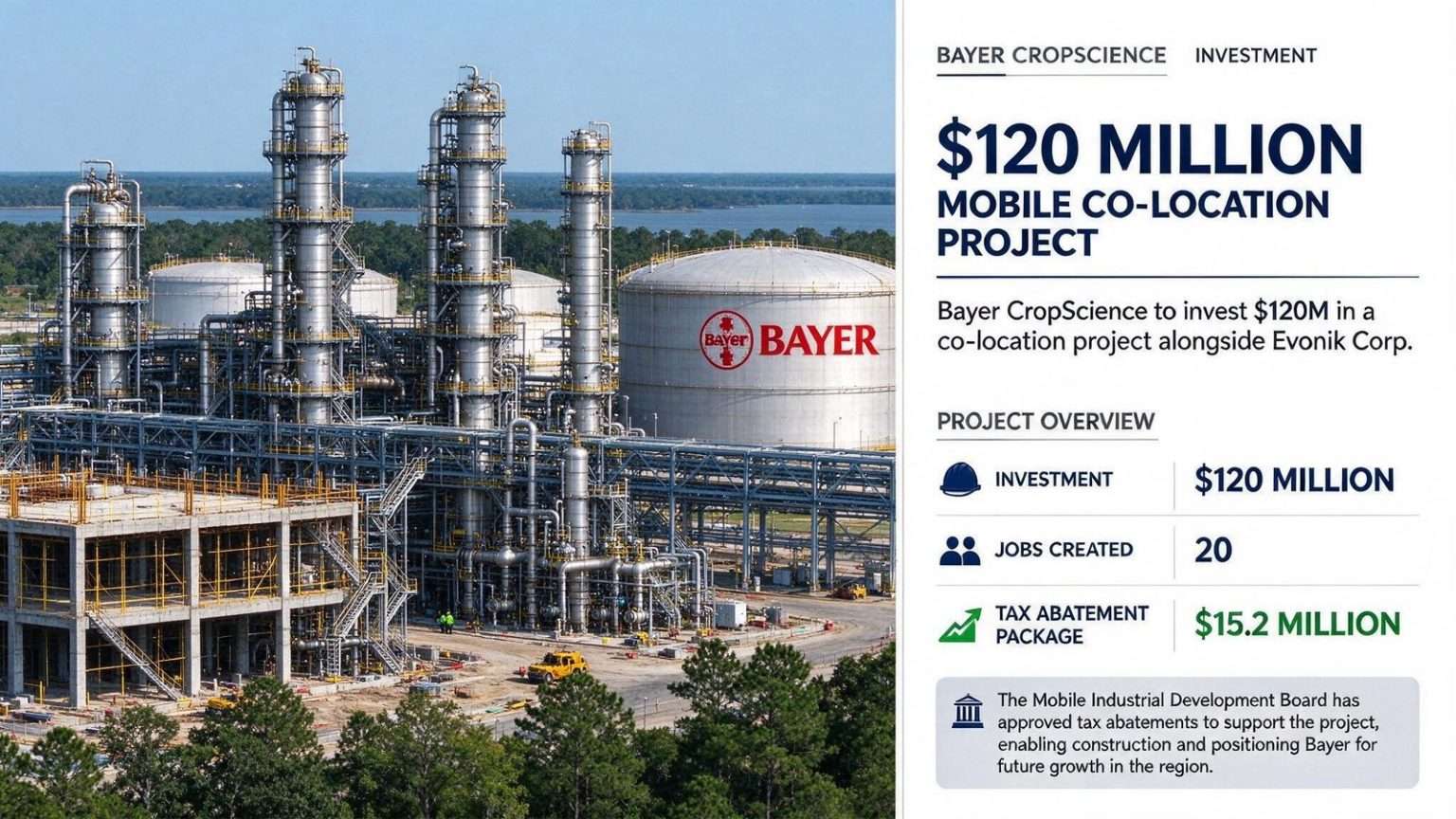
Mobile’s industrial development board has cleared the way for Bayer CropScience to invest an estimated $120 million in a co-location project alongside Evonik Corp., a scaled-back version of a much larger manufacturing plan the German chemical giant first floated for the city’s chemical corridor more than two years ago. The decision removes the principal financial hurdle from a project that will fold Bayer’s production needs into an existing chemical complex rather than build a new plant from the ground up. It is also the latest illustration of how Mobile has landed major industrial investment in recent years: often through expansions layered onto facilities already operating in the area.
At the center of the approval is a package of tax abatements totaling roughly $15.2 million, approved Thursday. The relief is split into two pieces: $8.8 million in sales and use tax abatements tied to construction and equipment purchases, which expire once the project becomes operational, and $7.4 million in ad valorem tax abatements spread over 10 years. Abatements of this kind are a standard tool in Alabama’s economic development playbook. Industrial development boards across the state operate under state enabling law that allows them to acquire, own and lease project property and to grant exemptions from non-educational taxes when a project meets investment and, in some cases, employment thresholds. The logic is straightforward — reduce upfront costs enough to win a project that might otherwise be built in another state or overseas, while keeping a meaningful share of tax revenue flowing to local governments and schools.
Education taxes remain protected
Even with the abatements in place, Mobile County Public Schools are still expected to collect an estimated $7.3 million in education taxes over that same decade-long abatement period. In Alabama, education taxes are customarily carved out of abatement packages by state law, a protection that reflects the constitutional earmarking of education revenue. That means even a heavily abated project continues contributing to public schools from the moment it comes online, even as most of its non-educational tax burden is shelved for a period of years. For a school system the size of Mobile County’s, which serves tens of thousands of students across the county and is among the largest districts in the state, that guaranteed stream matters when board members weigh whether to support a given abatement request.
The arrangement also illustrates the trade-off local taxing authorities routinely accept. In exchange for giving up some near-term revenue, the community gains a long-lived industrial facility that broadens the tax base, supports construction and supplier jobs during the build-out, and eventually rolls onto the tax rolls at full value once abatements expire. The 10-year horizon on the ad valorem piece means the county and other non-educational taxing bodies will begin collecting a growing share of the project’s property taxes well within the working life of the plant, and the full burden thereafter.
Chamber sees a foothold for future growth
Troy Wayman, vice president of economic development for the Mobile Area Chamber of Commerce, characterized the approval as a sign of the city’s pro-business approach to economic development, saying it gives Bayer a presence in the Mobile area that could pave the way for future growth similar to what Evonik has experienced locally.
“This gives Bayer a presence in our community,” Wayman said. “They’re one of the biggest names in the international chemical industry, and we hope it provides an opportunity for future growth.”
The Chamber’s economic development staff has long marketed Mobile’s combination of assets to precisely this kind of buyer: a deepwater port with direct Gulf and ocean access, Class I rail service, interstate highway connections, an established chemical manufacturing cluster and a workforce already trained in process-plant operations. Wayman’s reference to Evonik’s local growth points to the track record of the German specialty chemicals company, which has expanded its Mobile operations repeatedly since first establishing itself in the area, growing its footprint and its payroll as customers and product lines have been added. The hope among recruitment officials is that Bayer follows a similar arc — starting small, then compounding.
A scale-down from the original mega-plant vision
The project represents a significant scale-down from Bayer’s original ambitions in Mobile. The company initially proposed building a stand-alone global herbicide production facility in the area that would have employed 180 workers and represented a total investment of about $396 million. Within months, that projected investment climbed to roughly $500 million as Bayer sought to expand supply chain capacity amid surging industry demand for herbicides effective against glyphosate-resistant weeds. At the time, a project of that size would have ranked among the larger single industrial announcements in Mobile County in recent memory, with a permanent payroll several times what the current arrangement will produce directly.
The demand surge behind those numbers is rooted in one of the more consequential shifts in modern American agriculture. Glyphosate, the herbicide that anchored weed control across the Cotton Belt and the Midwest for decades, gradually lost effectiveness as weeds developed resistance, forcing farmers to look for alternative chemistries to protect crops. That pressure sent demand climbing for glufosinate-based products, including the herbicide Bayer markets in the United States under the brand name Liberty. Securing enough manufacturing capacity for that molecule, and for the precursor chemistry that feeds it, became a strategic priority for the company — and the reason Mobile first appeared on its expansion map.
Rather than build a freestanding mega-plant, Bayer ultimately opted to co-locate with Evonik’s existing Mobile operations. Under the arrangement, Bayer will rely on a chemical Evonik already produces to help manufacture the herbicide, which will in turn be finished at other Bayer facilities already in operation elsewhere. The structure spares Bayer the years of site preparation, permitting and infrastructure work a greenfield plant requires, while putting its process alongside a partner whose chemistry is integral to the product.
Why chemical companies are co-locating
Because of that structure, the roughly 20 jobs created by the project will technically be classified as Evonik positions rather than direct Bayer hires, though Wayman said he remains hopeful the arrangement signals Bayer’s longer-term commitment to the region. Employment figures understate the wider effect, too: construction spending, ongoing maintenance contracts, and the additional volume moving through local suppliers all accrue to the area even when the permanent headcount on one company’s books is modest.
Wayman said the co-location approach is becoming increasingly common within the chemical industry, and Bayer will be the second major chemical company in as many years to take that route in Mobile. The model has obvious appeal in a capital-intensive sector. Shared utilities, shared feedstock pipelines, shared storage and shared emergency response infrastructure all lower the cost and risk of adding production capacity, and sitting next to a supplier eliminates freight and logistics costs for an intermediate chemical that might otherwise have to be shipped in. For the host company, a co-located customer effectively underwrites expansion of its own capacity. For the host city, two international chemical names end up on one site instead of none.
The trade-off, from an economic development standpoint, is that the community captures fewer direct jobs than a stand-alone plant would have brought. Mobile officials, however, have generally treated the arrangement as the realistic price of keeping major chemical investment in the city at all, particularly when the alternative was the project being scaled back further or moved to another region entirely.
A precedent set with BASF
The Bayer approval follows a template Mobile’s industrial development board used only recently before. In June 2013, the same board approved similar tax abatements for BASF Corp. to construct an $84.3 million facility on land within Evonik’s Degussa Road complex. That project, like Bayer’s, put a new production unit inside an existing chemical site rather than on open ground elsewhere in the county, and it made BASF another anchor tenant operating in close physical proximity to Evonik’s operations. The Degussa Road complex itself carries a name that tells the history of Mobile’s chemical cluster: it traces to Degussa, the German chemical company whose successors’ operations evolved into today’s Evonik presence in the city.
Taken together, the BASF and Bayer deals sketch a clear pattern in how Mobile competes for chemical investment. Instead of assembling greenfield sites and hoping for a marquee announcement, the city has cultivated a working cluster — anchor companies with deep local roots, shared infrastructure, experienced contractors and a workforce pool — and then marketed that cluster to other international firms looking for a faster, lower-risk entry into the U.S. market. Each success makes the next one easier, because every new tenant deepens the supplier base and reinforces the argument that Mobile can staff and support a modern chemical operation.
Timeline and what comes next
The Bayer project is expected to be completed before the end of 2015, a timeline that puts design, procurement and construction on a compressed schedule relative to the typical greenfield build. Work of this kind generally proceeds in stages — site preparation and foundations, installation of the process units, tie-ins to existing utility and feedstock systems, and finally commissioning, during which the new equipment is run through its paces before full production begins. Because the project sits inside an operating complex, much of the heavy infrastructure a standalone plant requires is already in place.
For residents of the surrounding area, the most visible effects in the near term will be construction activity and truck traffic around the complex, followed by the steady, low-profile operations typical of a modern chemical facility once the project is online. The sales tax relief expires when the project becomes operational, meaning the city’s sales tax base gets the benefit during the construction window when purchases of materials and equipment are heaviest.
The corridor’s broader momentum
The approval adds another chapter to the ongoing growth of Mobile’s chemical manufacturing corridor, which has increasingly become a magnet for international chemical firms looking to expand their U.S. supply chains alongside established local partners. The corridor’s advantages are cumulative: proximity to the Port of Mobile for inbound feedstocks and outbound product, rail lines that connect directly to the national network, interstate highway access for the region’s trucking fleet, and a concentration of industrial tradespeople who keep construction schedules realistic in a sector where skilled labor is often the binding constraint.
For city and county leaders, the Bayer vote is also a case study in patience. The company first floated its much larger plan more than two years ago, and the project that finally cleared the board Thursday is a fraction of the original in both dollars and jobs. But it leaves a global chemical company operating in Mobile with room to grow — which, in the way local recruitment officials see it, is exactly how a $120 million co-location becomes something bigger.