ALEA Honors Troopers for Dauphin Island Regatta Rescue Efforts
ALEA honored five Marine Patrol troopers for search-and-rescue work after sudden storms capsized boats during the Dauphin Island Regatta.
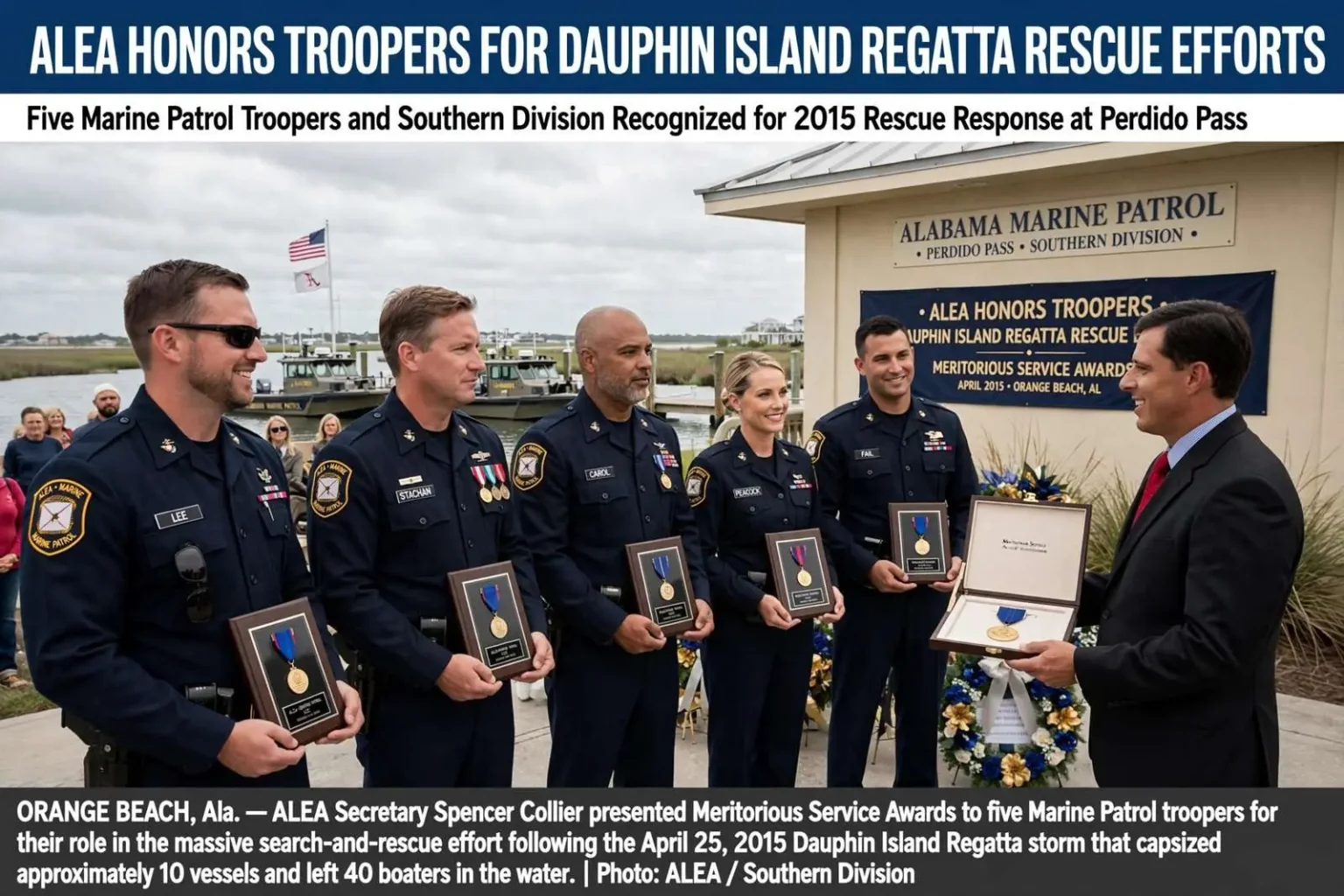
The Alabama Law Enforcement Agency honored five Marine Patrol troopers and the agency’s Southern Division for their role in the massive search-and-rescue response following the deadly Dauphin Island Regatta storm earlier this year. The ceremony brought together troopers, agency leadership and families affected by the storm to recognize an effort that stretched across days of searching and tested every resource Alabama’s marine law enforcement could put on the water.
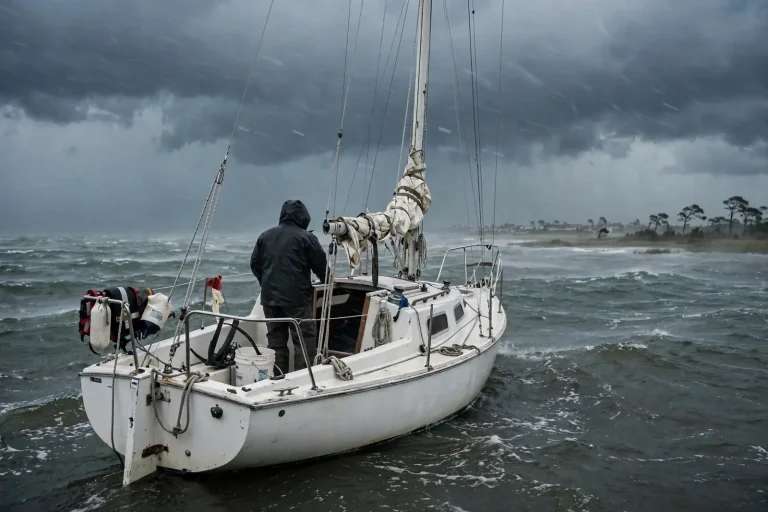
On April 25, sudden, severe winds capsized about 10 sailing vessels in Mobile Bay during the annual regatta, throwing at least 40 people into the water. What had begun as one of the region’s most anticipated spring sailing events turned in minutes into one of the deadliest maritime emergencies the bay has seen, with boats overturned, crews clinging to hulls and debris scattered across open water.
ALEA Secretary Spencer Collier described conditions that day as shifting from calm to extreme within minutes, a change so abrupt that even experienced sailors had little time to react before the storm overtook the racing fleet.
“Troopers did not hesitate in the call for help and they placed their own lives in danger to help those in need,” Collier said during a ceremony at the Alabama Marine Patrol office at Perdido Pass in Orange Beach. “Conducting rescue missions in conditions such as these is treacherous, but troopers chose to enter into an area of near hurricane-force winds to help others.”
Awards for the Rescuers
Collier presented Meritorious Service Awards to Troopers Scott Lee, Jason Stachan, Bill Carol, Jessie Peacock and Wade Fail for their part in the response. The awards recognized work that began in deteriorating weather and continued long after the immediate rescues ended, as the troopers shifted from saving lives in the water to searching for those who never made it back to shore.
The Southern Division, which oversees the agency’s marine operations along Alabama’s Gulf coastline, was also formally recognized. The division’s crews launch from posts scattered along the coast, from Orange Beach to Mobile Bay, and the regatta response drew on vessels and personnel from across the area in an operation that continued around the clock.
Over roughly 10 days after the storm, troopers and other searchers combed more than 9,500 square miles of open water and shoreline looking for six boaters who went missing when the storm hit. Five were eventually found. One boater, a 71-year-old Mobile resident, was never located, and his absence remains the sharpest edge of the regatta’s legacy for the sailing community.
The scale of the search required coordination well beyond a single agency. Marine Patrol troopers worked alongside other law enforcement officers, volunteer boaters and Coast Guard crews, tracing currents and wind patterns across the bay, along the causeway, out to the barrier islands and down the ship channel in an effort to account for every missing sailor.
A Regatta Tradition Interrupted
The Dauphin Island Regatta, a decades-old sailing tradition on Mobile Bay, draws hundreds of participants each spring. The race has long served as a gathering point for sailors from across the central Gulf Coast, with courses that cross the open water of the bay and finish near Dauphin Island at the bay’s southern mouth. For many families, the event marks the opening of the sailing season and a reunion of crews that race together year after year.
The 2015 storm prompted a review of race-day weather protocols and renewed appreciation across the region for the marine law enforcement and Coast Guard crews who respond when conditions on the bay turn dangerous without warning. Race organizers and officials have since weighed questions about how such events monitor approaching weather, how quickly races can be abandoned, and what equipment sailors carry for emergencies — a conversation that rippled through sailing communities well beyond Alabama.
The dangers the storm exposed were not hypothetical. Squall lines moving across Mobile Bay can produce wind shifts that overwhelm small vessels in minutes, and the bay’s shallow expanses offer little protection once a boat is knocked down. Sailors who frequent the bay understand its moods, but the regatta storm demonstrated how quickly a familiar body of water can become unforgiving.
What Marine Patrol Troopers Do
The Alabama Marine Patrol, the division within ALEA responsible for enforcing boating and water safety laws, maintains a permanent presence along the state’s coastal waters and major waterways. Its troopers conduct safety inspections, respond to boating accidents and emergencies, assist stranded vessels and work search-and-rescue cases in conditions that most boaters avoid. Along the coast, the agency’s posts at places like Perdido Pass position crews where boating traffic is heaviest and where response times matter most.
The regatta response illustrated why that presence matters. Troopers who had been assigned to the regatta — where their routine role on race day is safety oversight — became first responders the moment the storm struck, pulling people from the water and accounting for capsized crews while conditions remained dangerous. The transition from event support to mass rescue happened with no warning and no pause.
ALEA officials said the recognition ceremony was meant to highlight the risks marine troopers accept as part of routine duty along Alabama’s coastline, and to formally thank the Southern Division for a rescue effort that authorities credited with saving dozens of lives in a matter of hours.
That credit is not an exaggeration of convenience. With at least 40 people in the water and vessels breaking apart under near hurricane-force winds, the speed of the response made a measurable difference between a deadly afternoon and a far worse one. The officers and crews who launched into the storm did so knowing the same conditions that capsized the fleet could capsize them.
Mobile Bay’s Weather and Its Sailors
Mobile Bay occupies a central place in the region’s maritime life. The bay receives the waters of the Mobile River system and opens southward through passes between the mainland and Dauphin Island, connecting the Port of Mobile to the Gulf of Mexico. Its open expanse, roughly 30 miles long, makes it a popular sailing ground — and exposes boats to the full force of weather systems moving inland from the Gulf.
Spring and summer squalls along the northern Gulf Coast can intensify rapidly, and forecasters have long advised boaters to treat fast-building cumulonimbus clouds over the bay as a signal to seek shelter. The regatta storm reinforced that advice in the starkest possible way. Boaters across the region now speak of the April storm as a defining reminder that weather on the water can change faster than forecasts can follow.
The Search Continues in Memory
For the family of the missing 71-year-old Mobile sailor, the end of the formal search did not bring closure. Extended searches for people lost at sea are among the most difficult operations in emergency response: currents in the bay, tides through the passes and winds that shift by the hour move floating objects far from where they are last seen, and the search area grows with each passing day. The 9,500 square miles covered by searchers reflected that expanding grid.
The boating community that gathers each year for the regatta has continued to hold the storm’s victims close, with many sailors marking the anniversary and keeping the memory of those lost part of the event’s story. The trophy and the tradition go on, but the race now carries a weight it did not have before.
Recognition and What Comes Next
Awards like the Meritorious Service medals presented at Perdido Pass serve more than ceremonial purposes. Within law enforcement, public recognition of extraordinary response work signals to other troopers that the agency sees and values the risks taken in the field. For the families of those rescued, the ceremony offered a chance to say thank you directly to the people who pulled their loved ones from the bay.
Collier’s remarks, delivered in front of the Marine Patrol office where much of the coastal operation is based, framed the day’s honors as representative of a larger commitment. The troopers honored by name — Lee, Stachan, Carol, Peacock and Fail — stood for crews throughout the Southern Division who launched into the storm without being asked twice.
The regatta storm also left the region with practical lessons that extend beyond sailing. Emergency officials noted the importance of communication between agencies during a mass rescue, the value of pre-positioned marine assets on busy event days, and the need for boaters to file float plans so searchers know where to look. Each of those lessons has been folded into the way marine events on the bay are planned and staffed.
For now, the story of the 2015 Dauphin Island Regatta remains what it became in the hours after the first mast went down: an account of sudden loss on familiar water, and of the men and women in uniform who went out into the wind to bring people home. The agency’s ceremony made certain that the second part of that account gets its due.