Gov. Bentley Appoints Scott Taylor to Baldwin County Circuit Court
Alabama Gov. Robert Bentley appointed District Judge Scott Taylor to fill a Baldwin County circuit court vacancy effective later this month.
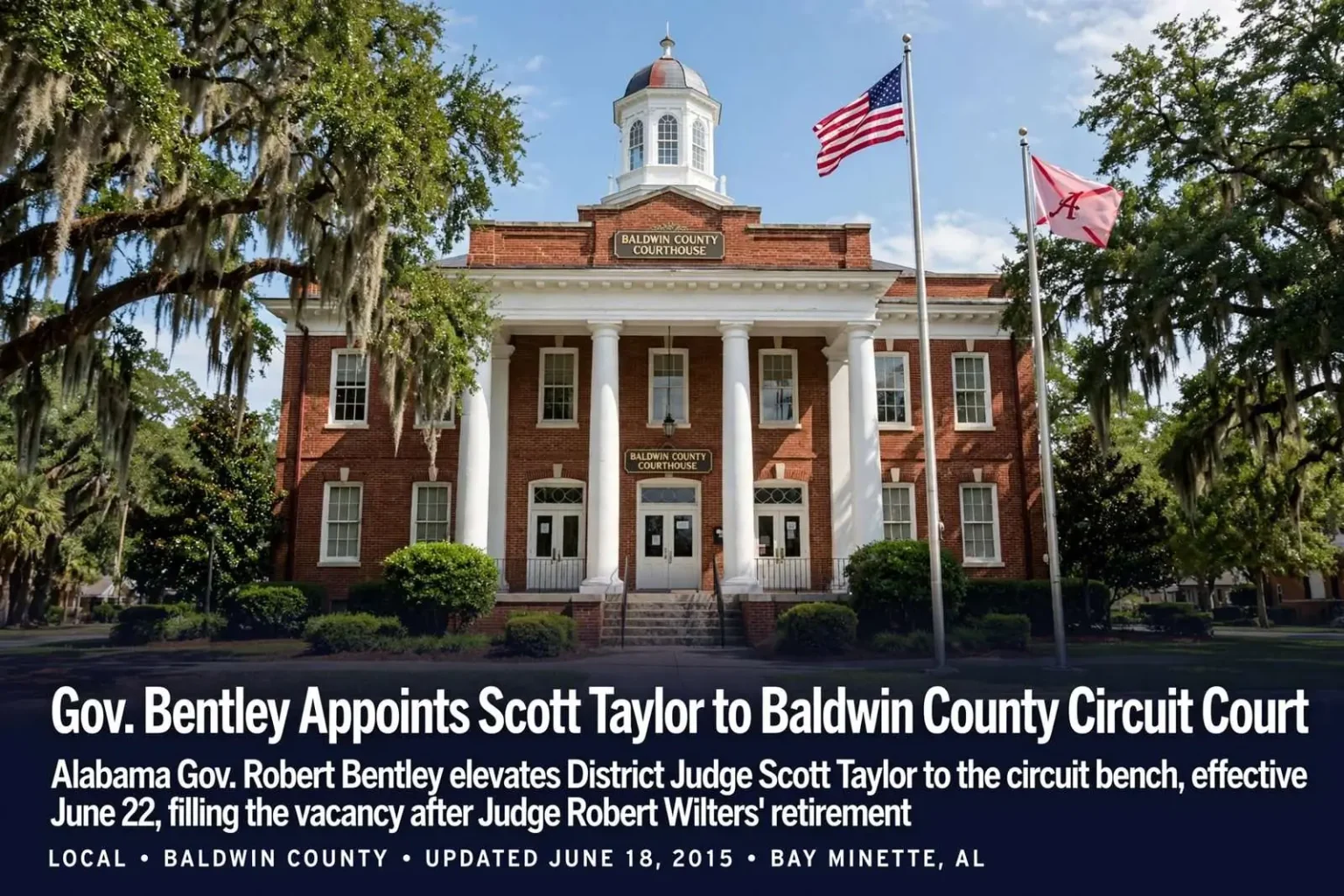
Alabama Gov. Robert Bentley has appointed District Judge Scott Taylor to a Baldwin County circuit court vacancy, elevating him from the district bench effective June 22 and setting off a new round of judicial changes in the county. The appointment fills one of the most consequential openings a Baldwin County court has had in recent years and immediately reshuffles the lineup of judges who handle the county’s most serious cases.
Taylor will move into the circuit judgeship left open after longtime Judge Robert Wilters announced his retirement, effective this month. Wilters is not stepping away from public service altogether; he has said he plans to run for Baldwin County district attorney in the March 2016 primary, challenging incumbent Hallie Dixon. That decision adds a second layer of intrigue to the judicial picture in the county, since a sitting retired judge challenging the incumbent DA guarantees that the local legal community’s attention will stay fixed on the courthouse through the next election season.
Circuit courts sit at the top of Alabama’s trial court system. In Baldwin County, circuit judges preside over felony criminal cases, major civil lawsuits, divorces and other family matters — a docket that touches nearly every significant legal dispute in the county. District courts handle misdemeanors, small claims, traffic cases and preliminary hearings that determine whether felony charges move forward.
How the seat was filled
Taylor had been one of three finalists under consideration for the circuit court seat, alongside Fairhope attorney Clark Stankoski and Daphne attorney William “Bill” Scully Jr. Under Alabama’s process for filling judicial vacancies, a nominating commission reviews interested candidates — weighing their experience, temperament and standing in the legal community — and forwards a short list of names to the governor, who then has 30 days from receiving that list to make a final selection. The process is designed to take judicial appointments out of pure politics, though governors’ choices inevitably draw scrutiny from attorneys and voters alike.
The appointment puts Taylor on the bench in Bay Minette, where the county’s main courthouse anchors a judicial system stretched by rapid growth. With new subdivisions, businesses and retirees arriving each year, the courts’ caseloads have grown with the population, making each judgeship a significant piece of the county’s capacity to administer justice.
An appointment, however, is not a guarantee of tenure. As a circuit court judge, Taylor will not simply keep the post indefinitely by appointment. He will be required to run for election to the seat next year, giving Baldwin County voters the chance to weigh in on his tenure at the ballot box. Judges appointed to fill vacancies must stand before the electorate at the next regular election cycle, and incumbency — even recently acquired incumbency — is a meaningful advantage in those races, since the appointee can point to time served on the bench.
The ripple effect on the district bench
Taylor’s move up to circuit court creates a new vacancy on the district court bench, where he had served as judge for Place 1. That opening is expected to trigger the same nominating commission process, with a new slate of candidates eventually presented to the governor for consideration. Local attorneys interested in the seat will submit their qualifications, the commission will vet them, and Bentley will once again pick from a short list — meaning the county’s judicial roster may not be settled for months.
The shuffle reflects the kind of ripple effect common in smaller judicial circuits, where a single retirement can prompt a chain of appointments and, eventually, new elections. One judge’s departure creates a vacancy; filling that vacancy creates another; and every appointed judge must eventually stand for election. In a county with Baldwin’s volume of cases, even a temporary gap on a bench affects scheduling, court backlogs and the pace at which criminal defendants and civil litigants get their day in court.
Baldwin County’s circuit and district courts handle a broad range of civil, criminal and family matters for one of the fastest-growing counties in the state, making judicial appointments closely watched by the local legal community. The county’s population boom along the U.S. 98 and Interstate 10 corridors has brought with it growth in real estate litigation, business disputes and criminal dockets, and attorneys practicing in Bay Minette follow each appointment closely because judges’ backgrounds and management styles shape how efficiently their clients’ cases move.
Local attorneys said they expect the district court vacancy left by Taylor’s promotion to draw strong interest from the Baldwin County bar. District judge seats offer broad courtroom experience — judges there see misdemeanors, civil suits up to a statutory dollar limit, small claims and juvenile matters — and have historically served as a proving ground for future circuit judges. Taylor’s own path from the district bench to circuit court follows exactly that progression, and whoever succeeds him will inherit the same docket that prepared him for the promotion.
Who’s who in the shuffle
The identities in the case illustrate how interconnected Baldwin County’s legal community is. Wilters, the retiring circuit judge, built a long career in the county’s courts before deciding to run for district attorney, a post that would put him back in the same building in a different role. Hallie Dixon, the incumbent he plans to challenge, holds the top prosecutorial job for the county and will defend the seat in the March 2016 primary. Taylor, meanwhile, moves between the two court levels while facing his own election next year.
The two finalists who were not selected — Fairhope attorney Clark Stankoski and Daphne attorney William “Bill” Scully Jr. — remain part of the county’s bench of experienced practitioners, and either could surface again as a candidate, whether for the new district court vacancy or a future opening. In communities the size of Baldwin County’s, the pool of lawyers considered for judgeships is relatively small, and few cycles pass without one of the same names appearing on a short list.
The governor’s office has not announced a timeline for filling the district court seat, but the statutory framework sets the rhythm: once the nominating commission delivers its list, Bentley has 30 days to act. Judicial nominating commissions convene as vacancies arise, and the process — application, review, interviews and a vote on the short list — typically takes weeks. Until an appointment is made, the district court’s Place 1 docket will be covered through arrangements among the remaining judges, a routine but burdensome task in a court that handles thousands of filings a year.
What it means for court operations
Short term, the practical effect on litigants should be minimal, since both courts will operate at full strength throughout the transition. Longer term, the composition of the bench matters. Circuit judges in Baldwin County carry heavy dockets of felony prosecutions and civil trials, and their sentencing practices and case management styles are familiar topics among defense attorneys, prosecutors and civil lawyers alike. District judges, for their part, set the first impression many residents have of the court system — in traffic court, small claims and misdemeanor arraignments.
The coming election adds another dimension. Taylor must run next year for the seat he now holds by appointment, and the district court vacancy will eventually be filled by an appointee who faces the same requirement. That means Baldwin County voters, not just the governor’s nominating commission, will have the final word on much of the trial bench — an unusual amount of judicial turnover to be settled in a single election cycle.
For now, the county’s legal community is watching three separate storylines unfold at once: a new circuit judge learning an expanded docket, a district judgeship heading into the nominating process, and a district attorney’s race in which a retired circuit judge will challenge the incumbent prosecutor. Each will play out against the backdrop of a court system adapting to one of Alabama’s fastest-growing populations, where the demand for courtrooms, judges and prosecutors has only moved in one direction for years.
What comes next
The sequence from here is fairly well defined. The nominating commission for the district court seat will gather applications from across the county’s bar, interview candidates and produce a short list, after which Bentley will have his 30 days to appoint a successor to Place 1. That appointee, like Taylor before them, will serve until the next election, when the seat appears on the ballot. Anyone elected to the district bench next year will begin a fresh term with the full weight of the county’s growing caseload behind it.
Taylor’s own election run will unfold in parallel. Circuit judgeships are countywide races, and while incumbency is a strong asset, appointed judges must build name recognition across a county that stretches from Mobile Bay to the Florida line — from Daphne, Fairhope and Foley to Bay Minette and Gulf Shores. Campaigning for a judicial seat means meeting voters in all of those communities, a requirement that shapes how well judges are known outside the courthouse.
Meanwhile, the March 2016 district attorney’s race will put a retired circuit judge and the sitting DA on the same ballot, a matchup that ensures courthouse politics remain part of the county’s civic conversation through next spring. Between the appointments, the elections and the ongoing population growth driving the dockets, Baldwin County’s judiciary enters one of its busiest transitions in years — with every stage of it conducted in public view.