Mobile Fundraisers Raise $265,000 for Leukemia and Lymphoma Society
A dozen south Alabama volunteers raised about $265,000 for the Leukemia and Lymphoma Society, topping the previous year's Mobile-area campaign total.
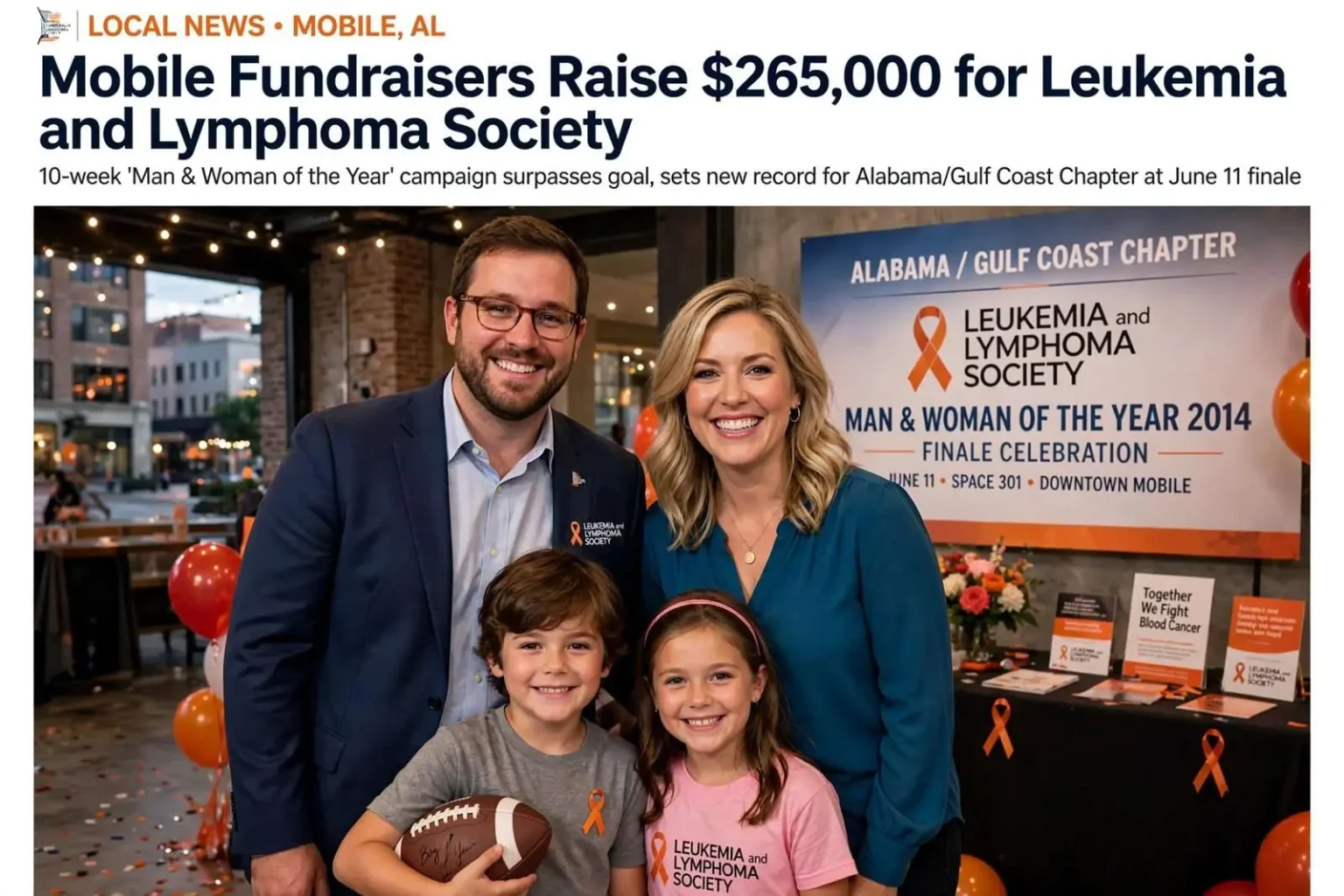
A friendly fundraising battle among a dozen south Alabama community leaders raised roughly $265,000 this spring for the Leukemia and Lymphoma Society, blowing past the campaign’s original goal and setting a new high-water mark for the local chapter. The 10-week competition, known as the Alabama/Gulf Coast Chapter’s Man and Woman of the Year campaign, wrapped up with a finale event at Space 301 in downtown Mobile on June 11.
The campaign’s structure is simple and, year after year, effective: candidates are nominated for their community standing and their willingness to ask, then spend ten weeks turning their personal and professional networks into a fundraising engine. Every dollar counts toward the total, every event is self-organized, and the titles at stake give the whole enterprise a competitive spark that straight appeals rarely generate. This year’s class turned that formula into the chapter’s most successful campaign yet.
A Competition With a Cause
Contestants organized paint parties, golf outings and game nights to bring in donations, competing for bragging rights and a shared cause: supporting blood cancer patients and their families. The events ranged across the spring calendar and across the community, from ticketed evenings downtown to casual gatherings that pulled first-time donors into the fold. Candidates leaned on employers, friends, churches and civic groups, and the variety of formats meant donors could choose whatever suited them — a night out, a round of golf or an afternoon with a paintbrush.
Patrick Byrne of Hargrove Engineers + Constructors and Dee Dee McCarron of the United Way of Southwest Alabama emerged as the top fundraisers and were crowned Man and Woman of the Year at the close of the campaign. Byrne, who had previously supported a colleague through cancer treatment, said the experience deepened his commitment to the cause. McCarron pointed to the disease’s reach across the community as motivation for the team’s push.
The backgrounds of the two winners illustrated how the campaign draws from different corners of the community. Hargrove Engineers + Constructors, headquartered in Mobile, is one of the city’s best-known professional services firms, and Byrne’s candidacy mobilized a large corporate network. McCarron’s work with the United Way of Southwest Alabama put her at the center of the region’s charitable infrastructure, giving her both a platform and a practiced understanding of how local giving actually works. Together they set a pace the rest of the field chased all spring.
Faces Behind the Fundraising
This year’s campaign also spotlighted a Boy and Girl of the Year, two children being treated for a form of blood cancer, whose presence at fundraising events put a personal face on the drive. Campaign organizers across the country have found that candidates raise more — and donors give more willingly — when the statistics are attached to a name and a face from their own community. The two honorees appeared at events through the spring, and their stories gave the ten weeks of parties and outings their emotional center.
One of the young honorees was surprised with a signed football and a trip through a partnership with a children’s charity during a ceremony at Hank Aaron Stadium, the downtown ballpark that has been home to Mobile’s professional baseball team and a familiar venue for community events. The moment gave the campaign one of its most memorable evenings and underscored the kind of partnerships the chapter has cultivated across Mobile’s civic and sports institutions.
Chapter Executive Director Casey Wilson credited the volunteers with pulling in donors well beyond the organization’s usual reach. That ripple effect, she said, extended through business and social circles across Mobile and Baldwin County. The campaign’s candidates, she noted, did not simply raise money from the people who already support the chapter — they brought in neighbors, coworkers and friends who had never given to a blood cancer cause before, some of whom will keep giving long after the competition ended.
Records, and Where the Money Goes
The total marks a jump of roughly $50,000 over the previous year’s campaign and nearly $175,000 more than was raised two years earlier, according to the chapter. That trajectory — a campaign that has grown by six figures in two years — tracks with the chapter’s broader momentum and reflects both the depth of the candidate class and the growing familiarity of the Man and Woman of the Year brand along the Gulf Coast.
Funds raised go toward research as well as direct assistance — co-pay help, travel costs and other financial support — for regional families managing a cancer diagnosis. The direct-assistance side is where local fundraising connects most visibly to local need: treatment for blood cancers often means months of chemotherapy, hospital stays and travel to specialists, and the out-of-pocket costs can overwhelm households even when insurance covers most of the medical bills. Grants that offset co-pays or travel can be the difference between completing a treatment plan and abandoning it.
Individual fundraising highlights included a sporting clay tournament that alone brought in about $12,000, and a celebrity golf outing that raised roughly $15,000. Those two events — both built around the region’s enthusiasm for outdoor recreation — accounted for a meaningful share of the total by themselves and demonstrated the range of formats candidates used. Between them sat dozens of smaller gatherings, online pushes and corporate matching efforts that added up in ways no single event could.
Organizers said the growing variety of events reflects an evolving local fundraising culture along the Gulf Coast. The traditional gala-and-golf model still anchors much of the region’s charitable calendar, but younger donors respond to experiences — paint nights, game nights, interactive events — and candidates who mix formats reach donors that a single formal dinner would miss. The chapter’s campaign has become a showcase for that shift, and its record total suggests the approach is working.
Why Blood Cancer Research Resonates Locally
The Leukemia and Lymphoma Society funds research into leukemia, lymphoma, Hodgkin’s disease and myeloma — the family of cancers that begin in the blood-forming cells and bone marrow — along with patient services delivered through local chapters like the Alabama/Gulf Coast office. Blood cancers affect children and adults alike, which gives the cause a reach across generations that many single-disease organizations do not have, and research funded by organizations like LLS has contributed to advances that have steadily improved survival rates over recent decades.
For the families the chapter serves in Mobile and Baldwin counties, the practical value of the campaign arrives in the form of help with the everyday costs of cancer — rides to treatment, insurance co-pays, and the small financial gaps that grow into crises during long treatment periods. Chapter staff connect families to those programs year-round, and the spring campaign is what funds the pipeline. Every dollar raised in the ten-week competition gets routed into that mix of research support and direct aid.
Since 2013, the Alabama/Gulf Coast chapter has raised close to half a million dollars for cancer research and patient support, much of it spent directly on Mobile- and Baldwin County-area families. The 2014 campaign’s record total pushed the chapter’s cumulative figure significantly closer to that half-million mark and set an expectation that next year’s class of candidates will be measured against $265,000 — a bar that would have seemed out of reach just two campaigns ago.
For the candidates, the ending brought relief and, for two of them, titles. For the chapter, it brought a new record, a wider donor base and a template for future campaigns. And for the two children who served as Boy and Girl of the Year, it brought a community that spent a spring learning their names — and a stack of funds dedicated to making their treatment, and that of families like theirs across the Gulf Coast, a little easier to bear.
The finale at Space 301 gave the campaign a fitting downtown stage. The venue, part of Mobile’s Centre for the Living Arts complex on Conti Street, has hosted exhibitions and community gatherings in the heart of the city’s revitalized downtown corridor, and its open layout suits a celebration that mixes awards, announcements and socializing. Crowds filled the space for the June 11 wrap-up, where the final totals were announced and the year’s titles handed out after weeks of leaderboard-watching among the candidates.
The Man and Woman of the Year format traces its origins to the society’s national fundraising playbook, which has run versions of the competition in communities across the country for decades. The design deliberately recruits candidates who have a personal connection to the mission — a relative treated for leukemia, a coworker in remission, a friend’s child in treatment — because those stories travel. Candidates are judged strictly on dollars raised, which keeps the competition clean and turns the final night into a genuine countdown rather than a foregone conclusion.
What distinguished this year’s edition locally, organizers said, was the breadth of the candidate field. A dozen leaders spanning engineering, nonprofit administration, real estate, health care and small business meant a dozen distinct networks activated at once, and each candidate’s events reached audiences the others could not. A paint party guest might never attend a clay shoot; a golfer might never wander into a game night. The sum of those overlapping circles is what pushed the total past every projection the chapter had set.
The campaign also benefits from the region’s strong tradition of competitive philanthropy. Mobile and Baldwin County donors have long shown a willingness to rally around visible community causes — hospital expansions, school initiatives, disaster recovery — and the campaign channels that instinct into a deadline-driven format that rewards urgency. Candidates report that many donors gave multiple times across the ten weeks, adding to their totals each time a new event was announced, a pattern organizers attribute to the social momentum of the competition itself.
Behind the celebration, the chapter’s staff will spend the coming months converting the campaign’s energy into its year-round work: connecting newly diagnosed families to assistance programs, following up with first-time donors, and recruiting next year’s candidates. The record total ensures those programs are funded more comfortably than ever before, but it also raises the stakes for a 2015 campaign that will open with the highest benchmark in chapter history on the board.
For now, the chapter and its volunteers are savoring the number. A decade ago, a quarter-million-dollar spring campaign would have been unthinkable for an office serving two counties along the northern Gulf Coast; this spring, it happened — organized by volunteers, funded by neighbors, and capped by a June night in downtown Mobile that reminded everyone involved why the ten weeks of work were worth it.