Mobile Business Owners Rally Community to Send Care Packages to Deployed Troops
A Mobile flooring business launched a Gulf Coast care package drive for deployed troops after their son, a Marine, described the need overseas.
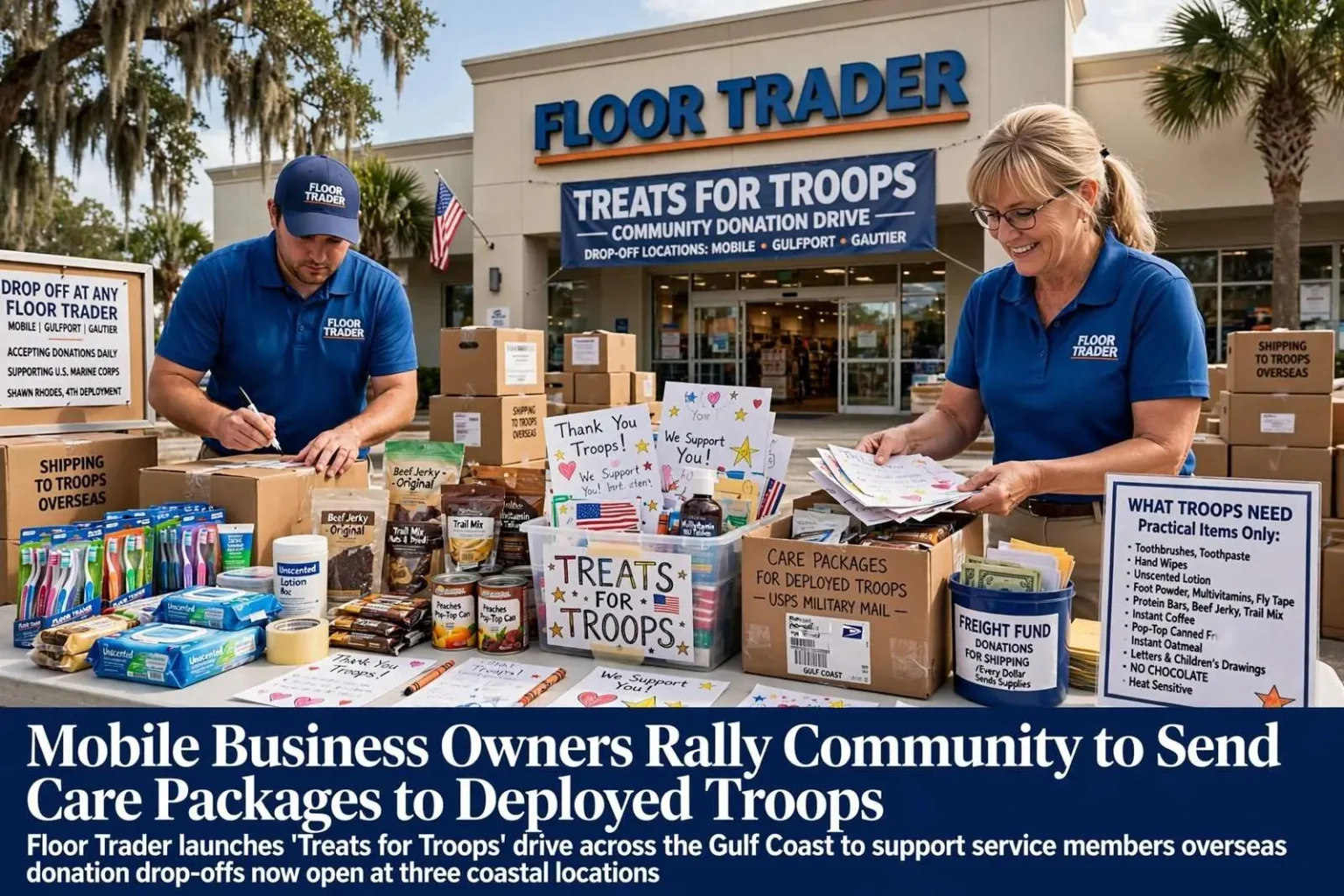
A Mobile business is turning a family connection to the military into a Gulf Coast-wide donation drive, collecting supplies for U.S. troops stationed overseas. The owners of Floor Trader started the “Treats for Troops” collection after talking with their son, Shawn, a member of the U.S. Marine Corps currently on his fourth overseas deployment.
During one of those conversations, Shawn told his mother, Vicki Rhodes, that many service members he serves alongside do not have family back home, or don’t have relatives with the means to regularly send care packages. That conversation became the spark for a company-wide effort that has since grown to involve all of the company’s coastal locations and, organizers hope, the wider Gulf Coast community.
Vicki worked with her son to put together a detailed list of items troops actually need and can use in the field, then opened up donation drop-off points at all three Floor Trader locations along the coast: Mobile, Gulfport and Gautier. The spread of the drive across Mississippi as well as Alabama reflects how tightly the region’s communities are connected by military service, with families on both sides of the state line sending sons and daughters into the same deployments.
What Troops Actually Need
The wish list leans practical rather than sentimental. Organizers are asking for basic hygiene items such as toothbrushes, toothpaste, hand wipes and unscented lotion, along with foot powder, multivitamins, and fly tape, since flying insects are a persistent nuisance for deployed troops during the summer months.
The emphasis on unscented products is not an aesthetic choice. In deployed environments, strong fragrances can attract insects and, in some settings, pose security concerns, which is why experienced care-package senders often steer donors toward plain, functional versions of everyday items. Foot powder addresses one of the most common complaints among service members who spend long hours in boots in hot climates — a daily reality along the Gulf Coast that deployed troops know well.
Soft-cover books and magazines, along with letters and children’s drawings, are also welcome, giving service members something personal from home. Organizers note that for troops without families sending packages, a letter from a stranger — particularly one written by a child — can mean as much as anything in the box.
Snacks With Rules
Snacks make up a major part of the drive, with a few important restrictions. Anything sent must remain in its original packaging, and organizers are asking that chocolate be left off donation lists entirely, since it doesn’t hold up to shipping times and overseas heat.
Anyone who has left a candy bar in a Gulf Coast car in July understands the problem: packages bound for deployed units can spend weeks in transit and sit in hot warehouses and transport vehicles before reaching their destination, and melted chocolate arrives as an unusable mess that can ruin the other contents of a box.
Suggested snack items include protein bars, beef jerky, instant coffee, small pop-top canned fruit, trail mix, nuts, pretzels and instant oatmeal. The list favors dense, shelf-stable foods that survive rough handling and deliver quick energy or familiar comfort during long duty days. Pop-top cans matter because many deployed locations lack easy access to can openers, and single-serving packaging helps troops carry food into the field.
Covering the Cost of Shipping
Because shipping supplies overseas isn’t free, organizers are also accepting cash donations earmarked specifically to cover freight costs, which can add up quickly when sending boxes of goods across the ocean to military installations.
The logistics of overseas mail are easy to underestimate. Care packages bound for deployed service members typically travel through military mail systems that route boxes through multiple sorting facilities and modes of transport before they reach a forward operating base, and flat-rate shipping boxes filled with canned goods, books and toiletries quickly become heavy. A single full box can cost a substantial amount to send, and a community-scale drive collecting hundreds of boxes generates freight costs that would overwhelm volunteers without dedicated funding.
Cash donations solve that problem directly. Money set aside for postage allows organizers to keep accepting donated goods from people who cannot afford shipping, and lets the drive send boxes as fast as supplies arrive rather than waiting to accumulate postage.
Why the Gulf Coast Answers These Calls
The drive resonates in a region with deep military roots. The Gulf Coast is home to major installations and a large community of veterans, active-duty personnel and military families, from the Navy and Coast Guard presence along the coast to the Army and Air Force communities inland. Mobile itself has long served as a crossroads for service members moving through the region, and many local businesses have histories of supporting deployed units through collection drives, discount programs and care-package efforts.
Deployment cycles shape daily life for many families across south Alabama and south Mississippi, and community efforts like Treats for Troops give neighbors without direct military connections a tangible way to participate. For service members who receive packages from strangers, the message is straightforward: the people back home have not forgotten them.
How to Take Part
Residents who want to contribute can drop off items at any of the three participating Floor Trader locations in Mobile, Gulfport or Gautier during regular business hours. Organizers say the most useful donations follow the published wish list closely — hygiene items, the approved snacks in original packaging, soft-cover reading material and letters or drawings from children.
Those who prefer to help financially can ask store staff about the freight fund, with every dollar going toward postage rather than overhead. Organizers also encourage donors to think in terms of what travels well: nothing that melts, nothing that shatters, nothing that requires refrigeration, and nothing that needs to be opened with tools the troops may not have.
For Shawn Rhodes and his fellow Marines on their fourth deployment, the packages represent more than supplies. They are proof that a conversation between a mother and a son on the other side of the world can grow into a region-wide effort — one that residents from Mobile to the Mississippi Gulf Coast can join simply by picking up a few extra items on their next trip to the store.
The drive is expected to continue collecting while troops remain deployed, and organizers have said they will keep the drop-off points open as long as the need exists. For a region that sends so many of its own into uniform, that is a commitment the Gulf Coast community has rarely had trouble keeping.
From a Family Conversation to a Regional Drive
The origins of the effort are modest by any measure. Floor Trader, a flooring retailer with stores across the Gulf Coast, became the staging ground for the collection because the family that runs it wanted to do something concrete after hearing from Shawn about the troops around him who receive nothing from home.
Military support organizations have long noted that deployed units include service members with no support network at all — young troops estranged from family, those whose relatives cannot afford regular shipping, and others who simply have no one writing to them. Units often informally share packages when they can, but the gap is real, and it is exactly the gap Vicki Rhodes set out to close after that phone conversation with her son.
Working directly with a service member on deployment gave the drive an advantage most collections lack: the wish list reflects current, field-level reality rather than guesswork. Items that sound thoughtful but sit unused — bulky goods, duplicates, things that melt or leak — were filtered out before the list ever reached the public, and items Shawn’s unit actually needed moved to the top.
A Region Built Around Service
Community response to drives like this one tends to be strong along the Gulf Coast, where military service is woven into the region’s economy and identity. Shipbuilding and ship repair anchor hundreds of local jobs, Reserve and National Guard units draw from every county, and generations of families have sent members into every branch of the armed forces.
That familiarity works in the drive’s favor. Donors here do not need an explanation of what deployment means — many have lived it through a spouse, a parent, a coworker or a child. Retail locations along the coast have proven natural collection points precisely because they sit inside everyday shopping routines, letting people add a tube of toothpaste or a box of trail mix to a trip they were making anyway.
Business-organized collection drives also tend to sustain momentum in ways one-time events do not. With drop-off points open daily at three stores spread across two states, the drive can accept donations steadily through the deployment cycle rather than in a single weekend burst, matching the ongoing nature of the need overseas.
What Happens Next
Once enough goods and freight donations accumulate, organizers box and ship the collections to Shawn’s unit for distribution, with service members who lack family support receiving first priority. From there the packages join the military mail pipeline and make their way to the deployed location, where the practical items get used in the field and the letters and drawings get posted in common areas for everyone to share.
For the Rhodes family, the drive has turned a retail business into something closer to a community supply line — a role the owners say grew naturally out of wanting to support their son and the people serving beside him. And for the troops on the receiving end, each box is a reminder that a network of strangers from Mobile to Gulfport to Gautier is paying attention.