Mobile City Council Delays West Mobile Annexation Vote by Two Weeks
The Mobile City Council voted 6-1 to delay Mayor Sandy Stimpson proposal to annex three West Mobile areas, citing misinformation about the plan.
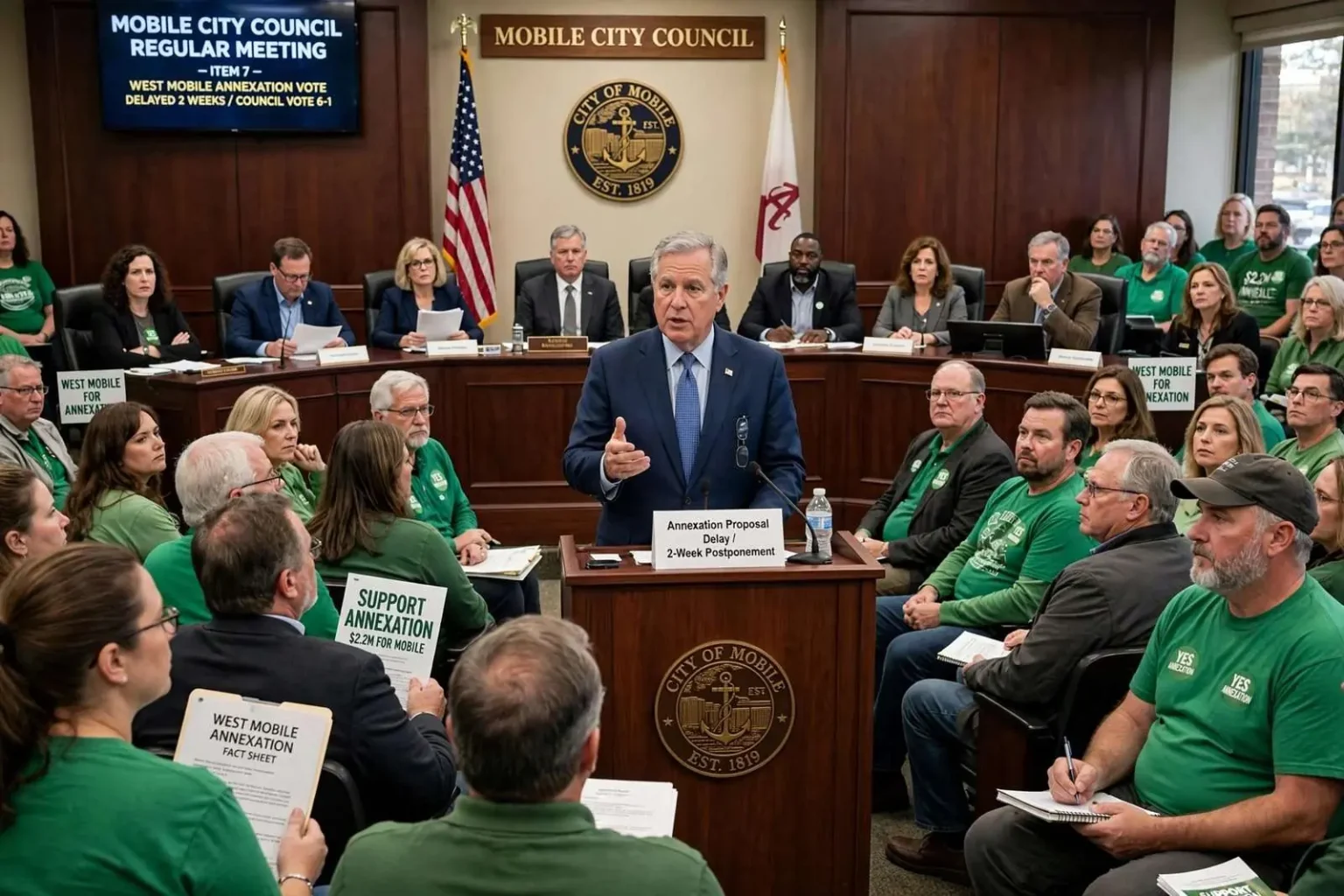
The Mobile City Council voted Tuesday to delay a decision on Mayor Sandy Stimpson’s proposal to annex three areas of West Mobile into the city, pushing the vote back by two weeks after the mayor cited misinformation circulating about the plan. The postponement keeps one of the most consequential boundary questions in the city’s recent history open a little longer, and it gives both supporters and skeptics additional time to press their cases. Council chambers filled well before the item came up, a sign of how closely the proposal is being watched on both sides of the city’s western edge.
The delay passed 6-1, with the majority of council members agreeing to take more time before deciding on a proposal that could reshape the city’s boundaries and boost its population past 200,000 residents, making Mobile the second-largest city in Alabama. The population threshold carries symbolic weight in a state where Birmingham and Huntsville have traded the top positions in recent census counts. Crossing 200,000 would move Mobile ahead in those rankings and change how the city is measured in statewide and national comparisons.
The Mayor Points to Misinformation
Stimpson asked the council at the start of the meeting to postpone the vote, saying false claims about the annexation proposals had been spreading through the community. He did not specify what misinformation had been circulating but said additional time would allow for a more informed discussion. The request put the council in the position of adjudicating a public debate the mayor said had been corrupted by bad information, a dynamic that has accompanied virtually every annexation fight in the region.
The mayor first announced his annexation plan in October 2019, targeting three unincorporated areas of West Mobile. The areas sit along the growth corridors west of the city limits, neighborhoods that use Mobile addresses and city services informally while paying no city property taxes. If approved, the annexation would bring in an estimated $2.2 million in additional revenue and add thousands of residents to the city’s rolls.
The $2.2 million figure has been central to the administration’s pitch, representing new tax base without the upfront capital costs that greenfield annexations sometimes carry. City officials have argued that the residents in the affected areas already behave like Mobilians, shopping in the city, driving its roads and identifying with its institutions. The proposal, in that framing, simply aligns the tax map with the social one.
Annexation fights in Mobile County follow a pattern familiar to anyone who has watched similar battles in Baldwin County or across the South. Unincorporated suburban areas weigh lower taxes and county services against full membership in the city, with questions of schools, zoning and representation threading through the debate. In Mobile’s case, the growth stakes are amplified by the city’s long competition with its suburbs for population and commercial investment.
Supporters Turn Out in Green
Despite the delay, dozens of West Mobile residents attended the meeting wearing green to signal their support for joining the city. Many spoke during public comment, emphasizing that their communities are self-sufficient and would bring additional tax revenue and economic growth to Mobile. The coordinated color made the supporters easy to count from the dais, a visual argument that the annexation has an organized constituency on the ground.
Del Sawyer, chairperson of the West Mobile annexation committee, told council members that residents in the affected areas are eager to become part of the city. He said residents just want to be part of Mobile and contribute their fair share, noting that they bring a lot to the table. Sawyer’s committee has organized the neighborhoods’ case for annexation, compiling petitions and presenting the areas’ commercial and residential assets to city officials.
The supporters’ argument rests partly on reciprocity: West Mobile residents already spend money inside the city, they say, generating sales tax revenue for Mobile while their own neighborhoods collect none of the benefit of city zoning, police coverage and infrastructure planning. Joining the city, in their telling, formalizes a relationship that already exists. The green shirts in the council chamber were the public face of that argument.
Council Members Want Existing Issues Addressed First
Not all council members were convinced the timing was right. Council member CJ Small argued that the city should focus on resolving existing problems before expanding its borders, asking whether Mobile was truly ready to expand while current issues remained unresolved. Small’s district includes parts of the city’s core, where the demands of existing neighborhoods weigh heavily in his calculus.
Other council members echoed similar concerns, questioning whether city services such as police, fire and infrastructure maintenance could adequately serve a larger population without straining the existing budget. The service question is the practical heart of every annexation debate: new residents bring tax revenue, but they also bring miles of streets to pave, hydrants to service and response times to maintain. Council members wanted assurances that the $2.2 million projection would survive contact with those costs.
The skepticism also reflects the council’s institutional memory of past growth debates, in which expansions promised revenue that arrived more slowly than the services it was meant to fund. Members who have shepherded budgets through lean years are wary of commitments that assume the rosiest revenue projections. The two-week delay gives the administration time to answer those questions with numbers.
The 6-1 vote itself carried information about the council’s mood. A supermajority was willing to wait, but only one member voted against the delay outright, suggesting that outright opposition to the annexation is thinner than the debate in the chamber might suggest. The vote to postpone, rather than to reject, keeps the proposal alive while conceding that the case for it is not yet complete.
What Comes Next
The annexation proposals are expected to return to the council agenda in two weeks. If the council ultimately approves the plan, a special election would be held to allow residents in the affected areas to vote on whether they want to be absorbed into the city. That election requirement is the final check in Alabama’s annexation process, and it means the residents of West Mobile themselves will cast the deciding votes no matter what the council does.
The special election stage changes the character of the campaign. Council debate will give way to door-to-door organizing in the three areas, with supporters and opponents making their cases to the very households whose ballots decide the outcome. The green-shirt contingent will have to translate chamber testimony into neighborhood votes, and the mayor’s office will have to make its revenue and service projections legible to residents weighing a new tax bill.
Stimpson has framed the annexation as a growth opportunity, pointing to the potential for new commercial development along major corridors that could generate additional revenue to offset the costs of expanded city services. The development argument looks past the immediate tax math to the compounding effects of city zoning and infrastructure investment in West Mobile’s commercial strips. The administration’s case, in short, is that annexation does not just add the West Mobile of today; it accelerates the West Mobile of the next decade.
That framing also responds to the demographic backdrop behind the council debate. Mobile’s population has been roughly flat for decades while its suburbs have grown, and the city’s census standing has slipped in a state where Huntsville’s boom has rewritten the rankings. Annexation is one of the few levers a city can pull to change those numbers, which is why mayors across Alabama have pursued it aggressively. For Stimpson, the 200,000 mark is both a policy goal and a message about the city’s direction.
The residents of the three areas, for their part, are being asked to weigh real trade-offs. City residency brings Mobile’s property tax rate, but it also brings city zoning protections, refuse service, proximity-based police and fire coverage and a vote in city elections. Supporters in the chamber argued that the services are worth the taxes; the special election will test whether that view commands a majority on the ground.
The two-week delay also gives opponents time to organize. No organized opposition turn-out matched the green shirts on Tuesday, but skepticism on the council and in the community is documented, and the election campaign will give it structure. Misinformation, the stated reason for the delay, cuts in both directions in a campaign environment, and both sides will be watching the other’s claims closely.
Whatever the council decides in two weeks, the West Mobile annexation debate has already accomplished one thing: it has surfaced, in public, the questions that will define Mobile’s next decades. How the city grows, who pays for it, and whether the boundaries drawn in 1819 and amended since still describe the place Mobile has become. The vote delayed Tuesday will answer a piece of that, and the special election that may follow will answer the rest.
The council will take the proposal up again in two weeks with the same seven members, the same projections and a fuller record of what the community thinks. Between now and then, the green shirts will keep making their case in West Mobile living rooms, the administration will keep defending its numbers, and the city will wait for a decision on whether its western boundary moves and its population crosses a line that would make it the second-largest city in Alabama.