Federal Judge Allows Most Corruption Charges Against Mobile County License Commissioner to Proceed to Jury
A federal judge cleared most corruption charges against Mobile County License Commissioner Kim Hastie for the jury as her 2015 trial neared its end.
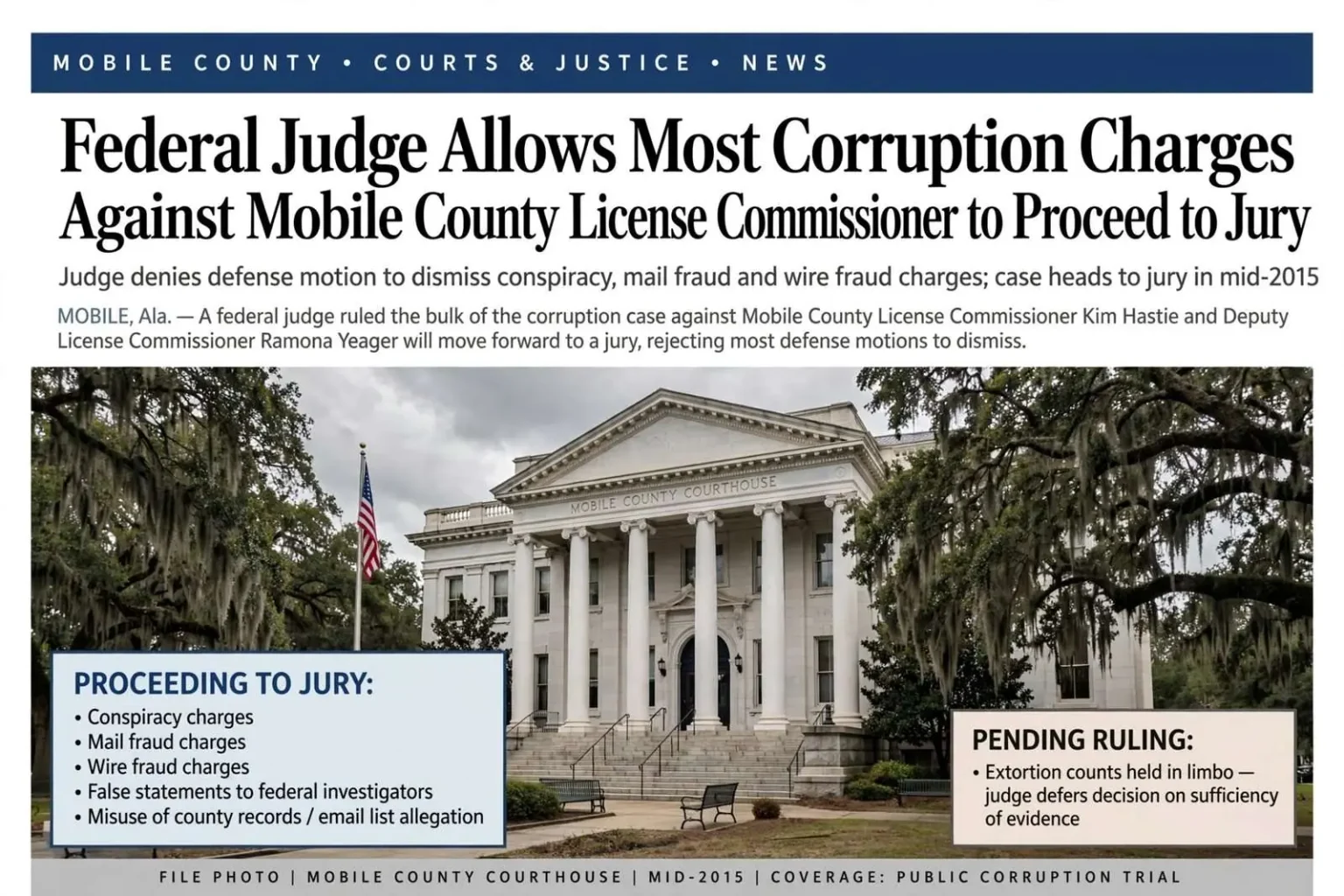
A federal judge presiding over the corruption trial of Mobile County License Commissioner Kim Hastie ruled largely against the defense in mid-2015, clearing the way for jurors to weigh most of the charges against Hastie and her deputy as the trial neared its conclusion. U.S. District Judge Kristi DuBose rejected defense motions seeking to dismiss conspiracy, mail fraud and wire fraud charges against Hastie and Deputy License Commissioner Ramona Yeager, keeping the core of the government’s case intact as it headed to the jury.
DuBose also ruled that jurors could consider separate allegations that Hastie lied to federal investigators and improperly shared personal information from county records when she provided an email list to a mayoral campaign in 2013. That ruling meant the jury would hear not only the broader fraud and conspiracy theories advanced by prosecutors, but also the narrower claims about how Hastie handled sensitive data maintained by her office.
The judge did, however, hold off on deciding what to do with a set of extortion counts, expressing skepticism about whether prosecutors had cleared the legal bar required to prove that charge. The postponement left one piece of the indictment in limbo even as the rest of the case moved forward, and it gave the defense at least a partial victory in an otherwise difficult stretch of the trial.
The Office at the Center of the Case
The trial put an unusual spotlight on an office most Mobile County residents interact with only when they renew a tag or register a vehicle. The Mobile County License Commission operates as an independent agency, separate from the county commission, and is headed by an elected license commissioner under a structure created by the Alabama Legislature. That setup gives the commissioner meaningful authority over contracts, staffing and spending — authority that became the heart of the dispute between prosecutors and the defense.
Because the commissioner is elected, the defense built much of its argument around the idea that discretionary decisions about how the office promotes itself and serves the public fall within the legitimate powers of the position. Prosecutors, by contrast, framed the same decisions as a scheme to convert public resources and private relationships into personal and political benefit.
Mail fraud and wire fraud charges, the backbone of federal public corruption cases, hinge on showing a scheme to defraud that uses the mails or interstate wires in furtherance of the scheme. Conspiracy charges require proof that defendants agreed to commit an offense, not just that questionable decisions occurred. Defense attorneys argued throughout the trial that the government’s evidence amounted to bookkeeping disagreements and office politics rather than criminal intent, a framing that DuBose’s rulings declined to adopt at the dismissal stage.
The Email List Allegation
Among the allegations the jury was allowed to consider was the claim that Hastie improperly shared personal information drawn from county records when she provided an email list to a mayoral campaign in 2013. The allegation touched on the boundary between an elected official’s constituent data and the privacy expectations of the residents whose information ends up in government databases.
For Mobile County residents, the episode raised practical questions about how information collected during routine transactions with the License Commission can be used downstream. County records that residents supply for licensing purposes are maintained for official business, and the case tested whether repurposing that data for campaign work crosses a legal line rather than merely a political one.
The false-statement allegations, separately, centered on statements Hastie allegedly made to federal investigators during the inquiry. Lying to federal agents is itself a crime under federal law, independent of whether the underlying conduct being investigated is ever proven, which is why such counts frequently appear in public corruption prosecutions even when the main charges remain contested.
The Extortion Counts and the Computer Consultant
The one set of counts left unresolved involved extortion allegations that centered on Hastie’s relationship with a local computer consultant who held a contract with the License Commission. Prosecutors alleged that Hastie pressured the consultant into donating door prizes for office Christmas parties and contributing to her campaign, using the weight of her authority over his government contract to extract the gifts.
The consultant testified that he complied because he feared losing his contract. But DuBose noted that fear alone is not enough under federal law. To sustain an extortion conviction, prosecutors need evidence that the defendant made an actual threat that a reasonable person would recognize as coercive — a distinction that separates criminal pressure from the ordinary unease a vendor might feel when dealing with a government client.
Prosecutors pushed back by pointing to Hastie’s own admission to an FBI agent that she had repeatedly threatened to fire the consultant. They also highlighted an internal office list tracking which vendors had donated to the Christmas party, evidence they argued showed a pattern of conditioning goodwill — and potentially future business — on contributions to office festivities and the commissioner’s political committee.
DuBose’s decision to hold the extortion counts open rather than dismiss them outright reflected the narrowness of the legal question. The judge signaled doubt about whether the record, as it stood, satisfied the standard for coercion, but she declined to resolve the issue definitively before the jury finished its work, leaving the counts in procedural limbo while deliberations approached.
The Defense Theory: An Accounting Dispute, Not a Crime
The defense spent much of the trial arguing that Hastie’s spending decisions, while perhaps questionable in process, amounted to an accounting dispute rather than criminal conduct. Attorneys for the commissioner maintained that she acted within her authority as an elected official when she produced newsletters for constituents and hired outside marketing and lobbying help for her office, expenditures prosecutors characterized as part of a fraud scheme.
That argument carried real weight in a case built largely on the inner workings of a county office. Newsletter production, promotional spending and contract work with local vendors are all activities that elected officials across Alabama routinely undertake, and the defense urged jurors to see Hastie’s choices in that same light — aggressive administration, perhaps, but administration nonetheless.
The defense also worked to portray the government’s case as an after-the-fact reconstruction of ordinary office practices. Internal lists, party planning and vendor relationships, attorneys argued, took on a sinister cast only when filtered through the assumptions of federal investigators who spent years examining the office’s books.
Character Witnesses and the Defense’s Final Push
Character witnesses called on Hastie’s behalf during the trial offered testimony aimed at humanizing the commissioner and vouching for her integrity in office. Character evidence plays a limited but meaningful role in federal trials: while it cannot directly rebut proof of specific acts, it allows defendants to argue that their general reputation for honesty and lawful conduct makes the government’s narrative less plausible.
The defense’s closing posture combined that character testimony with its broader theme — that the case against Hastie was manufactured from routine county government practices by prosecutors and investigators who never fully understood how the License Commission operated. Whether jurors found that framing persuasive would determine whether Hastie left the courthouse as a convicted defendant or an acquitted one.
What the Rulings Mean for the Jury
By rejecting the defense motions to dismiss the conspiracy, mail fraud and wire fraud counts, DuBose ensured the jury would deliberate on the full scope of the government’s theory against both Hastie and Yeager. Under federal law, judges decide legal questions such as the sufficiency of the evidence after the government rests, while juries weigh the facts. Dismissing a count before deliberation requires the judge to find that no reasonable jury could convict on the evidence presented — a high bar that DuBose concluded the government had cleared for most of the indictment.
The rulings also shape how the jury hears the case in closing arguments. With the false-statement and records allegations now part of the deliberations, prosecutors can present a layered case: even if jurors harbor doubts about the larger fraud theory, they could still convict on narrower counts involving the email list or the statements to investigators.
For the defense, the residual fight over the extortion counts represented the last realistic chance to trim the indictment before verdict. If DuBose ultimately found the coercion evidence insufficient, those counts would fall away; if not, jurors would weigh them alongside everything else.
Broader Stakes for Mobile County
Beyond the courtroom, the trial carried consequences for public confidence in county government. The License Commission touches nearly every household in Mobile County through tag renewals, titles and related services, and allegations that its leadership blurred the line between official authority and political benefit resonated well beyond the federal courthouse.
The case also fit into a wider pattern of federal public corruption prosecutions in Alabama over the past decade, in which state, county and municipal officials have faced charges built on the intersection of public office and private benefit. Federal prosecutors in the Southern District of Alabama have pursued such cases with regularity, and defense attorneys have consistently argued that the line between zealous politics and criminal fraud is thinner on paper than in practice.
As the trial moved toward its conclusion, the question before jurors was stark: whether Hastie’s conduct as an elected official reflected criminal intent that defrauded the public, or aggressive but lawful administration that happened to attract scrutiny. The answer would carry implications not only for Hastie and Yeager, but for how Mobile County’s independent licensing office conducts its business in the years ahead.