University of South Alabama Mobile
Prosecutors Fight Mobile Official’s Bid to Split Trial Into Three
Federal prosecutors moved to block Mobile County License Commissioner Kim Hastie's request to face three separate trials instead of one.
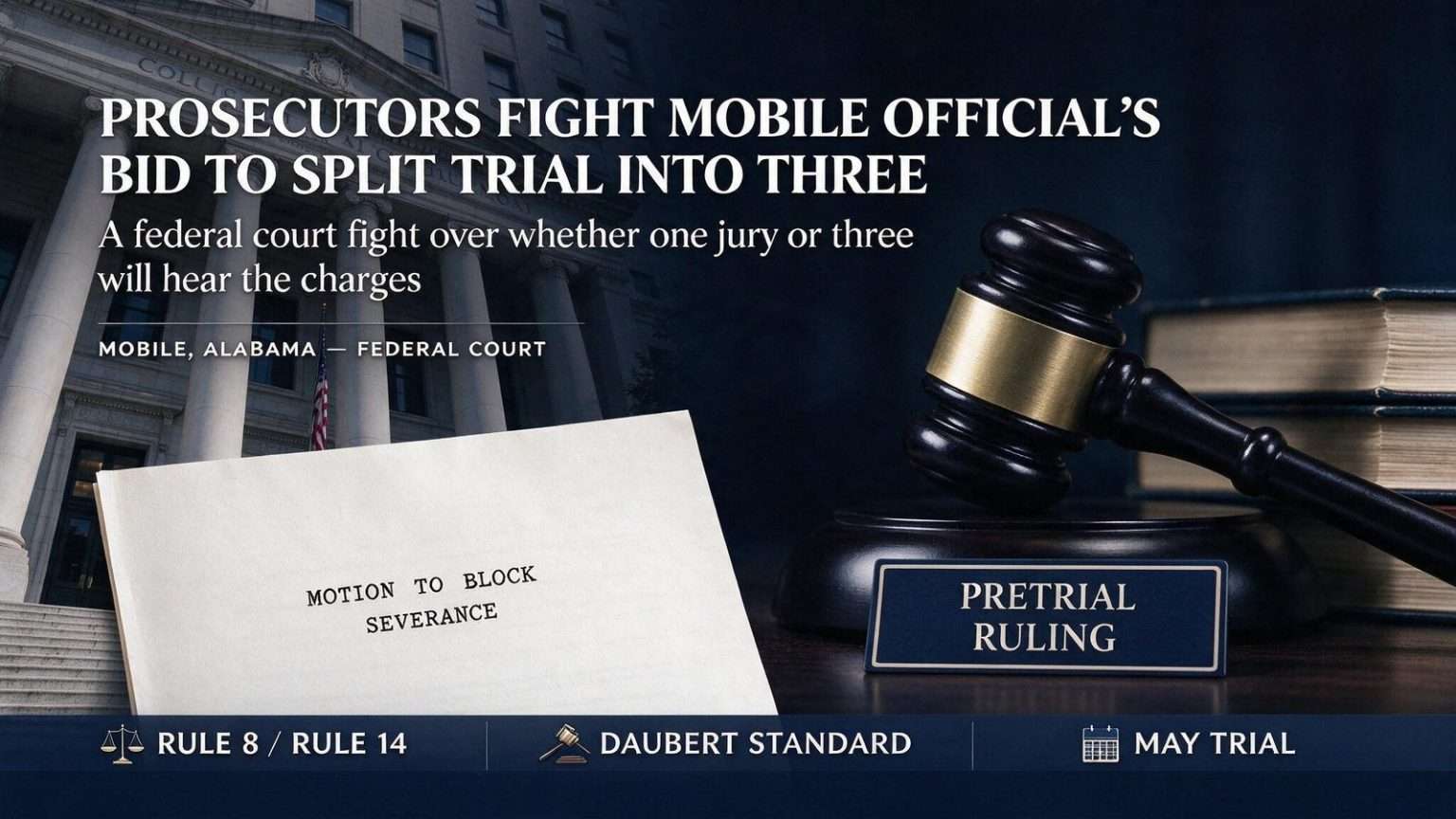
Federal prosecutors filed a motion this week seeking to block Mobile County License Commissioner Kim Hastie’s request to be tried separately three times rather than once on the 18 criminal counts contained in her federal indictment. In court filings, Assistant U.S. Attorney Greg Bordenkicher argued that splitting the case into three trials would waste judicial resources rather than protect Hastie’s rights.
“She believes a single trial would hamper ‘judicial efficiency’ and she attempts to persuade the Court that three separate trials would be a better use of the Court’s time and resources,” Bordenkicher wrote. “The position is wishful thinking.”
The dispute over trial structure is a procedural fight with major consequences either way. A single trial consolidates all the evidence before one jury; separate trials would mean three juries, three rounds of witness testimony and three opportunities for appeal on overlapping facts. Federal judges weigh such motions against Rule 8 and Rule 14 of the Federal Rules of Criminal Procedure, which permit multiple offenses to be charged together when they arise from the same scheme, and allow severance only where a joint trial would seriously prejudice the defendant.
The Defense’s Position
Hastie’s defense attorneys had argued in a February 27 filing that combining all charges into a single trial would force them into a “one-size-fits-all strategy” that could unfairly prejudice her defense, calling the approach “repugnant to the spirit of the Constitution.”
The defense’s concern centers on spillover: evidence that is admissible to prove one category of charges may paint the defendant in a broadly negative light that influences how a jury views every other count. Separate trials, in that view, confine each body of evidence to the charges it actually supports. Prosecutors counter that the counts in Hastie’s indictment share witnesses, documents and an overall narrative, making one trial the honest and efficient way to present the case.
The Charges Behind the Fight
Hastie and her husband, John, were indicted after federal authorities alleged the couple failed to report $58,633 in income to the IRS, income prosecutors say came from brokering land transactions and from timber cutting and land clearing services.
Additional charges added in January accused Hastie of coordinating a scheme to forward thousands of residents’ emails to a political consulting firm, which was then used to send messages expressing Hastie’s support for Sandy Stimpson during his 2013 campaign for Mobile mayor.
The email forwarding allegation drew particular attention because it touched the machinery of county government itself. The License Commissioner’s office handles vehicle registrations, hunting and fishing licenses, and other transactions that require residents to provide email addresses as part of routine business. Prosecutors allege those addresses were diverted to political use — a claim that transformed a routine campaign-era dispute into a federal criminal matter.
For Mobile voters, the case revived questions about the boundary between public office and political activity. Alabama’s elected license commissioner holds an independent constitutional office, separate from the county commission and county administration, which means the position operates with few of the oversight structures that constrain appointed department heads. How courts and prosecutors treat the alleged misuse of constituent emails will shape expectations for every officeholder who collects resident contact information in the course of public business.
The Battle Over Expert Testimony
In a separate filing on the same day, prosecutors moved to exclude testimony from Semoon Chang, a former University of South Alabama economics professor Hastie had hired to produce an unpublished study. That study concluded that merging the Mobile County Revenue and License Commissions would save taxpayers roughly $1 million.
Prosecutors said Hastie solicited the study in October without informing Mobile County commissioners and never actually paid Chang for the work. Bordenkicher argued Chang’s testimony was irrelevant to the criminal charges and risked misleading jurors.
“Dr. Chang has no knowledge of any issues that are necessary to rendering a verdict,” Bordenkicher wrote, adding that the study lacked “well-researched, independent, transparent, academic” grounding and that prosecutors disputed its findings and methodology entirely. He also suggested Hastie intended to use Chang’s testimony to improperly bolster her own credibility with self-serving, hearsay-based evidence.
The fight over Chang’s potential testimony illustrates how expert evidence gets scrutinized in federal criminal cases. Under the standard set out in Daubert v. Merrell Dow Pharmaceuticals, trial judges act as gatekeepers, admitting expert testimony only when the underlying methodology is reliable and the expert is qualified to offer it. A study commissioned by a criminal defendant, conducted for her benefit, and — according to prosecutors — never paid for, faces a steep climb under that standard.
For the defense, Chang’s study serves a narrative purpose: it portrays Hastie as a reform-minded officeholder commissioning serious analysis of how county government could save money. Prosecutors want that portrait excluded, arguing it has nothing to do with whether the tax counts or the email counts were violated, and exists mainly to make the defendant look like a public servant rather than a defendant.
What Happens Next
Hastie’s case was scheduled to go to trial in May, with both the trial-structure dispute and the admissibility of Chang’s testimony left for the presiding federal judge to resolve ahead of proceedings.
Those pretrial rulings will do much to define the trial itself. If the judge grants severance, prosecutors would have to present their case in separate installments, and the defense would gain the chance to tailor its strategy to each. If the motion is denied, a single jury hears everything at once. On the expert question, exclusion of Chang would remove one of the few affirmative themes available to the defense; admission would let the study’s $1 million savings claim reach the jury despite the prosecution’s challenge to its methodology.
Either way, the May trial date gives the court a fixed horizon for resolving the motions. Federal criminal cases in the Southern District of Alabama routinely proceed through exactly this sequence — indictment, motion practice, rulings from the bench, then trial — and the pace of the Hastie case has tracked that calendar since the original charges were filed.
Whatever the judge decides, the case has already become a reference point in Mobile County government. The License Commissioner’s office is one of several independent county offices — alongside the Revenue Commissioner and the probate courts — whose overlapping duties and separate elected leadership have repeatedly prompted consolidation proposals over the years. Chang’s study, whatever its fate in court, keeps that debate alive: its conclusion that merging the Revenue and License Commissions could save roughly $1 million is exactly the kind of finding consolidation advocates have cited for decades.
An Office Under Scrutiny
The case has drawn significant attention in Mobile County, where Hastie has served as an elected license commissioner overseeing vehicle registration, hunting and fishing licenses, and other county services.
The office touches nearly every household in the county. Vehicle registrations alone put hundreds of thousands of residents through License Commissioner branch offices each year, making the position one of the most visible elected posts in county government even though its work is largely administrative. That visibility cuts both ways for an officeholder facing criminal charges: the constituency is broad, and the attention to the case is correspondingly intense.
The indictment’s two threads — the alleged unreported income from land brokering and timber services, and the alleged email forwarding scheme tied to the 2013 mayoral race — will be weighed by whatever jury ultimately hears them. Hastie’s presumption of innocence holds unless and until prosecutors prove the charges beyond a reasonable doubt, and her defense team’s motions reflect its effort to control how much of the government’s story a jury hears at one time.
For now, the scheduling order, the severance ruling and the Daubert decision remain with the presiding judge, whose pretrial rulings will determine the shape — and possibly the duration — of one of Mobile County’s most closely watched federal prosecutions.
The prosecutorial pushback on all three fronts — severance, the Chang study and the trial timeline — reflects the government’s effort to present its case as a single coherent narrative. From the Justice Department’s perspective, the tax allegations and the email scheme are chapters of one story about how the officeholder used her position, and fragmenting that story across three trials would let each jury see only a slice of the evidence.
Defense strategies of this kind are common in multi-count federal indictments. Severance motions rarely succeed under federal appellate standards, which require a showing of genuine prejudice rather than mere inconvenience, but they persist because the stakes are high: a jury that hears eighteen counts in one sitting hears hours of government evidence before the defense begins its case. Splitting that burden is often the most realistic path a defense team has to a better outcome, even when the odds of the motion are long.
The coming weeks of motion practice will also shape the appeals record. Whatever the district court decides on severance and the expert testimony is preserved for review in the event of a conviction, which gives both sides an incentive to argue the issues thoroughly now rather than holding arguments in reserve. For Mobile County residents following the case, the practical effect is that most of the significant action will happen in written filings and courtroom arguments before any jury is seated in May.