Defense Strategy Emerges in Mobile County License Commissioner Corruption Trial
As her federal corruption trial continues, Mobile County License Commissioner Kim Hastie's defense is leaning on past state attorney general opinions.
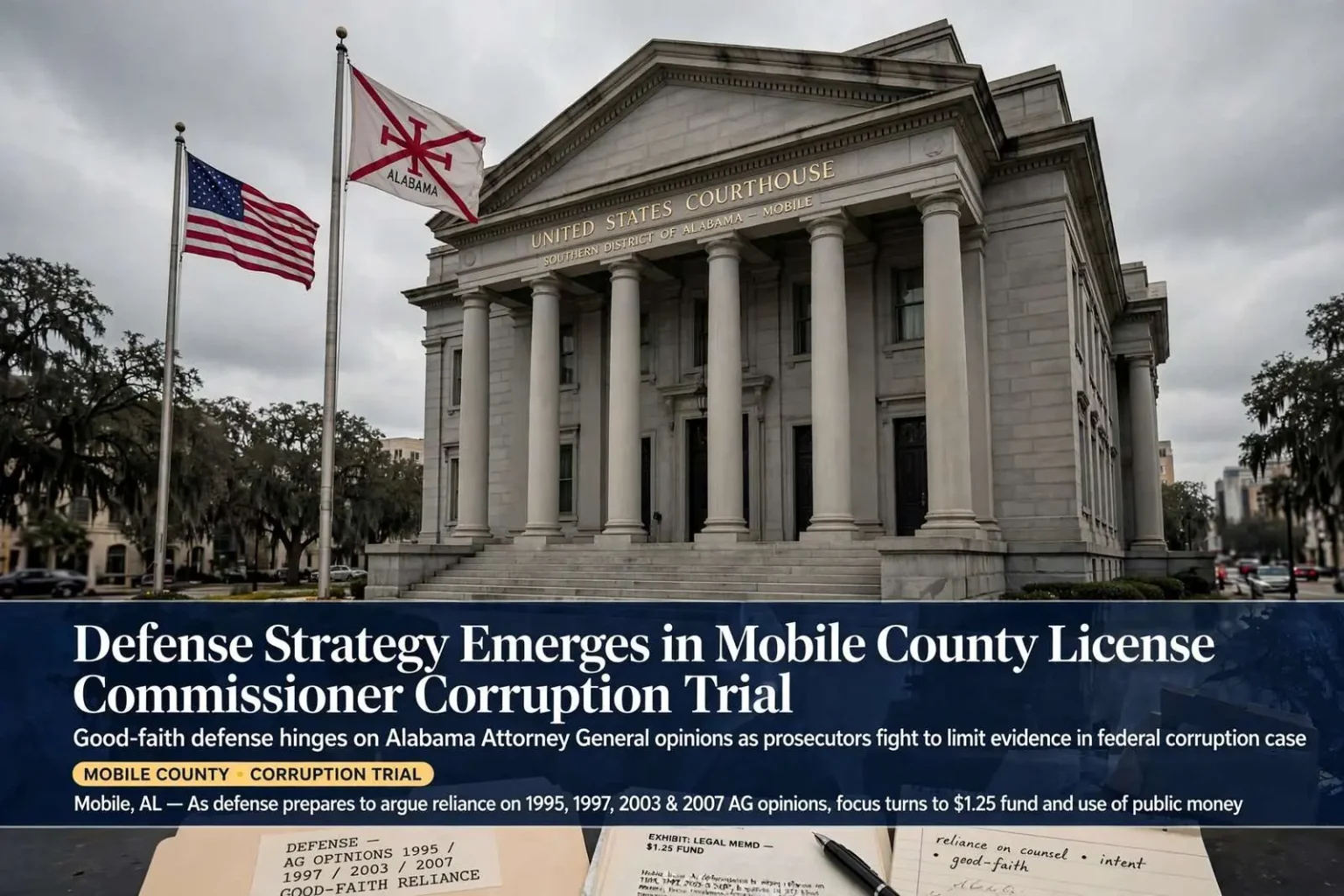
As she prepares to open her defense against federal corruption charges, Mobile County License Commissioner Kim Hastie is expected to lean heavily on a series of Alabama Attorney General opinions that her legal team argues justified her use of public funds. Prosecutors, however, have asked the presiding judge to prevent jurors from hearing about those opinions unless Hastie herself takes the stand to testify. The dispute over what evidence reaches the jury has become a central front in a case that has been winding through Mobile’s federal court and drawing attention across Alabama’s courthouse circles.
Part of the case against Hastie centers on allegations that she improperly used taxpayer money to produce a newsletter promoting her plan to merge her office with the Mobile County Revenue Commission, and that she obscured how the newsletter was financed by pressuring a computer consultant to alter his invoices. Federal prosecutors have framed the newsletter spending as a use of public resources for what amounted to an advocacy campaign for a government restructuring that would have reshaped how vehicle titles and registrations are handled across Mobile County. The alleged invoice changes, prosecutors argue, were an attempt to hide the true source of the money behind the mailings.
Prosecutors further allege she misused money from a fund built from a $1.25 fee tacked onto driver’s license transactions to pay a political consultant who helped draft legislation aimed at accomplishing the merger. The License Commission collects the fee on transactions processed through its offices, and prosecutors contend the money was never intended to underwrite lobbying or legislative work. The defense sees the same fund in a very different light, setting up one of the trial’s core arguments about how the money flowing through the commissioner’s office can lawfully be spent.
The defense contends the so-called $1.25 fund gives commissioners broad discretion in how the money is spent, so long as it serves a public purpose, and points to four Attorney General opinions issued in 1995, 1997, 2003 and 2007 as support for that reading. In Alabama, attorney general opinions are the state’s most common form of informal guidance for local officials, who frequently request them before spending money or exercising authority that is not clearly spelled out in statute. Hastie’s lawyers argue she did exactly what a prudent public official is expected to do: consult the state’s chief legal officer before acting.
What the Attorney General Opinions Mean
While such opinions aren’t legally binding, they can shield public officials from liability if followed in good faith. The doctrine matters enormously in cases like this one, because it separates an official who made a legal mistake from an official who deliberately broke the law. Defense attorneys argue that a commissioner who relied on consecutive attorney general opinions spanning more than a decade cannot be shown to have acted with the criminal intent federal fraud charges require, regardless of how prosecutors characterize the underlying spending decisions.
Federal prosecutors previously sought to block the defense from introducing those opinions as evidence at all, but a federal judge sided with the defense earlier this year, allowing at least some reference to the opinions during trial. That early ruling preserved the core of the good-faith defense, but it left open questions about how far the references could go — questions that returned to the courtroom as the defense prepared to present its side of the case. Prosecutors have continued to press for limits, arguing the opinions could confuse jurors about what the law actually required.
The Hearsay Fight Over Hastie’s Own Words
The more recent dispute centers on whether testimony describing conversations Hastie had with the License Commission’s attorney about those opinions would amount to inadmissible hearsay if offered by a third-party witness rather than Hastie herself. Prosecutors argued that allowing another witness to describe what Hastie said about the legal advice she received would improperly let her position be presented to the jury without her facing cross-examination. The rules of evidence generally bar secondhand accounts of what someone said when the statement is offered to prove its truth, and prosecutors contend this is precisely that situation.
The defense views the testimony differently, arguing that statements about why Hastie sought legal advice go to her state of mind rather than to the truth of the underlying legal conclusions. In white-collar cases, evidence of a defendant’s reliance on counsel is often among the most powerful proof of good faith available, and defense teams routinely fight to get it in front of jurors. Whether the conversations reach the jury may effectively determine how much of the good-faith story jurors ever hear, which is why both sides devoted significant briefing and argument to the question.
The Offices at the Center of the Case
The trial, which also involves Deputy License Commissioner Ramona Yeager as a co-defendant, has drawn significant attention in Mobile County as one of the more prominent public corruption cases to reach federal court in recent years. The License Commission occupies an unusual place in county government. In most Alabama counties, the probate judge handles vehicle titles and registrations, but Mobile County operates under a commission structure that puts the work in the hands of an elected commissioner and a staff that processes tens of thousands of transactions every year, from car tags to driver’s license renewals.
The proposed merger with the Revenue Commission, the measure at the heart of the alleged newsletter campaign, would have consolidated functions that currently sit in separate county offices. Proposals to restructure how Mobile County handles titles, tags and property assessment have surfaced repeatedly over the years, with supporters arguing consolidation would save money and reduce duplication, and critics warning about the loss of independent oversight. Prosecutors allege Hastie used public money to promote one side of that debate; the defense maintains the newsletter was a legitimate public information effort about a proposal the commissioner believed would benefit county residents.
The dispute over the $1.25 fee also illustrates how Alabama funds its county license operations. Fees attached to transactions are a common financing mechanism for county offices across the state, covering everything from equipment upgrades to employee training, and the money is typically administered under broad statutory language rather than line-item appropriations. That structure gives local officials flexibility but little day-to-day supervision, which is why spending disputes tend to turn on questions of purpose and documentation rather than on whether the money was available. Both sides agree the consultant was paid from the fund; they disagree sharply on whether the work he performed served the public purpose the fee was intended to advance.
The Federal Courtroom Setting
The case is being heard in the federal courthouse in downtown Mobile, where the Southern District of Alabama handles the region’s major federal criminal dockets. Public corruption prosecutions in Alabama have frequently been brought in federal court, where prosecutors can use fraud statutes that reach schemes to deprive the public of honest services and misuse of government funds. The burden of proof sits with the government, which must establish criminal intent beyond a reasonable doubt — a hurdle that good-faith evidence like the attorney general opinions is specifically designed to raise.
Public officials across Alabama have watched the case closely because of the questions it raises about routine administrative decisions. County commissioners, license offices and probate judges make daily judgments about how restricted funds can be spent, often with guidance that comes in the form of non-binding attorney general opinions. A verdict either way will shape how cautiously those officials approach similar fund decisions in the future, and how much weight they give informal legal guidance when nobody has told them the money cannot be used.
Whatever the jury decides, the potential consequences are serious. Federal fraud counts carry substantial maximum prison terms per count, and a conviction would also raise questions about Hastie’s ability to continue in the elected office she holds. For Yeager, the co-defendant, the same evidentiary fights apply, since much of the government’s theory rests on actions taken within the commission’s offices. The judge’s evidentiary rulings in the coming days will therefore do much to define the shape of the verdict questions jurors ultimately receive.
What Comes Next in the Trial
Both prosecution and defense are expected to continue presenting evidence in the days ahead as the case moves toward its conclusion. The defense case is expected to focus on documentation of the opinions, testimony about the fund’s purpose and witnesses who can speak to Hastie’s decision-making process. Prosecutors, having presented their account of the newsletter, the altered invoices and the consultant payments, will look to counter the good-faith narrative with evidence that the commissioner knew the spending was questionable and worked to keep details from public view.
Jurors will ultimately be asked to sort through dueling interpretations of the same fund, the same newsletter and the same legislation. If the defense succeeds in getting the attorney general opinions and the related testimony before the jury, Hastie’s team believes the good-faith reliance defense will carry the day. If prosecutors succeed in keeping that material out or minimized, the case will turn on the government’s evidence of intent. Either way, the resolution will be closely watched in Mobile County government, where the offices involved touch the daily lives of hundreds of thousands of residents who register vehicles and renew licenses through the commission each year.