Mobile County Emergency Agency Faces $711,000 FEMA Debt Deadline
Mobile County's emergency management agency owes FEMA more than $711,000 after years of delays on a new emergency operations center project.
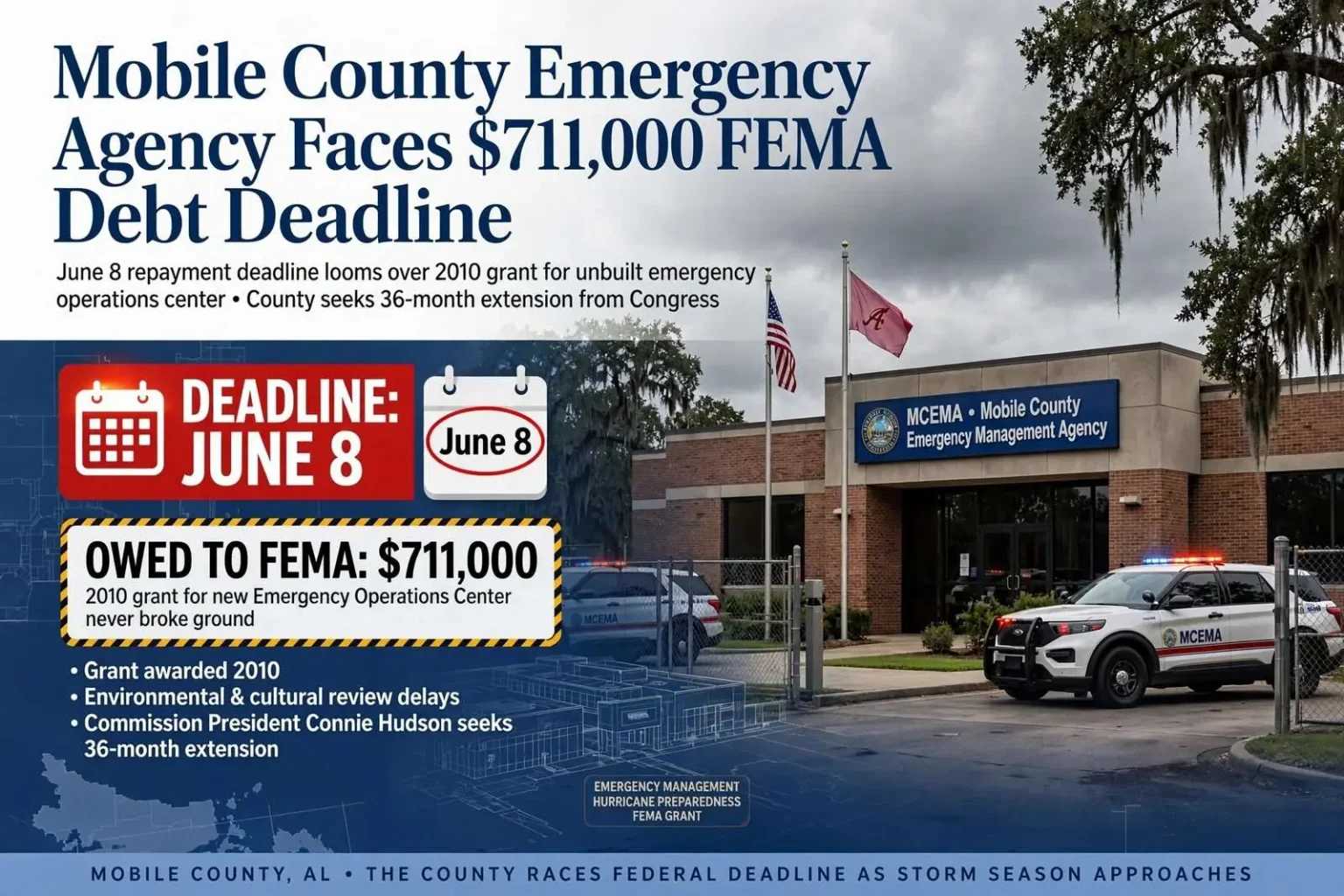
Mobile County’s emergency management agency is racing against a federal deadline after learning it owes the Federal Emergency Management Agency more than $711,000, stemming from a long-delayed construction project that never broke ground.
The Mobile County Emergency Management Agency (MCEMA) faces a June 8 repayment deadline for the debt, which traces back to a 2010 grant intended to help build a new emergency operations center. Under the terms of that grant, construction was supposed to begin within a defined performance period. Five years later, the project still had not broken ground, despite two previous extensions.
Mobile County Commission President Connie Hudson told MCEMA members this week that the agency is hoping U.S. Rep. Bradley Byrne and Sens. Richard Shelby and Jeff Sessions will intervene on the county’s behalf to secure one more extension, this time for 36 months.
MCEMA first learned the grant needed to be repaid through a letter from the Alabama Law Enforcement Agency dated May 5, prompting Hudson to formally request help from the state’s congressional delegation on May 15.
According to MCEMA director of operations John Kilcullen, the delays stemmed from a chain of federally required reviews. An environmental study had to be completed and approved before construction could begin. The process was further slowed when the Seminole Tribe of Florida requested a cultural survey of the 8.3-acre site to check for historical artifacts. “You cannot break ground until after those are complete,” Kilcullen said.
By 2012, construction documents were ready, but securing full funding hit additional snags, prompting the first extension request. FEMA approved the environmental and historic preservation assessment that March, and by August the city of Mobile issued a warranty deed transferring the 8.3 acres, located near the current 911 call center in west Mobile, for the project. The project later secured a separate grant of more than $1.3 million from FEMA for related costs, deepening the county’s investment in a facility that has yet to rise.
Why the Emergency Operations Center Matters
An emergency operations center is the nerve center a county turns to when disaster strikes — the facility where elected officials, emergency managers, first responders and utility and volunteer agencies gather under one roof to coordinate a response. In Mobile County, the stakes are defined by geography: the county fronts the Gulf of Mexico, sits along Mobile Bay, and has absorbed hurricanes, tropical storms and the flooding events that follow them. When a hurricane threatens, the current arrangements have county emergency managers operating alongside the 911 call center in west Mobile, a working but constrained setup.
The planned EOC was designed to change that. An 8.3-acre site near the existing call center would house a purpose-built facility with the communications systems, briefing space, backup power and redundancy that a major hurricane response demands. For an agency whose mission runs from hurricane season planning to hazardous material response and tornado recovery, a modern EOC is the difference between coordinating a disaster and improvising one.
How a Grant Becomes a Debt
Federal construction grants come with performance periods — the window in which a recipient must show progress or complete the work. When that window closes without groundbreaking, the award can be de-obligated, and the recipient can be required to return funds already advanced. Two extensions bought the county time, but the clock eventually ran out, and the letter from the Alabama Law Enforcement Agency — which administers federal emergency management grants in Alabama — formalized the repayment obligation in May.
The county’s response has been to attack the timeline rather than the debt itself. Hudson’s May 15 letter to the delegation asked the state’s representatives in Washington to seek a 36-month extension, the longest request the county has made. The argument local officials carry is straightforward: the delays that consumed the original performance period were not the county’s foot-dragging but the federal government’s own required reviews, including the cultural survey requested by the Seminole Tribe under federal historic preservation law.
The Review Chain That Stalled the Project
The sequence Kilcullen described is familiar to any government body that has built with federal dollars. Before a shovel moves, an environmental study must document the site’s conditions; a historic preservation assessment must confirm the project will not damage significant resources; and tribes with ancestral ties to the region are entitled to consultation, including requests for cultural surveys. The Seminole Tribe of Florida’s request regarding the west Mobile site added months — and each review had to be finished, approved and funded before construction documents could translate into groundbreaking.
That a tribe based in Florida holds an interest in Mobile County land surprises some residents, but the Gulf Coast’s indigenous history runs deep, and federal law gives federally recognized tribes a voice in projects that could disturb ancestral sites regardless of state lines. The cultural survey requirement is not optional for the county: skipping it would jeopardize not only this grant but the county’s standing in future federal funding rounds.
Even with reviews cleared by 2012 and the land deeded over by August of that year, the county still had to assemble full funding, and the snags in that process triggered the first extension request. Grant-funded construction of this kind typically involves local matching obligations, engineering and design costs, and bidding cycles — each of which can stretch a schedule that federal deadlines do not pause.
What the Delegation Can Do
Alabama’s congressional delegation carries weight in these matters. Shelby, as a longtime chairman of the Senate Appropriations Committee, holds one of the most influential budget positions in Washington; Sessions served on the Senate’s budget and judiciary panels; and Byrne represented south Alabama in the House with a focus on the region’s federal interests. An extension request routed through those offices goes to FEMA with institutional backing, and federal agencies routinely accommodate delegations when a recipient’s delays stem from the government’s own review requirements.
A 36-month extension would give MCEMA the runway to finish funding, bid and build the center without the repayment hanging over the project. The alternative — repaying more than $711,000 while still trying to fund construction — would set the county’s emergency preparedness back years and consume dollars better spent on the facility itself.
The Stakes for Mobile County Residents
For county residents, the debate is more abstract than it sounds: it is about where the coordination happens the next time a hurricane takes aim at the Gulf Coast. Mobile County’s emergency managers plan for storm surge along the bay, evacuations of low-lying areas, sheltering, debris clearance and the long recovery that follows landfall. A purpose-built EOC near the 911 center consolidates that work, hardens it against the power and communication failures that accompany major storms, and puts every responding agency in the same room.
The June 8 deadline gives the county a narrow window, and the outcome now rests with Washington. Whether the answer arrives in time — and whether the center that was conceived in 2010 finally breaks ground — will determine if the more than $2 million in federal investment the project represents is redeemed by a building, or lost to a repayment.
MCEMA’s Broader Mission
The repayment fight comes as MCEMA continues the everyday work that residents rarely see: maintaining the county’s all-hazards plan, coordinating weather monitoring and early warning, running training exercises with fire, police, medical and volunteer organizations, and managing the alerts that reach residents’ phones when dangerous weather develops. The agency’s staff plan year-round for hurricane season, which on the Gulf Coast runs from June through November, while also preparing for tornadoes, river flooding, winter storms and industrial incidents along the port and chemical corridor.
County emergency management operates as the connective tissue between municipal governments, the county commission, state agencies and FEMA when disaster strikes. That role depends on relationships built before an emergency — which is why the physical EOC, where those relationships become daily coordination, has been a county priority for years.
The County Commission’s Position
Hudson, who represents the county commission’s presidency as well as a commission district, has taken the lead on the grant issue, briefing MCEMA members and directing the outreach to Washington. The commission’s position is that the county has done what the federal process required — completing the reviews, accepting the land transfer, preparing construction documents — and that the failure to break ground should not be billed to local taxpayers when the sticking points were federal requirements themselves.
County officials have not detailed what would happen if the extension request fails, but the repayment obligation would land on the agency’s budget at a time when emergency management needs — from communications equipment to planning staff — compete for the same dollars. The commission is expected to keep pressing the delegation until the June 8 deadline passes or the answer arrives, whichever comes first.