Downtown Mobile Alliance Hosts Electronics Recycling and Homeless-Aid Drive
Downtown Mobile Alliance partnered with a local recycler for a two-day e-waste drop-off, while also collecting winter items for the Mobile Rescue Mission.
Residents across downtown Mobile had a chance to clear out old electronics and help their neighbors in need during a two-day recycling drive held in mid-January. The event, timed to the post-holiday stretch when closets and storage rooms are at their fullest, paired an environmental service with a charitable collection — two of the civic seasons’ most reliable impulses gathered under one warehouse roof in the heart of the historic district.
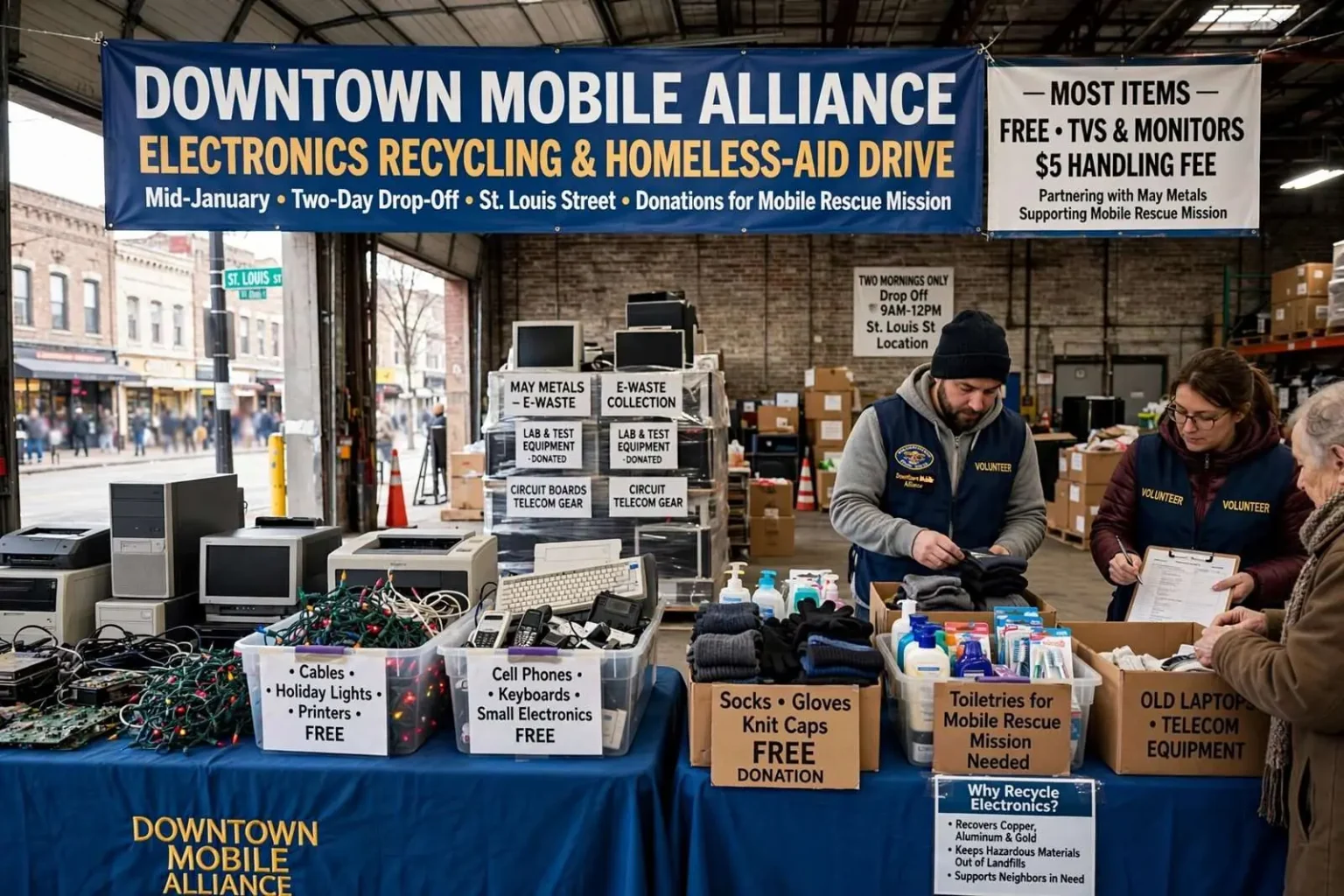
The Downtown Mobile Alliance teamed up with local recycling firm May Metals to host the event at a warehouse on St. Louis Street, welcoming drop-offs over two mornings. The morning-only format concentrated the drop-off traffic into predictable windows and let the warehouse crews sort incoming material as it arrived rather than accumulating a backlog. For downtown workers and residents, the St. Louis Street location put the event within walking distance of much of the central business district.
What could be dropped off
Most items were accepted free of charge, including computer towers, servers, cell phones, printers, scanners, stereo equipment and even old strands of Christmas lights. The breadth of the free list was the point: nearly every household and small office in the district holds obsolete versions of at least one of those items, and the cost of disposing of them properly — rather than tossing them in the trash — has historically discouraged exactly the cleanout the event invited.
Only televisions and computer monitors carried a small handling fee, reflecting the extra cost of recycling glass and hazardous components found in older screens. Cathode-ray-tube displays contain leaded glass and internal components that require specialized disassembly, and flat-panel screens carry their own processing complications. Charging a modest fee on those items alone kept the rest of the drive free while covering the genuine expense of handling the most difficult equipment responsibly.
The list of accepted materials was extensive, covering everything from laminating machines and fax machines to lab and test equipment, printed circuit boards and telecommunications gear. The inclusion of lab, test and telecom equipment made the event as much a service to downtown businesses as to households — offices and professional firms regularly retire specialized electronics that have no resale market and no easy disposal route, and a drive that accepts them gives commercial tenants a reason to finally clear their storage rooms.
Organizers said the goal was to give downtown residents and business owners an easy, responsible way to dispose of electronics that would otherwise end up in landfills. Electronic waste is among the fastest-growing municipal waste streams, and discarded devices carry both recoverable metals — copper, aluminum, gold-bearing circuitry — and toxic components that leach into soil and groundwater when buried. Recycling channels those materials back into the supply chain and keeps the hazards out of the ground.
A drive with a second purpose
Alongside the e-waste collection, the Alliance used the event to gather donations for the Mobile Rescue Mission, which provides shelter and services to people experiencing homelessness in the area. The pairing turned a disposal errand into a charitable stop, and the Mission’s needs list gave donors a specific, practical target rather than a vague call for goods. The Mission, a downtown institution, serves men, women and families year-round, and winter months strain its supplies at exactly the moment cold weather raises the stakes for those on the street.
Volunteers asked attendees to consider bringing practical winter necessities such as socks, gloves, knit caps, sweatshirts, toiletries and grooming supplies like razors and combs. The list skews toward the unglamorous items shelters burn through fastest — clean socks and personal care supplies rarely arrive in donation bins in the quantities shelters actually need, while colder months make them urgent. Volunteers at the drive accepted those goods at the same door that took the old computers, which is what made the combination work.
Pairing an electronics recycling event with a charitable donation drive reflects a growing trend among downtown business and civic groups to combine environmental stewardship with direct community support. The logic is practical as much as idealistic: each cause on its own asks residents to make a separate trip, while a combined event doubles the return on one errand. Downtown organizations that have adopted the model report it broadens participation beyond the audience any single appeal would reach.
For many households, January is a natural time to clear out clutter left over from the holidays, and organizers hoped the timing would encourage broader participation. New devices received as gifts make old ones disposable by definition, and the year’s turning point prompts the cleanouts that other seasons defer. Placing the drive in mid-January caught both impulses — the post-holiday purge and the New Year’s instinct toward order — at their peak.
A recurring fixture downtown
The Downtown Mobile Alliance has organized similar collection events in the past, working with area businesses to keep electronic waste out of local landfills while supporting nonprofit partners. The Alliance, which represents downtown property owners and businesses and manages the district’s promotion and beautification, treats drives of this kind as part of its core mission — the kind of event that serves members and the broader public alike while reinforcing downtown Mobile’s identity as a walkable, civically engaged neighborhood.
Community members interested in future recycling or donation drives are encouraged to watch for updates from downtown civic organizations, which frequently partner with local nonprofits on seasonal collection events. The pattern has become familiar enough that many residents now hold their retired electronics until the next drive rather than discarding them, a habit that quietly multiplies the impact of each event.
Events like this one highlight the ongoing partnership between Mobile’s downtown business community and organizations serving vulnerable residents, an effort that has become a regular feature of the area’s civic calendar in recent years. A recycling firm donates its expertise, a warehouse donates its floor space, a business association donates its organizing reach, and a shelter receives the winter supplies it needs most — a chain of cooperation that costs no single participant much and adds up to a working piece of the city’s social infrastructure.
The mid-January drive also illustrates how the district’s organizations divide the civic labor. The city and county operate the region’s formal waste and social services; what events like this add is flexibility — the ability to convene a two-day collection, rally volunteers and target a specific need without a bureaucratic lead time. For downtown Mobile, that agility has become part of how the neighborhood solves small problems before they become large ones.
By the time the two mornings ended, the St. Louis Street warehouse had collected the district’s retired electronics for responsible recycling and a stack of winter supplies bound for the Mobile Rescue Mission — and downtown residents had been reminded, once again, that clearing out a closet in January can do double duty. The Alliance’s organizers say the drive will return; the community, they note, has never needed much persuading.
The handling fee on screens deserves a note of its own, because it reflects a national problem local drives have learned to manage. Televisions are the item most often abandoned on curbs and in dumpsters, precisely because their disposal costs money, and the leaded glass inside an older set is the most hazardous material a household electronics cleanout produces. By pricing screens honestly — a few dollars to cover real processing costs — the drive kept the fee from becoming a deterrent while ensuring the region’s most troublesome e-waste reached a facility equipped to handle it.
May Metals’ role in the event reflects the quiet economics of responsible recycling. Firms like it recover value from discarded electronics — stripping copper from wiring, sorting aluminum, harvesting circuit boards for precious-metal reclamation — and that recovered value subsidizes the collection side of the operation. When a civic group supplies the venue and the volunteers, and the recycler supplies the processing, the resulting drive can accept most items free while still putting every load of material through the channels regulations require.
The Mobile Rescue Mission’s place at the center of the drive’s charitable half was no accident of geography. The Mission operates in the downtown area, close enough that the organizations’ work overlaps daily, and winter is its season of greatest strain — when cold nights fill beds and deplete the supply closet fastest. Donation drives timed to January land exactly when the pantry and the clothing shelves are thinnest, which is why volunteers steered donors toward socks and cold-weather gear rather than the canned goods most drives default to.
The Alliance’s member businesses had a stake in the event beyond goodwill. Downtown commercial tenants generate their share of e-waste — upgraded office equipment, retired telecom hardware, obsolete printers — and disposal through ordinary channels is costly and complicated for small offices. A drive in the district, organized by their own association, converted a lingering business problem into a community event, and gave the same firms a visible way to support the shelter down the street.
That is the quiet formula behind events like this one: a civic association’s convening power, a business’s technical capacity, a nonprofit’s list of real needs, and a public ready to clear out its closets once a year. Each drive that works makes the next one easier to organize — and in downtown Mobile, the mid-January collection has become one of those traditions the calendar now quietly expects.