Baldwin County school officials are moving into a new stage of a countywide effort to clear away aging, unused campus buildings, with the next round of demolitions set to take place in Fairhope.
The cleanup follows a similar project completed in Bay Minette, where the city covered the cost of tearing down several outdated structures at the old Baldwin County High School site, including the former Ertzinger house, a home economics and agriculture building, and an old classroom wing along East Fifth Street. That project demonstrated the model: a municipality absorbs the demolition cost for vacant school property, and the district gains cleared, safer land it can eventually put back to use.
In Fairhope, crews are expected to take down the former Fairhope Alternative School building along with six cottages that once served the old Fairhope Intermediate School. School system spokesman Terry Wilhite said the structures have deteriorated to the point of becoming eyesores and, in some cases, safety hazards. No final decision has been made on how the cleared sites will eventually be used, he said.
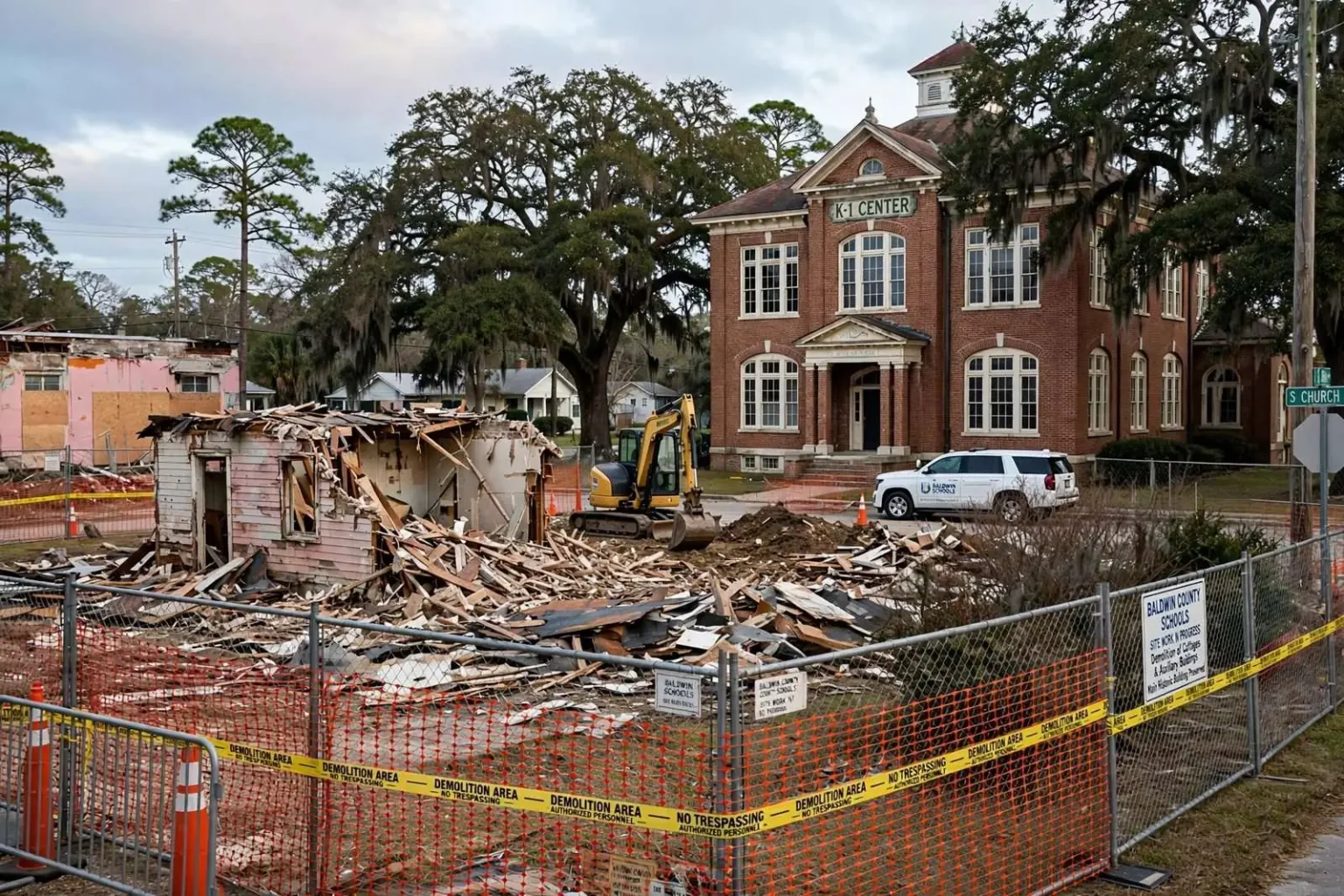
The demolition list also includes several buildings at the shuttered K-1 Center on South Church Street, which has sat empty since it closed in 2011. Crews plan to remove a group of cottages, a pink-colored building and the old cafeteria there. The center’s main historic school building and the Pelican’s Nest Science Center, however, will be spared and remain standing, a distinction that reflects both the building’s condition and its standing in a community that pays close attention to its historic structures.
Fairhope’s identity is bound up with its built history. The city was founded as a single-tax colony more than a century ago and has long treated its older buildings as part of its character, which makes every demolition decision on a Fairhope campus a matter of public interest. The district’s decision to preserve the main K-1 Center building while clearing the surrounding outbuildings threads that needle: removing the hazards without erasing the structure the community knows.
The tax vote that shapes everything
The timing of the demolitions lines up with a broader financial decision facing Baldwin County voters. Residents were scheduled to weigh in on March 31 on a proposed 8-mill property tax increase intended to fund a 10-year, $350 million capital improvement plan for the school system.
The capital plan behind the tax request was built from a system-wide inventory of needs across one of Alabama’s fastest-growing counties. Baldwin County’s student population has expanded along with its residential boom, from the beach communities on the south end to the growing suburbs of the east shore, and campuses built for a smaller county now serve thousands more students than they were designed for.
Renovating and reopening the K-1 Center for pre-kindergarten, kindergarten and first-grade students ranks among the top priorities in that plan, along with construction of a new Bay Minette Elementary School serving grades K-6. Those two projects bracket the county’s geography, one on each side of the bay, and both involve the same sites where demolition work is now underway.
Wilhite said clearing older, unused buildings ahead of time is a practical way to hold down future construction costs. He pointed to the district’s recent experience building the new Foley Elementary School, where enough open space existed on the property to construct the new building while students continued attending classes in the old one, avoiding the need for temporary relocation.
That Foley arrangement, building beside an operating school, was possible only because the campus had room to spare. Applying the same approach at other sites, he said, depends in part on getting old structures out of the way well before new construction begins. Demolition first is cheaper than the alternatives: temporary portable classrooms, split schedules or leased space while a new building rises where the old one still stands.
The sequencing also explains why the district is acting before the tax vote rather than after. Whatever the outcome on March 31, the demolished buildings are not coming back, and cleared sites make any future plan, district-funded or tax-funded, simpler and faster to execute. A property with unsafe vacant structures on it is a liability in every scenario; the same property with a clean pad is an asset waiting for a decision.
What the K-1 Center has been since 2011
The K-1 Center’s decade of vacancy has made it a familiar landmark and a familiar frustration for Fairhope residents. A school building that closed in 2011 has stood through more than ten years of the city’s growth, watching the population around South Church Street expand while the campus itself waited. The Pelican’s Nest Science Center, which will remain, gives the site a living educational purpose even while the main building sits empty.
Reopening the center for pre-kindergarten, kindergarten and first-grade students would answer two pressures at once. Early-grade capacity is scarce in fast-growing Baldwin County communities, and concentrating the youngest students in a dedicated building matches the school-within-a-school model many growing districts use. A reopened K-1 Center would relieve crowding at existing Fairhope elementaries while putting a sound historic building back into daily use.
The cottages and auxiliary buildings that once served Fairhope Intermediate tell the story of an older era of school construction, when campuses grew by adding small buildings rather than wings. Those structures age differently from main buildings, with more rooflines, more exterior walls and more places for water intrusion and decay, which is why districts often find their auxiliary buildings fail first.
What the tax vote means for the timeline
The March 31 vote on the 8-mill increase is the hinge on which the county’s capital plans turn. An 8-mill increase on property taxes, about $8 per year per $1,000 of assessed property value, is the funding mechanism for the $350 million plan, and without it the district would face the same inventory of needs with a much smaller budget. School tax votes in Baldwin County have historically drawn heavy attention, because property owners across the county’s diverse communities share the cost and the benefit.
The county’s growth cuts both ways in that debate. Rapid residential growth is what creates the need for new schools, new Bay Minette Elementary among them, and growth also enlarges the tax base that would pay for them. A district that can show cleared sites, prioritized projects and a specific 10-year plan makes a more concrete case to voters than one asking for money with details to be determined later.
For Fairhope residents who have watched the K-1 Center and the old alternative school sit vacant for years, the demolition work marks a visible step toward whatever comes next for those properties. Concrete crews, fencing and rubble are an unglamorous sign of progress, but they are proof that the district’s capital process has moved from study to action on specific Fairhope sites.
The demolition work also carries an immediate safety dividend. Vacant buildings attract trespass, and deteriorated structures on a school campus pose liabilities the district does not want to carry through another decade. Taking them down now, before any construction decision, removes the hazard while the funding question is decided.
The Bay Minette precedent deserves a closer look because it shows the financial logic of the whole effort. The old Baldwin County High School structures, the Ertzinger house, the home economics and agriculture building and the East Fifth Street classroom wing, had outlived every educational purpose they once served. When the city agreed to cover the demolition cost, the district recovered usable land without spending its own capital budget, and the community removed structures that had become hazards on a visible corner of the city. Both sides gave up something small and gained something larger, which is exactly the kind of arrangement a county with more needs than revenue looks for.
Baldwin County’s approach, clearing first, voting second, building third, reflects lessons learned from the Foley Elementary project and from the Bay Minette demolition partnership with the city. Each step has produced a precedent the next step relies on: the city of Bay Minette showed how municipal cooperation can clear a site, Foley showed how new construction can coexist with a working campus, and the Fairhope demolitions apply both lessons to a site where the district’s top-priority renovation project is waiting on the tax vote.
Whatever Fairhope residents see on those cleared sites in the years ahead, the district’s stated priorities give a strong indication. The K-1 Center’s main building, spared by this demolition round and ranked among the top projects in the capital plan, is positioned to become an early-grades campus again, surrounded by new construction rather than decaying outbuildings. The March 31 vote determines whether that plan proceeds on the county’s preferred schedule, but the groundwork, literally, is being laid now.