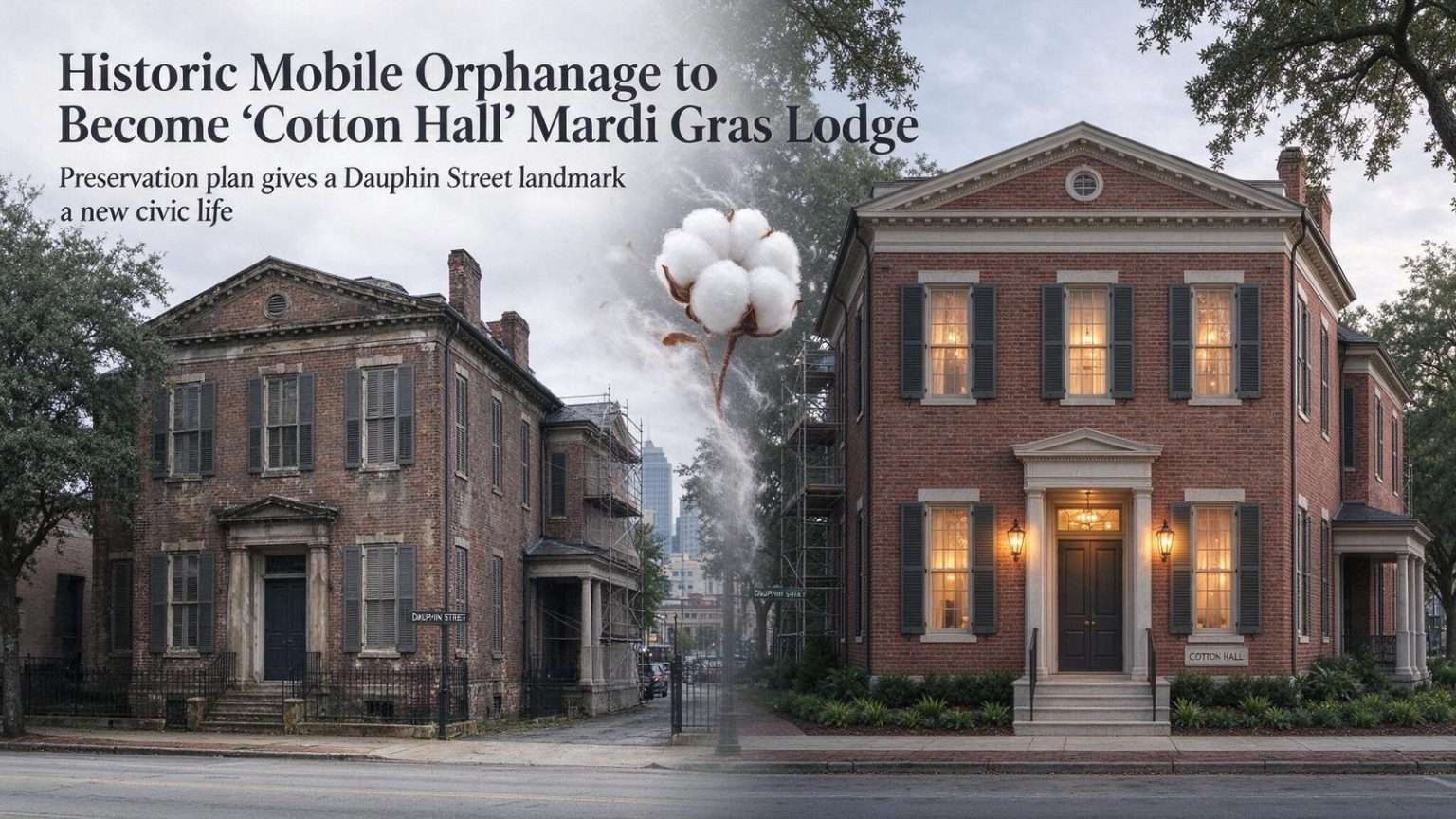
One of Mobile’s oldest Mardi Gras organizations has ambitious plans for one of the city’s most historic buildings. The 1845 Protestant Children’s Home near downtown Mobile is set for a multimillion-dollar restoration that will transform the former orphanage into a private meeting lodge, giving the building a new lease on life after years of sitting vacant and returning an irreplaceable piece of the city’s architectural heritage to active use.
The 2.4-acre property at 911 Dauphin Street, near the Broad Street intersection, is owned by the nonprofit Historic Restoration Society, led by David J. Cooper Sr., a former president of the Mobile Carnival Association. The society purchased the site for $440,000 and has begun a roughly $3 million restoration of the main building and a second wing added in 1950 — a substantial investment for a structure that has been out of service and deteriorating in recent years.
A new home for the Infant Mystics
Once complete, the property will be leased to the Infant Mystics, a Mardi Gras society founded in 1867, and renamed “Cotton Hall” in a nod to the group’s founders, many of whom worked as cotton merchants, traders, bankers and clerks during a time when the cotton trade was a driving force in Mobile’s economy. The name ties the lodge directly to the commodity that built much of downtown Mobile, and it signals the society’s intention to honor its mercantile roots even as it moves into quarters of its own.
Mystic societies across Mobile have long maintained lodges and halls where they hold meetings, costume reveals, balls and the behind-the-scenes work that precedes the Carnival season. For an organization dating to the years just after the Civil War, a dedicated hall in a landmark building represents both a practical headquarters and a statement about the society’s staying power.
Jay Roberds of NAI Mobile, who is coordinating the restoration, called the property one of the city’s last sizable historic buildings still available for renovation — a reflection of how few large 19th-century structures in Mobile remain unclaimed by preservationists, developers and institutional owners.
A building born of tragedy
The original structure carries a story that predates Mardi Gras lodges by decades. Designed by Philadelphia architect Henry Moffatt and built for about $4,000, the three-story structure originally housed 17 orphans when it opened in response to the large number of children left parentless after Mobile’s 1839 yellow fever epidemic. Outbreaks of yellow fever swept the Gulf Coast repeatedly through the 19th century, and Mobile — a port city connected to New Orleans and the tropics by shipping routes — suffered some of the region’s worst seasons, with epidemics frequently leaving dozens of children without parents in a single summer.
The Protestant Orphan Asylum Society, founded in 1840 by women from several downtown churches, ran the home for well over a century. Such asylums, organized and financed largely by churchwomen’s groups, were the backbone of child welfare in Southern cities before the era of public social services, and the Mobile society’s longevity made the Dauphin Street building one of the city’s most continuously used charitable institutions.
The building operated as an orphanage until 1970, when the Alabama Baptist Children’s Home assumed management and relocated children to a new campus in west Mobile, ending more than 120 years of continuous service on the site and beginning the building’s long second act — and its slow decline.
Life inside the home
Leo Straughn, who lived at the home in the 1960s and 70s after his parents divorced, recalled around 80 children living there when he arrived with his siblings in 1963. He described dormitory-style rooms housing 15 to 20 children each, heart-pine floors, and a strict daily routine that included supervised study halls and long walks to school on Dauphin Street — a way of life that former residents remember with a mixture of hardship and affection.
Orphanage life at mid-century followed rhythms that have largely disappeared from American childhood. Meals, schoolwork and chores were scheduled and supervised; older children looked after younger ones; and the institutional family of the dormitory substituted, however imperfectly, for the households the children had lost. Former residents of the Protestant Children’s Home have preserved those memories through decades of change, and their recollections are part of what restoration advocates say makes the building worth saving — it is one of the few places in Mobile where that era of institutional childcare still has a physical address.
Many lives of a landmark
Since its orphanage days ended, the building has passed through several uses. It became home to Mobile City College in the 1970s after being added to the National Register of Historic Places in 1973, then Mobile Business College in 1985, followed by office space for the Mobile County Department of Human Resources beginning in 1991. Its second wing served briefly as a nursing home before the property later housed international workers training with the Retirement Systems of Alabama. In recent years it has sat vacant.
That procession of tenants — school, college, government office, care facility, training center — is a familiar biography for large historic buildings, and each adaptation left its mark on the structure. The restoration will have to reconcile those decades of alterations with the original 1845 fabric, a challenge that drives much of the $3 million price tag and that experienced preservation contractors in Mobile know well.
The National Register listing in 1973 placed the home among the officially recognized landmarks of the city, and the status carries weight in any restoration effort, both as a formal acknowledgment of significance and as a discipline on the kinds of changes the property can undergo.
A lift for the neighborhood
Cooper said the restoration will benefit more than just the Infant Mystics, describing it as a chance to create an attractive landmark in a once-neglected part of downtown. The Dauphin Street corridor west of Broad Street has seen years of disinvestment, and civic leaders have repeatedly pointed to anchor projects — churches, schools, businesses and restored landmarks — as the kind of investment that pulls a neighborhood back from decline.
Other Mobile Carnival Association societies will be able to rent Cotton Hall for weddings, birthday parties and fundraising events once work is finished, making the lodge a piece of shared civic infrastructure rather than a purely private clubhouse. Event rental income is also a practical matter for historic buildings, whose upkeep demands a revenue stream that a once-a-year society can rarely generate on its own.
Neighboring business owners have welcomed the project. “It’s going to be great for the area,” said Taylor Atchison, co-owner of a furniture and interior design business next door. “You never know what can happen to a big property like that; it can really define a neighborhood.”
Atchison’s optimism reflects what small business owners along the corridor have watched happen elsewhere in the city: a major property coming back to life changes the calculations of everyone nearby. Contractors and craftspeople spend months on site, society members and guests arrive year-round rather than only in Carnival season, and the simple fact of a lit, maintained, occupied building at a prominent corner alters how a block is perceived at night and on weekends.
What the project represents
The Cotton Hall plan sits at the intersection of two Mobile traditions: historic preservation and Carnival. The city’s mystic societies, some older than the state’s major institutions, have survived wars, depressions and demographic change, and their fortunes have always tracked the health of the city itself. Giving a society founded in 1867 a permanent hall in a building from 1845 binds those histories together in a single address.
It also reflects a wider pattern in Gulf Coast cities, where Mardi Gras organizations have stepped in as stewards of historic properties that government and the private market could not save. Restored lodge halls and krewe headquarters in Mobile and New Orleans alike have proven that the organizations built around Carnival can be durable custodians of architectural heritage, with the resources and motivation to maintain buildings that might otherwise slip toward demolition.
For the Historic Restoration Society, the project is the largest test yet of that model in Mobile. The purchase price, the scale of the restoration and the condition of a building that has been vacant in recent years all add risk, but the alternative for the Protestant Children’s Home was continued deterioration of one of the last sizable historic structures available for renovation in the city.
When the scaffolding comes down and Cotton Hall opens, the building will have completed a journey from orphanage to college to government office to Carnival lodge — a sequence of second lives that few structures manage. The 17 orphans of 1845, the 80 children of the 1960s, and the generations of Mobilians who passed through its classrooms and offices will share a building address with the Infant Mystics and their guests. On Dauphin Street, where the city’s history has always lived close to the surface, that may be the most Mobile outcome imaginable.