Theodore Man With Prior Manslaughter Conviction Arrested in Drug Raid
A Theodore man previously convicted of manslaughter faces new trafficking charges after a search warrant turned up drugs, cash, a gun and vehicles.
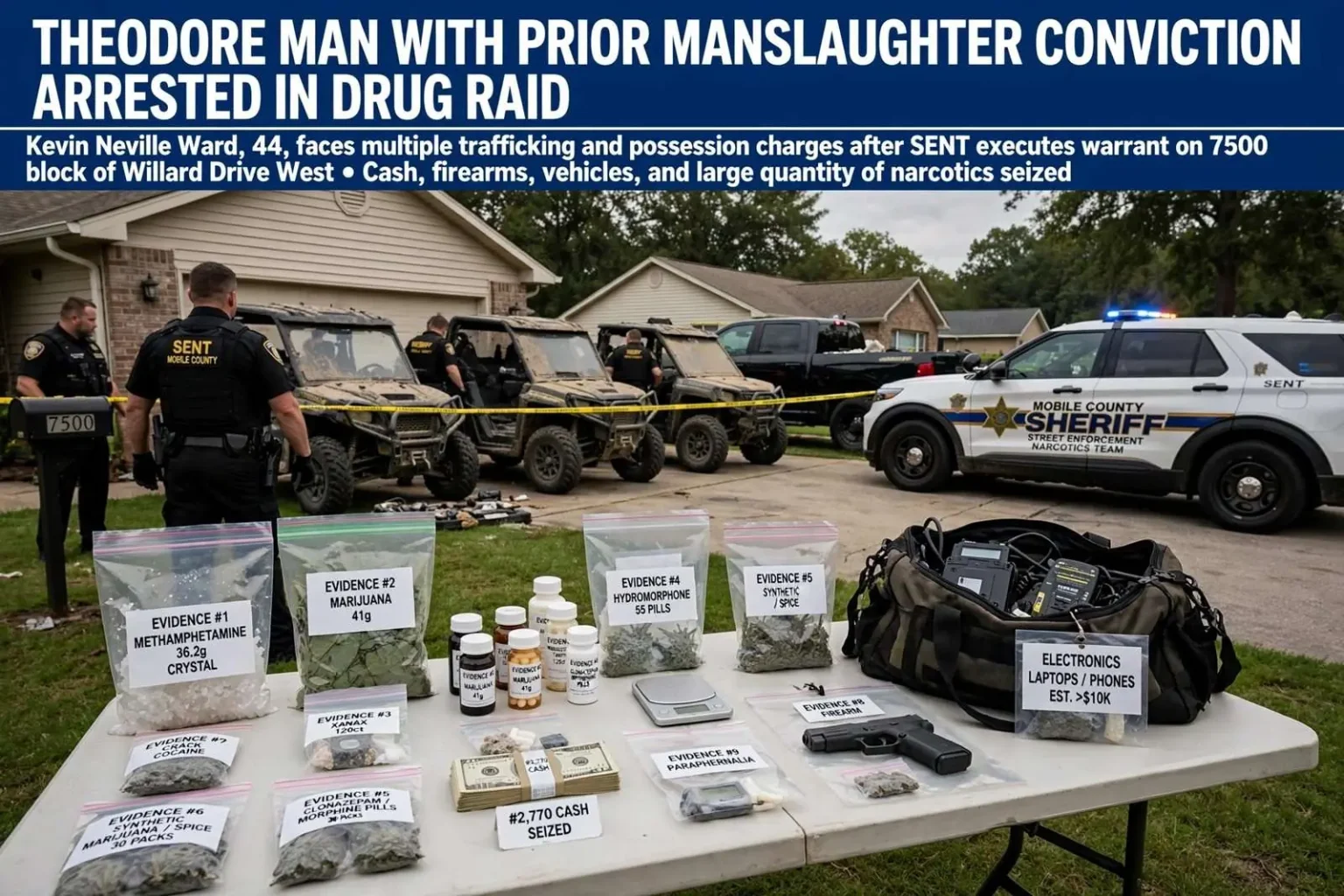
A Theodore man with a decades-old manslaughter conviction is facing new felony charges after investigators with the Mobile County Street Enforcement Narcotics Team executed a search warrant at a home in the community and recovered a large quantity of drugs, cash and property.
Kevin Neville Ward, 44, was arrested on charges including trafficking methamphetamine, trafficking a marijuana analog, first-degree possession of marijuana, possession of a controlled substance and possession of drug paraphernalia, according to the Mobile Police Department. The range of counts filed against him spans several categories of Alabama drug law, from trafficking offenses that carry mandatory minimum sentences to possession charges that reflect the variety of substances recovered from the home.
The search took place on the 7500 block of Willard Drive West, an address jail records list as Ward’s home. Investigators obtained the warrant after a period of work on the address, and the execution of the search brought investigators from the multi-agency narcotics unit to the Theodore neighborhood where the home sits among the residential streets of the community.
A long list of what deputies found
Detectives reported seizing a wide range of narcotics during the search, including more than 36 grams of crystal methamphetamine, roughly 41 grams of marijuana, more than 120 Xanax tablets, 55 Hydromorphone pills, and additional quantities of Morphine and Clonazepam. The assortment of substances recovered during a single search is notable even by the standards of large drug seizures, spanning stimulants, opioids, benzodiazepines and marijuana products.
Investigators also recovered more than 30 packs of synthetic marijuana, commonly known as spice, along with a smaller amount of crack cocaine. Synthetic marijuana products have been a recurring concern for law enforcement across Alabama because their chemical composition varies from batch to batch, producing unpredictable and sometimes dangerous reactions in users and complicating the work of emergency responders who treat overdoses.
Beyond the drugs themselves, officers reported taking $2,770 in cash, a firearm, a pickup truck, three all-terrain vehicles and more than $10,000 worth of additional electronics and property from the home. Asset seizures of that scope reflect the state’s civil and criminal forfeiture framework, under which property connected to drug activity can be taken by investigators, and they add a financial dimension to the case that extends beyond the criminal charges alone.
The firearm recovered during the search adds another layer to the investigation, since weapons found in close proximity to drug quantities are treated as aggravating factors by prosecutors and can influence both charging decisions and bond considerations in the aftermath of an arrest.
Search warrants of this scale involve extensive preparation before officers ever approach the door. Investigators document the address, coordinate the agencies involved, and plan for the handling of evidence ranging from bulk narcotics to firearms and vehicles, all of which must be inventoried, photographed and logged in the hours after a search concludes.
Why the charges rise to the trafficking level
The scope of the seizure points to an operation investigators viewed as more than incidental possession, which is reflected in the trafficking-level charges filed against Ward. Alabama’s trafficking statutes turn on quantity thresholds, and crossing them transforms a case from a possession matter into a trafficking prosecution with far more serious potential penalties.
Trafficking methamphetamine in Alabama carries some of the stiffest penalties in the state’s drug laws, with mandatory minimum prison terms that increase with the weight of the substance involved. The quantities documented in the warrant return in this case placed the allegations squarely in trafficking territory, according to the charges listed in court records.
The marijuana analog trafficking charge reflects the state’s approach to synthetic and chemically altered substances, which prosecutors pursue under analog statutes designed to keep pace with compounds engineered to skirt the chemical definitions of controlled substances. Those cases often hinge on laboratory analysis of the seized material, which becomes a key piece of evidence as the case moves forward.
Prosecutors will also weigh the cash, property and paraphernalia recovered at the home as they build the case, since packaging materials, scales and distribution records are among the indicators that separate a distribution operation from personal use. The listing of first-degree possession of marijuana alongside the trafficking counts suggests the quantities and circumstances were evaluated under multiple theories of the law.
A decades-old conviction resurfaces
Court records show Ward was charged with murder in 1990 and was convicted of manslaughter later that year, though no additional details from that decades-old case were immediately available. A prior felony conviction carries significant consequences in a new drug case, both at sentencing, where criminal history factors into the range of punishment, and in other areas of the law that treat repeat offenders differently from first-time defendants.
He remained in custody following Friday’s arrest. Bond in trafficking cases involving quantities of this size is typically set high, and defendants with prior felony records frequently face longer stays in custody as their cases move through the court system.
The reappearance in court records of a case from 1990 illustrates how far back the paper trail stretches in Alabama’s criminal justice system. County court records survive for decades, and prosecutors routinely pull a defendant’s full history when new felony charges are filed, both to inform charging decisions and to prepare for the sentencing phase if convictions are entered.
Xanax and the other prescription medications recovered at the home add a pharmaceutical dimension to the case, since diversion of legitimate medications into the illegal market remains one of the more persistent components of drug enforcement in Alabama. Pills recovered in bulk without corresponding prescriptions typically form the basis of separate possession and distribution counts.
Hydromorphone and Morphine are powerful opioids used medically for severe pain, and their presence alongside street drugs is an indicator investigators weigh heavily, because opioid diversion carries obvious overdose risks in the community where the substances are being sold.
SENT’s role in Mobile County drug enforcement
The Mobile County Street Enforcement Narcotics Team, a multi-agency unit that targets drug distribution operations across the county, has been active in recent years in communities including Theodore, where investigators say narcotics activity has periodically drawn law enforcement attention. The unit draws personnel from departments across the county, allowing it to pool resources and coordinate investigations that cross municipal boundary lines.
Narcotics task forces like SENT work cases that individual departments often lack the manpower to sustain, running surveillance over weeks and months, managing informants, and building the probable cause needed to obtain search warrants. That model has become standard across Alabama, where smaller municipal departments partner with county and state agencies to address drug distribution that no single agency could tackle alone.
Theodore, an unincorporated community southwest of Mobile, has seen its share of drug enforcement activity over the years as investigators have targeted distribution operations in residential neighborhoods. Cases that begin with community complaints often end with search warrants like the one executed on Willard Drive West, and the Mobile County Sheriff’s Office and Mobile Police Department both feed cases into the multi-agency unit’s pipeline.
The volume and variety of drugs seized in the search underscore the range of substances moving through Gulf Coast communities, where investigators have documented everything from methamphetamine and prescription opioids to synthetic products sold under street names. Each category requires different handling, different laboratory work and different charging analysis, which is part of what makes large seizures so labor-intensive for the agencies that process them.
What happens next
Ward’s case will move through the Mobile County court system, where trafficking cases are prosecuted in circuit court after grand jury review. The disposition of the seized property, including the vehicles, cash and electronics taken during the search, will be resolved through separate proceedings that run alongside the criminal case.
Investigators have not indicated whether additional arrests are anticipated in connection with the search, and the case file will grow in the coming weeks as laboratory results, inventory records and warrant affidavits are added to the record. For the neighborhood where the search took place, the execution of the warrant marked the visible end of an investigation that had been underway long before officers arrived at the door.
The multi-agency structure also gives investigators access to federal partners when cases cross thresholds that justify parallel prosecution, such as large quantities combined with firearms. Whether this case remains in state court or draws federal interest will depend on how the evidence is ultimately assessed by prosecutors in the weeks after an arrest.
Residents of communities like Theodore often provide the initial tips that set these investigations in motion, reporting traffic patterns, odors and activity around a home that seem out of place. Investigators credit those community reports with helping them focus resources on the addresses where enforcement makes the most difference, and the end of a case like this one typically returns the focus to the neighborhood that first raised the alarm.
The seizure of three all-terrain vehicles alongside a pickup truck and thousands of dollars in electronics illustrates how thoroughly investigators document a property once a warrant is executed. Every item with potential value becomes part of the inventory, both as potential evidence and as property subject to forfeiture proceedings that can return proceeds to the law enforcement agencies that conducted the investigation.