Mobile Drug Raid Nets Cash, 8 Pounds of Marijuana and Weapon
A Mobile drug raid on Amsterdam Street turned up cash, eight pounds of marijuana and a gun, leading to a man's arrest on trafficking charges.
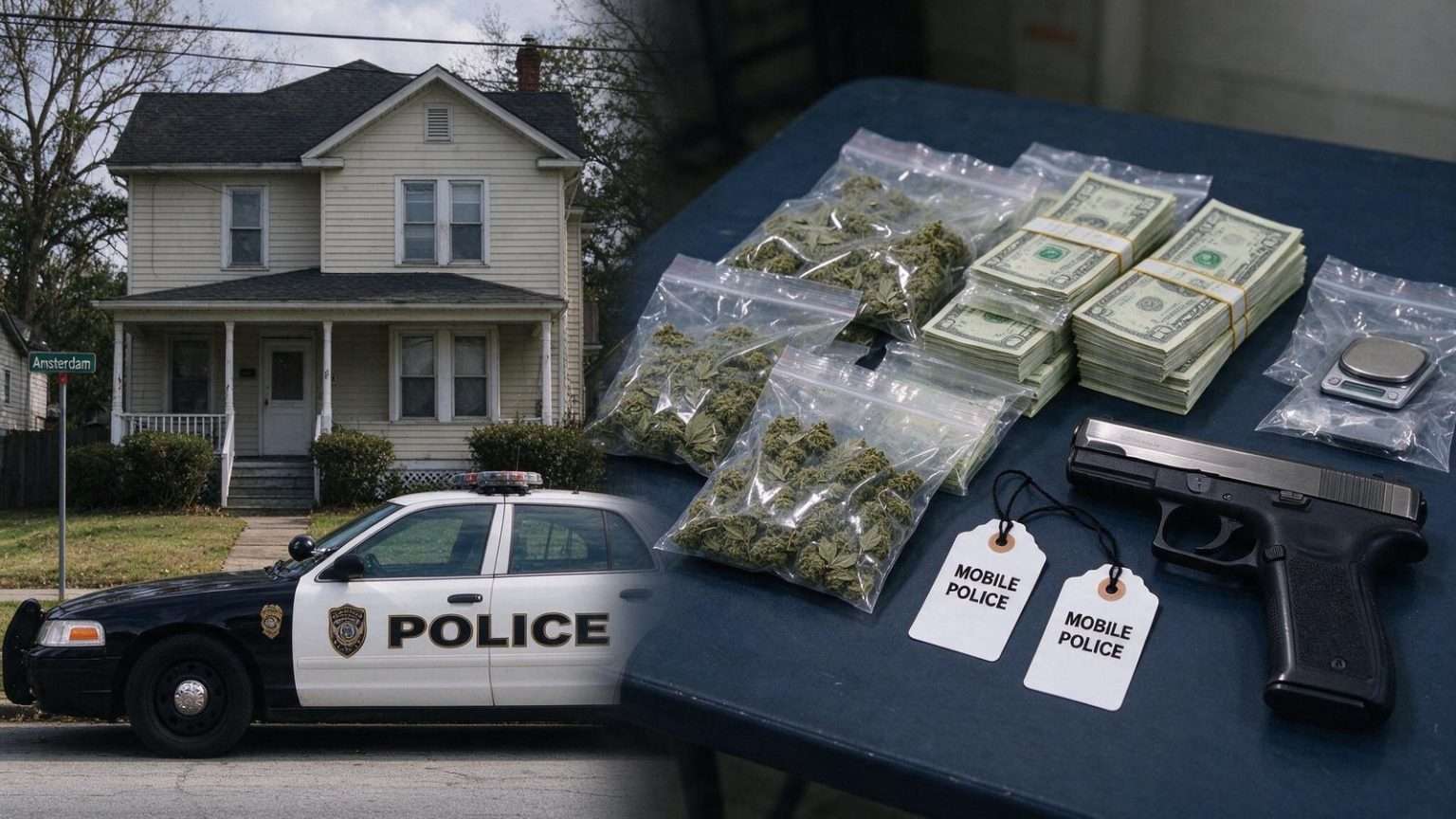
A search warrant executed at a home on Amsterdam Street in Mobile turned up thousands of dollars in cash, eight pounds of marijuana, a pistol and a vehicle, according to Mobile police, resulting in the arrest of a 68-year-old man on multiple drug trafficking charges.
Officers with the Mobile County Street Enforcement Narcotics Team carried out the raid earlier this week, recovering more than $2,000 in cash along with the marijuana and firearm. A Mobile Police Department spokeswoman said the seizure was substantial enough to support multiple felony charges against the resident of the home.
Leslie Davis, 68, was arrested and charged with trafficking marijuana, first-degree possession of marijuana, and two counts each of unlawful distribution of marijuana and possession of drug paraphernalia, according to records from the Mobile County Metro Jail. He remained in custody as of the following morning.
The combination of charges is what prosecutors call a trafficking case structure: possession on its own supports one set of penalties, but weight above the statutory threshold triggers the trafficking statute, and evidence of distribution — packaging, scales, cash, customer traffic — adds counts that each carry their own exposure. The pistol found at the home compounds the picture, because Alabama law treats a firearm in connection with drug offenses as an aggravating factor that prosecutors routinely highlight at sentencing.
A Long Record Behind the New Charges
Court records show Davis has a criminal history dating back more than two decades. Mobile County sheriff’s deputies arrested him on a marijuana possession charge in 1992, and he pleaded guilty in 1993, receiving two years of probation with a suspended one-year jail sentence. In 2000, he pleaded guilty to a separate first-degree marijuana charge and was sentenced to 10 years. Records show he had not faced arrest again until this latest case.
That history will matter in the case ahead. Alabama’s sentencing framework allows prior felony convictions to enhance the range a defendant faces, and a prosecutor presenting a trafficking case to a grand jury will file the defendant’s record alongside the evidence from the raid. A defendant with two prior marijuana convictions from the 1990s and 2000s faces a very different conversation with a judge than a first-time offender charged with the same conduct.
The 10-year sentence from the 2000 case also illustrates how the state’s marijuana penalties have hardened over the years. First-degree possession — the felony tier reserved for larger quantities — drew a decade in that case. Twenty years later, the same defendant is charged under the trafficking statute, which carries mandatory minimum prison terms and hefty fines that judges cannot reduce below the floor the Legislature set.
How the Search Warrant Came Together
Search warrants in narcotics cases are built over weeks, not hours. Investigators document traffic at a residence, interview informants, run criminal histories on the people coming and going, and assemble an affidavit for a judge that ties specific observations to a belief that drugs are being stored or sold inside. Only when a judge signs the warrant can officers enter, and everything recovered — the marijuana, the cash, the pistol, the vehicle — becomes evidence against the person named in the affidavit.
The Street Enforcement Narcotics Team, the specialized Mobile police unit focused on disrupting street-level and mid-level drug distribution across the city, exists for exactly this kind of casework. The unit pulls officers from area agencies, including the Mobile County Sheriff’s Office, and works the neighborhoods where distribution is concentrated, building cases small enough to execute and large enough to matter. Seizures like this one — weight, cash, a firearm and a vehicle in a single warrant — are the unit’s bread and butter.
The vehicle’s place on the seizure list reflects another layer of Alabama drug law. Vehicles used in connection with drug trafficking can be seized, and proceeds of suspected drug activity are subject to forfeiture proceedings that run parallel to the criminal case. For a defendant, the exposure extends beyond prison time to the loss of property the state alleges was involved in or purchased with the proceeds of the trade.
The Law on Marijuana in Alabama
Large seizures like this one, which combined cash, weight of product and a firearm, typically support the more serious trafficking charge under Alabama law, which carries stiffer mandatory penalties than simple possession. Under the state’s trafficking statute, possession of more than roughly two pounds of marijuana triggers a trafficking charge with a mandatory minimum prison sentence and a mandatory fine, and the penalties climb with the weight. Eight pounds sits well above the lowest threshold, and the mandatory structure means a judge has little room to soften the outcome on a conviction.
The distribution and paraphernalia counts work alongside it. Unlawful distribution covers the act of selling or furnishing marijuana, and the two counts alleged here suggest investigators believe sales, not personal use, were happening at the home. Paraphernalia counts are the small change of a narcotics case — the bags, scales and packaging materials that document a distribution operation — but they matter because each count is a separate conviction with its own sentence, and they give prosecutors room to negotiate when a case moves toward resolution.
What the Case Says About the Market
The size of the seizure is worth reading closely. Eight pounds is not an industrial quantity — multi-hundred-pound cases move through the region’s federal courts — but it is far beyond personal use, and it marks the mid-level of the market: product arriving from larger suppliers, broken down and moved in smaller amounts to street-level sellers. Cash of just over $2,000 alongside that weight suggests either a recent resupply or steady small sales, the kind of operation that rarely makes the news until a warrant turns it up.
Amsterdam Street sits in a residential part of the city, and neighbors in blocks like it usually know more than they say — the traffic pattern, the hours, the cars that cycle through. Narcotics units depend on that knowledge; tips from residents launch a large share of the warrants the team executes. And when the warrant comes, it lands on the whole street: the sirens, the patrol cars, the search that takes hours in plain view of the neighborhood’s front porches.
The defendant’s age is the case’s most striking detail. At 68, Davis is far older than the population that populates most drug dockets, and his two-decade-old record reads like a history of the state’s marijuana laws: a suspended sentence in 1993, a 10-year term in 2000, and silence until this week. Whatever the circumstances of the years between, the record he carries into court now spans an era in which Alabama’s marijuana penalties grew steadily harsher while the country around it moved the other direction.
Police have not indicated whether the investigation that led to the search warrant is connected to any broader narcotics operation in the area, and the department said additional details about the case would be released as it moves through the court system.
What Happens Next
Davis’ case now moves through the Mobile County court system on the track every felony follows: a preliminary appearance, grand jury review of the trafficking evidence, and — if the grand jury indicts — arraignment in circuit court, where the mandatory sentencing structure of the trafficking statute will frame every decision from plea negotiations to trial. Defendants facing mandatory minimums sometimes contest the weight itself, challenging the lab analysis or the search, because the number of pounds is the number of years.
The Metro Jail records will track the case’s progress, and the seized evidence — the marijuana, the cash, the pistol, the vehicle — will sit in evidence storage until the case resolves, one way or another. For the Amsterdam Street block, the warrant that arrived earlier this week closes one chapter in the neighborhood’s long acquaintance with the narcotics trade, and for the Street Enforcement Narcotics Team it is one more entry in a docket that never stays empty long.
The neighborhood dimension of these cases is easy to miss from a charge sheet. Residents on streets like Amsterdam live with the consequences of a drug house long before police arrive — the loitering, the noise, the traffic at odd hours, the sense that a block has been claimed by someone else’s business. City officials hear about it in community meetings, district attorneys rank it among their offices’ most common complaints, and narcotics units prioritize their warrant lists accordingly. A raid like this one is, in that sense, the visible end of a complaint-driven process that started with neighbors’ calls.
It is also worth placing the seizure in its regional context. Mobile sits on the Interstate 10 corridor that runs from the Texas border to the Atlantic coast, a highway that narcotics investigators describe as one of the primary drug movement routes in the Southeast, and the Port of Mobile adds maritime traffic to the picture. Product moving along that corridor feeds markets in every Gulf Coast city, and local units like the Street Enforcement Narcotics Team work the retail end of a supply chain that reaches far beyond the city limits. Eight pounds seized at one house is one node taken out; the value of such seizures, in the unit’s view, is cumulative pressure over hundreds of cases.
For Davis himself, the court process ahead will turn on facts that have not been made public: what the search actually found and where, what the laboratory analysis shows, and how his attorneys read the mandatory minimums against the possibility of a negotiated resolution. What is already public — the weight, the cash, the pistol, the record stretching back to 1992 — is enough to tell the shape of the case. The rest will unfold in a Mobile County courtroom over the months to come, as it has for every defendant who came through the same docket before him.