Fairhope Developer Distributes Communist Manifesto Excerpt at Baldwin Commission Meeting
A Fairhope developer handed out excerpts of the Communist Manifesto during public comment on Baldwin County's contested school tax referendum.
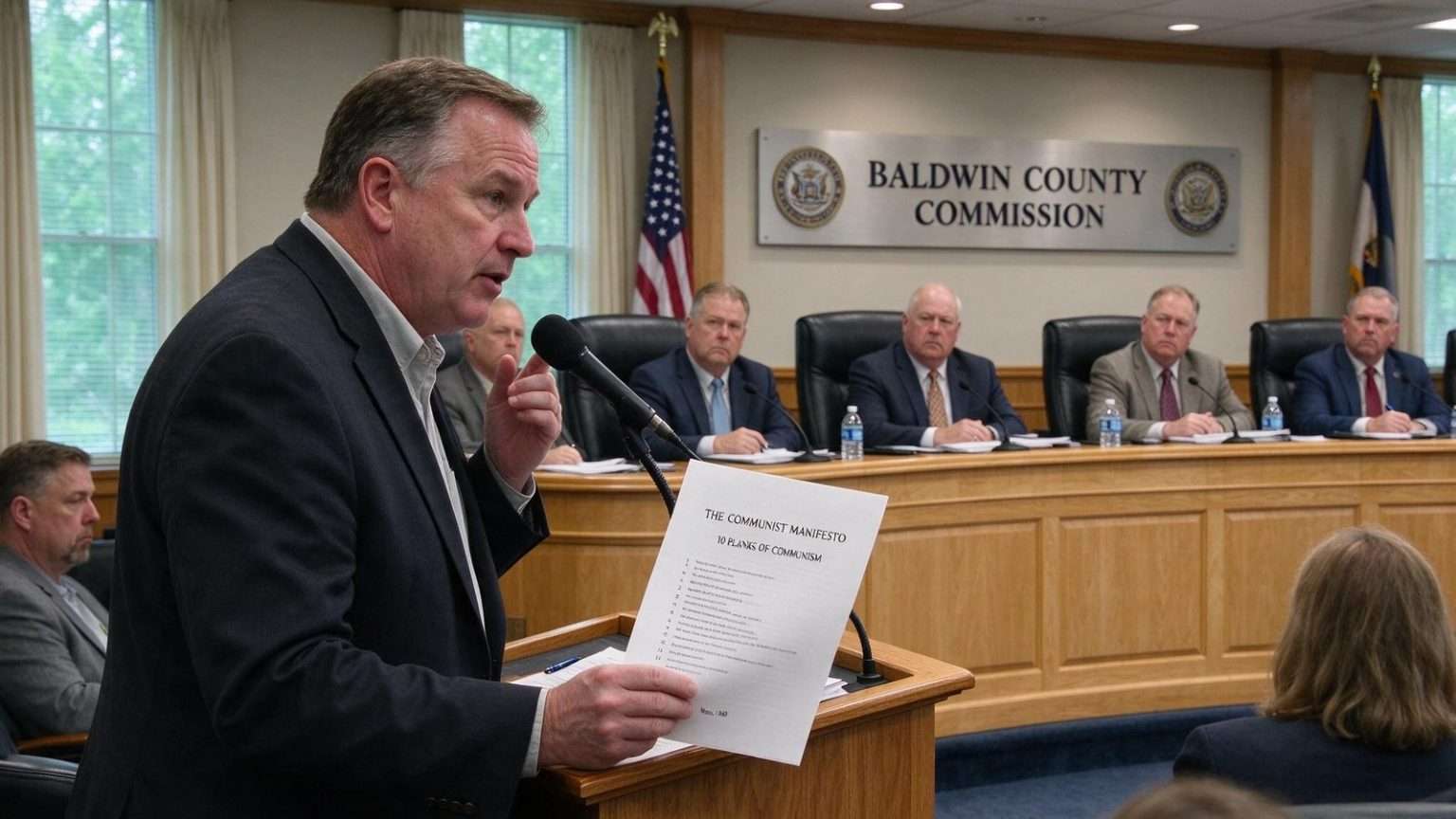
BALDWIN COUNTY — A Fairhope developer known for frequently challenging Baldwin County land-use policy took his opposition to a proposed school tax to an unusual place this week, distributing copies of a 19th-century communist text during public comment at a county commission meeting.
Richard Thompson, a regular presence at Baldwin County Commission meetings and a vocal critic of the county’s planning process, handed commissioners and attendees a single printed page listing the “10 Planks of Communism” drawn from Karl Marx’s Communist Manifesto, published in 1848.
Thompson pointed specifically to the document’s tenth plank, which calls for “free education for all children in government schools,” and suggested a connection between that historical text and Baldwin County’s public school system. “No need to respond,” Thompson told commissioners after distributing the handout, according to those present at the meeting.
The gesture drew little reaction from the dais but underscored the tone of the meeting. Public comment periods at county commission meetings are ordinarily filled with zoning appeals, road complaints and courtesy resolutions; Thompson’s distribution of a page of Marxist political theory — deployed as an argument against a school tax — stood out even by the standards of a unusually contentious election season.
A Referendum Dividing the County
The comparison came amid public comment dominated by opponents of a March 31 referendum asking Baldwin County voters to approve an additional 8-mill property tax to fund school construction, part of a broader $350 million plan to address overcrowding across the fast-growing county.
The referendum had split Baldwin County into committed camps. Supporters pointed to classrooms spilling into portable units, schools operating above design capacity and a student population growing faster than any in Alabama — the product of the county’s rapid residential development along the Eastern Shore, the I-10 corridor and the coast. Opponents countered that the tax burden on property owners, particularly in a county without a large industrial tax base, was too steep and that the district had not made its case that every dollar was needed.
An 8-mill increase is a significant ask in Alabama’s property tax structure, where constitutionally limited millages keep school property taxes among the lowest in the nation. Each mill represents one dollar of tax per thousand dollars of assessed value, and pushing a new countywide millage through a referendum requires a majority of voters in a special election — a high bar that made the weeks before March 31 a season of public forums, social media campaigns and, evidently, theatrical gestures at the county courthouse.
Thompson, who has previously argued that the county should eliminate public input requirements for small subdivisions, described what he called an “800-pound gorilla” of anti-tax sentiment running through Baldwin County politics, linking it to a national pattern of tea party groups tying federal education policy to broader concerns about government overreach.
Thompson’s frequent appearances before the commission have made him one of the county government’s most familiar gadflies. A developer by trade, he has built a reputation for challenging the county’s planning and zoning apparatus in public meetings, arguing that regulatory requirements — from subdivision review procedures to infrastructure mandates — add unnecessary cost and delay to development in one of Alabama’s fastest-growing counties. His positions have put him at odds at various times with county planners, civic groups and municipal officials across Baldwin County.
His decision to invoke the Communist Manifesto placed him squarely within a rhetorical tradition that circulated nationally during the tea party era. Opponents of expanded education spending in several states had made a practice of quoting the manifesto’s tenth plank — part of Marx’s ten-point program for a communist state, which also includes a progressive income tax and the abolition of child factory labor — to argue that public schooling represented an intrusion of state power into family life. The argument has been widely criticized by historians, who note that free public education predated Marx’s manifesto and existed in the United States long before 1848, but it became a recognizable feature of anti-tax politics nonetheless.
School Leaders Push Back
Commissioners did not directly address Thompson’s comments or handout during the meeting. However, school system leaders used the same public forum to push back on criticism that had circulated in the days leading up to the vote. Superintendent Robbie Owen and Chief Financial Officer John Wilson both spoke to provide additional detail on the district’s finances.
In a Facebook post published the same day, Baldwin County School Board President Norm Moore said he believed a small but vocal group of tax opponents had launched a “calculated effort” to undermine confidence in the school system ahead of the vote. “In their desperation, they are spreading lies and untruths about our schools, especially our finances,” Moore wrote, urging residents to keep the focus on the needs of Baldwin County’s students rather than partisan politics.
The decision by Owen and Wilson to appear at the commission meeting reflected the school system’s effort to control the financial argument in the referendum’s final weeks. School construction questions turn on bond capacity, debt service and millage math — details that critics had been citing selectively, in the district’s view — and the superintendent and his finance chief used the public forum to walk through the numbers directly. Moore’s social media post extended that counteroffensive into the evening, meeting the tax opposition on the same digital ground where much of the campaign argument was unfolding.
The exchange illustrated how heated the debate over Baldwin County’s school construction referendum had become in the final weeks before the vote, with both sides accusing the other of distorting the facts as the March 31 election approached.
A County Choosing Between Growth and Taxes
The referendum fight exposed the central tension of Baldwin County’s boom years. The county’s public schools were absorbing thousands of new students a year, driven by the same population growth that filled the subdivisions Thompson’s profession builds — growth that enriches the development community while straining the classrooms its newest residents attend. School leaders argued the $350 million construction plan was simply the price of keeping pace; opponents argued the county’s taxpayers had already done their part through impact on the existing tax base.
Into that argument stepped the county commission — a body with no direct authority over the school referendum, which the school board had called for the March 31 ballot. Commissioners found themselves hosting the debate all the same, as the public comment period of their regular meeting became one of the last open microphones before election day. Thompson’s manifesto handout, the tax opponents’ arguments and the school leaders’ rebuttal all played out in the same room, before an audience of commissioners who could only listen.
The public comment session closed without a vote, a resolution or even a response from the dais — by Thompson’s own instruction, “no need to respond.” But the meeting’s tableau said much about the moment: a developer waving a page of Marx, a superintendent defending a construction budget, a board president accusing his critics of lying, and a county four days from deciding whether its schoolchildren would get $350 million worth of new classrooms.
The 8-mill question sat at the heart of every argument in the campaign. Alabama’s property tax limitations, written into the state constitution and amended county by county over the decades, mean that school systems in even the wealthiest counties operate with comparatively modest local funding, and districts that want to build must persuade voters to raise their own millage. Baldwin County’s combination of high property values and low millages made the 8-mill ask fiscally significant for the district and — in the words of its opponents — expensive for the owners of homes, land and businesses who would pay it.
Opposition organizing followed the patterns of the tea party era, with online groups, neighborhood meetings and pointed critiques of the district’s spending and reserve accounts. Supporters organized in response through school PTOs, business associations and civic clubs, arguing that overcrowded campuses were a visible fact in every corner of the county and that postponing construction would only raise the eventual cost. The two campaigns spent the final weeks trading charges over financial details, attendance projections and the trustworthiness of the school system’s leadership.
For the commissioners seated through the public comment session, the meeting offered a preview of the electorate’s mood in the campaign’s closing days. The manifestos and counter-arguments delivered at the podium would not appear on any ballot — the March 31 referendum stood on its own — but the intensity on display in the commission chambers was a reliable measure of how hard-fought the school tax vote had become across Baldwin County.
The handout itself — a photocopied page of 170-year-old political theory — became the meeting’s most talked-about moment, a shorthand for how far the school tax fight had drifted from ordinary civic debate and into the symbolic warfare of Alabama’s tax politics.