Baldwin County Names Reggie Chitwood New Emergency Management Director
Baldwin County commissioners promoted Deputy EMA Director Reggie Chitwood to lead the agency, replacing retiring director Mitchell Sims.
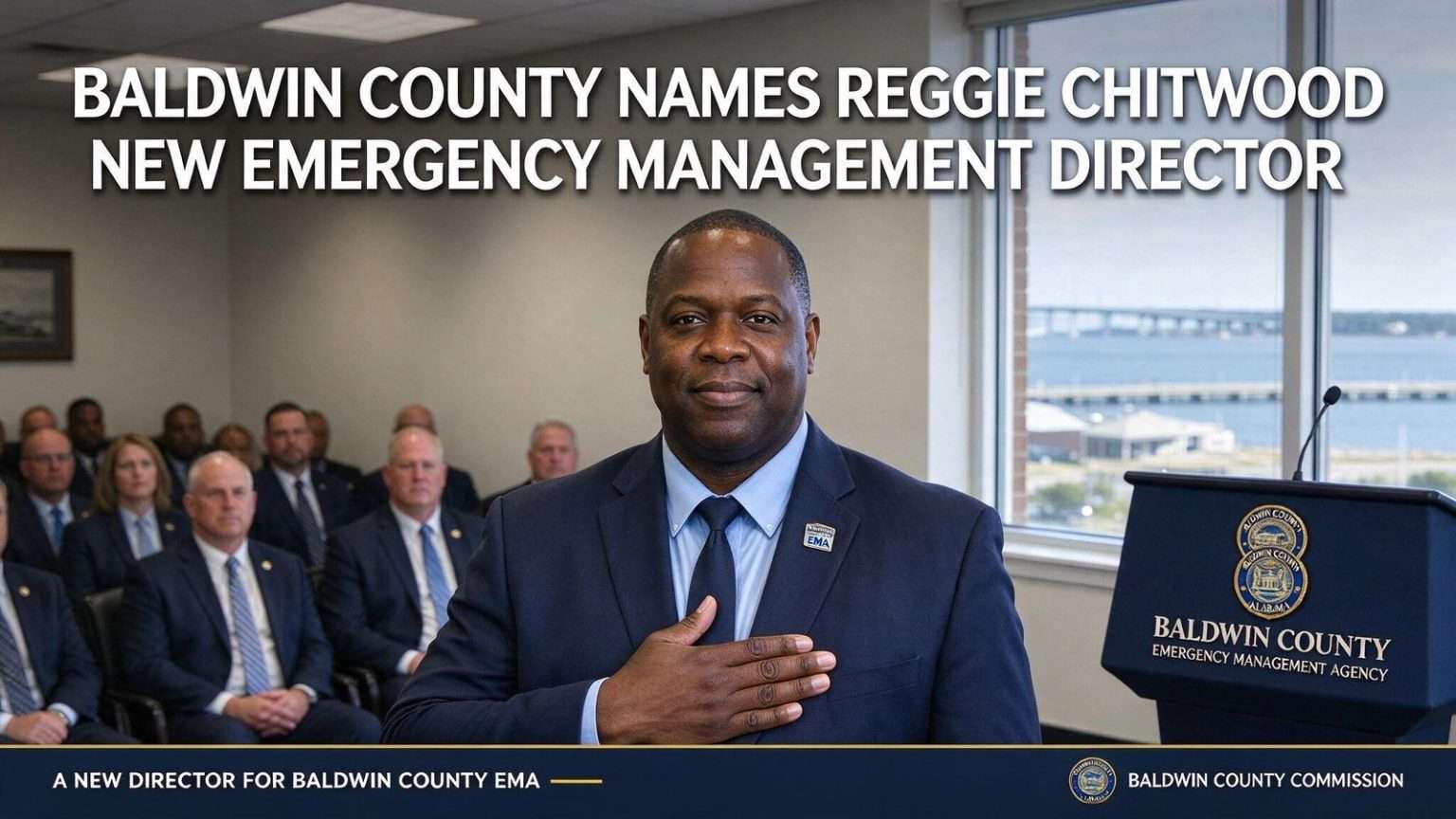
A New Director for Baldwin County EMA
Baldwin County commissioners voted Tuesday to promote Deputy Emergency Management Agency Director Reggie Chitwood to head the department, filling the role left open by the retirement of longtime director Mitchell Sims at the end of the month. Chitwood will take over as director effective April 1, earning an annual salary of $90,000 in the new role. His promotion keeps continuity within the department’s leadership, since he had already been serving as deputy director before the commission’s decision.
For a county whose emergency management operation is among the busiest in Alabama, the promotion was less a change of direction than a confirmation of one. Chitwood takes the department’s top job with years of firsthand knowledge of its operations, its personnel and its relationships with the county’s municipalities, fire departments and law enforcement agencies. Commissioners opting for the deputy over an outside hire signals confidence in the shop already running the county’s storm response.
Chitwood brings decades of public safety experience to the position. He spent 26 years as a law enforcement officer with the Arkansas Highway Police before retiring from that agency, and he has also held leadership roles in emergency response organizations at the national level, including serving as National Vice Commander for the United States Air Force Auxiliary’s Civil Air Patrol program.
The Resume Behind the Promotion
On the education front, Chitwood is a graduate of the University of Arkansas at Fort Smith and holds an Advanced Emergency Manager certification through the Alabama Association of Emergency Managers, a credential that reflects specialized training in coordinating disaster response, planning, and recovery efforts at the county level. The advanced certification is the state association’s mark of a manager who has moved beyond fundamentals into the full scope of the discipline — mitigation, preparedness, response and long-term recovery.
The Civil Air Patrol role adds a dimension most county EMA resumes lack. The United States Air Force Auxiliary’s volunteer program performs aerial reconnaissance, search and rescue support, and disaster imagery missions nationwide, and its National Vice Commander helps direct an organization that regularly supports exactly the kind of events a Gulf Coast emergency manager plans for. Chitwood’s service there connects him to the national emergency response community, not only Alabama’s.
Why Baldwin County’s EMA Job Is Different
Baldwin County’s Emergency Management Agency plays a central role in coordinating the county’s response to hurricanes, severe weather, and other emergencies along the Gulf Coast, working alongside local fire departments, law enforcement agencies, and state emergency officials during major storms and other crises. The agency also handles emergency planning and public communication in the lead-up to hurricane season, a responsibility that carries particular weight in a coastal Alabama county regularly in the path of tropical systems.
The geography explains the weight. Baldwin County stretches from Mobile Bay to the Florida line, mixing Gulf-front beach communities, bayshore towns, farmland and fast-growing suburbs. Hurricane evacuations there involve a handful of routes — including Interstate 10 and the coastal highways — that funnel traffic west toward Mobile, and the county’s EMA must coordinate shelters, evacuation messaging and recovery across one of Alabama’s most populous counties while its population continues to grow along the coast.
Tropical systems are the headline threat, but not the only one. Severe thunderstorms and tornadoes strike the county in every season, flash flooding follows heavy Gulf rains, and winter storms occasionally reach the coast. The director’s job is to keep the county’s plans, warning systems and interagency relationships ready for all of them — and to lead the after-action work that turns each event into better preparation for the next.
A Planned Transition
Outgoing director Mitchell Sims led the department through a number of significant weather events during his tenure before his retirement, and county officials have said the leadership transition was planned well in advance. That deliberateness matters in emergency management, where an abrupt change at the top can fray the relationships — with municipalities, the state EMA, the National Weather Service and county responders — that determine how well a county weathers a storm.
By installing Chitwood as deputy and then promoting him from within, Baldwin County preserved institutional memory at precisely the moment it could least afford to lose it. The April 1 effective date put the new director in the chair ahead of hurricane season, giving him months to settle in before the county’s highest-stakes months arrive.
What the EMA Does Before the Storm
Most residents encounter the Emergency Management Agency only when a storm is bearing down, but the department’s work runs year-round. Before hurricane season, the agency reviews evacuation plans, updates shelter agreements, tests warning systems and coordinates training exercises with the county’s fire departments, law enforcement agencies and municipal governments. Public communication — the forecasts, preparation checklists and evacuation guidance that reach residents through local media and county channels — is built months in advance of the first named storm.
When a system threatens the coast, the agency becomes the county’s operational hub. The director tracks the forecast with the National Weather Service’s Mobile office, advises the commission on local emergency declarations, opens shelters, coordinates evacuation decisions with the state, and positions resources for response and recovery. After the storm passes, the EMA leads damage assessment and the documentation that determines whether the county qualifies for federal disaster assistance — paperwork that can decide how much of the recovery bill taxpayers in Washington and Montgomery absorb.
That recovery role has become an increasingly visible part of the job on the Gulf Coast, where the interval between major storms has shortened and where storm costs — debris removal, infrastructure repair, hazard mitigation — run into the tens of millions for a single county event.
Growth Compounds the Challenge
Baldwin County’s rapid population growth has quietly made the EMA director’s job harder over the past two decades. Every new subdivision in the county’s interior, every new condo on the coast and every new business along the I-10 corridor adds residents to warn, evacuate and shelter — and more infrastructure to assess and repair afterward. An agency sized for the Baldwin County of a generation ago would be outmatched today, which is why continuity in leadership and planning has been a recurring theme for the commission.
Chitwood’s appointment arrives with the county’s emergency management community watching how the transition goes. His decades in law enforcement, his national-level Civil Air Patrol service and his advanced certification in Alabama’s emergency management association give him credentials that map directly onto the county’s needs; the open question for any new director is how quickly the county’s operational rhythms transfer from a retiring director’s head to his successor’s.
The county’s answer was to make that transfer gradual rather than abrupt — deputy first, then director on April 1, with Sims retiring at the end of the month after the handoff. In a county where the next hurricane season is always months away, that is the kind of succession planning residents rarely see but always depend on.
The Arkansas Chapter of the Resume
Chitwood’s 26 years with the Arkansas Highway Police shaped the career he brings to Baldwin County. Highway police work in that state concentrates on commercial vehicle enforcement, hazardous materials oversight and statewide interdiction — duties that demand incident command experience, coordination across jurisdictions and constant attention to safety on high-speed corridors. Those are the same competencies a county emergency manager uses when a hurricane closes the interstates and every responding agency needs one coordinated picture of the situation.
Retiring from that agency as a veteran officer, Chitwood then crossed into emergency management and the volunteer emergency response world, where his rise to National Vice Commander of the Civil Air Patrol put him in national-level leadership. The combination — sworn law enforcement career, national auxiliary command, Alabama emergency management certification — is an unusual profile for a county director, and Baldwin County’s commissioners evidently judged it the right profile for a county that faces hurricanes, tornadoes and everything between.
What Residents Should Expect Going Forward
For Baldwin County residents, the leadership change should be nearly invisible in daily operations — and that is the intent. The agency’s phone lines, warning systems, shelter plans and storm coordination continue under the same leadership team that ran them as recently as last season. Chitwood’s name will surface most visibly where the director’s is required: emergency declarations, hurricane briefings, county commission meetings and the public communications that precede each season’s first threat.
The measure of the transition will come with the county’s first major weather event under the new director. Emergency management is judged by the events that stress it — the evacuation that moves smoothly, the shelter that opens on time, the damage assessment that secures federal aid. Sims’s tenure included its share of such tests; Chitwood inherits both the expectations and the machinery Sims leaves behind.
With the commission’s Tuesday vote, the county formalized what its planners had prepared for months: a retiring director, a promoted deputy, an April 1 start and a $90,000 salary attached to one of the most demanding emergency management posts on the Gulf Coast. The storm season that follows will be the first chapter of the Chitwood era in a department whose work — when it goes well — most residents never notice at all.