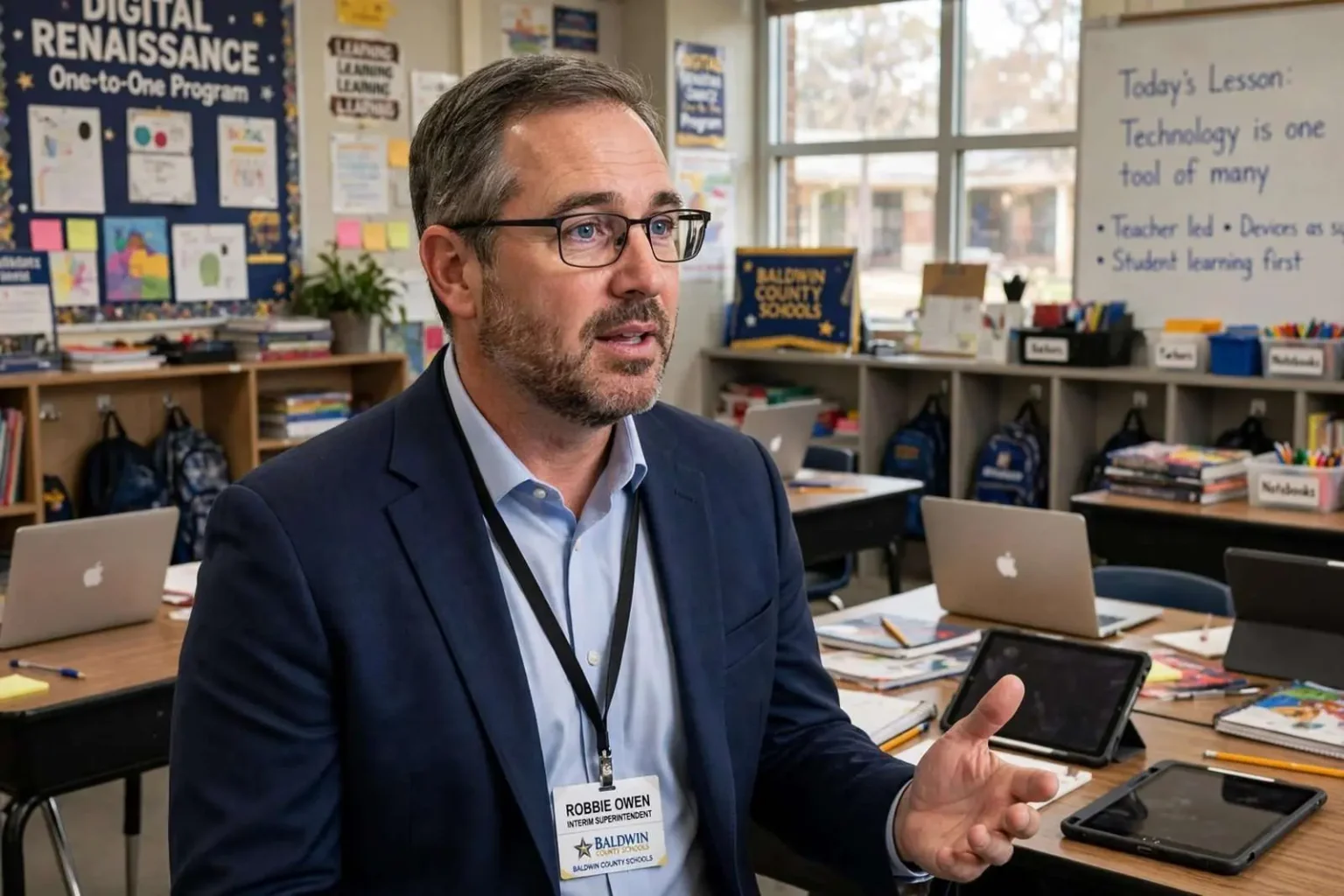
Students using laptops as part of Baldwin County's Digital Renaissance programBaldwin County's Digital Renaissance program issues laptops and iPads to students across the district.

Baldwin County’s interim school superintendent is pushing back on rumors that the district’s laptop and tablet program is on its way out, insisting the devices remain a valuable classroom tool even as officials welcome new ideas for how they’re used.

Robbie Owen, who was serving as interim superintendent at the time, said in an interview that he had fielded questions from parents, teachers and principals about the county’s one-to-one technology initiative, known as Digital Renaissance. Owen said there was no truth to talk that certain schools or grade levels might stop using the iPads and MacBook Air laptops issued to students.

“We’ve said repeatedly … it’s one tool of many,” Owen said, stressing that the devices were never intended to replace teachers or become the primary way students learn.

Under the program, Baldwin County issues a laptop and backpack to each student in fourth grade and above, while younger students in kindergarten through third grade use devices at school but do not take them home. The initiative, launched by former Superintendent Alan Lee, expanded to include kindergarten students starting in January 2014.

Owen said the amount of classroom time spent on devices varies significantly by grade level and subject, with elementary schools generally relying on them far less than middle and high schools. He emphasized that teachers remain the central figures in Baldwin County classrooms.

“The teacher is the focus … that’s the main person in that classroom,” Owen said. “The teachers are the ones who bring instruction to life.”

The comments come after some parents previously asked the Baldwin County Board of Education to make clear that participation in Digital Renaissance is optional, not mandatory, for students and families. County officials have since begun referring to the initiative more broadly as the “one-to-one” program.

Owen’s remarks reflect an effort to steady the ship during a leadership transition for one of Alabama’s largest and fastest-growing school systems. Baldwin County has invested heavily in classroom technology in recent years, and school leaders have said they intend to keep gathering feedback from teachers and families as the program continues to evolve.

With enrollment climbing across Baldwin County’s schools, from Bay Minette to the Eastern Shore and the beach communities to the south, district leaders have said maintaining consistent messaging about technology use is a priority heading into the search for a permanent superintendent.

Baldwin County sits directly east of Mobile County across Mobile Bay and is the largest county in Alabama by land area. It encompasses the Eastern Shore communities of Daphne, Fairhope, Spanish Fort, and Foley and stretches south to the beaches of Gulf Shores and Orange Beach along the Gulf of Mexico.

See also  Five Republicans, One Baldwin Senate Seat and No Clear Favorite

Long among the fastest-growing counties in the state, Baldwin blends suburban development near the bay with tourism-driven coastal economies. Its proximity to Mobile and its position on the Eastern Shore make it a recurring subject of regional news covering growth, infrastructure, schools, and the balance between development and coastal preservation.

Alabama is a state in the southeastern United States bordered by Tennessee, Georgia, Florida, the Gulf of Mexico, and Mississippi. Often called the Heart of Dixie, it spans Appalachian foothills in the north and flat coastal plains in the south. Its largest cities include Birmingham, Montgomery, Huntsville, and Mobile.

Alabama’s history encompasses Indigenous roots, Spanish and French colonial settlement, a cotton-plantation economy, the Civil War and Reconstruction, and the Civil Rights Movement of the 1950s and 1960s, followed by a shift toward manufacturing, aerospace, and technology. Local news across the state frequently reflects this mix of tradition and change.

Education in South Alabama spans public school systems in Mobile and Baldwin counties, a network of private and parochial schools, and institutions of higher learning including the University of South Alabama, Spring Hill College, and community colleges. Public-school governance rests with locally elected boards.

Boards oversee budgets, curricula, and facilities, often amid debates over funding equity and student achievement. The region’s colleges contribute not only to the workforce pipeline but also to healthcare, research, and cultural life, and education policy set in Montgomery frequently shapes what local districts can do.

Schools are also central to community stability. Enrollment trends, facility conditions, and graduation outcomes are watched closely by families and employers alike, making education a persistent focus of public attention and news coverage across the Gulf Coast.

Local government in the Mobile area operates through a combination of mayor-council or commission structures at the municipal level and a county commission in Mobile County, with elected officials handling budgets, public safety, infrastructure, and zoning. Baldwin County has its own commission and a collection of incorporated municipalities.

Decisions made in council chambers and commission meetings affect roads, school funding, economic development, and quality of life, which is why coverage of local government is a staple of regional journalism. The interplay between city, county, and state authorities often determines how effectively the area can address shared challenges.

See also  Will the He-Coon Walk Again? Whetstone Weighs a Return to Baldwin County Politics

Because many services residents rely on are delivered at the local level, the choices of elected officials have direct, everyday consequences. Budget priorities, in particular, reveal a community’s values and shape the trajectory of growth and public welfare for years to come.

The natural environment is central to life on the Gulf Coast, where barrier islands, bays, rivers, and wetlands support fisheries, recreation, and storm protection. Coastal Alabama faces challenges common to low-lying regions, including hurricane exposure, erosion, and the management of fragile ecosystems.

The Mobile-Tensaw Delta, one of the largest river deltas in the country, is a particularly significant natural asset. Conservation efforts, fisheries regulation, and shoreline restoration are frequent points of collaboration among state agencies, federal bodies like the Army Corps of Engineers, and environmental groups.

How the region plans for growth while protecting its natural assets is a recurring theme in local reporting. The tension between development pressure and ecological stewardship plays out in zoning fights, infrastructure projects, and disaster-recovery decisions that shape the coast for generations.

Mobile is the county seat of Mobile County in southwest Alabama and the state’s only saltwater port. Situated where the Mobile River meets Mobile Bay near the northern Gulf of Mexico, the city has long served as a commercial and cultural gateway between Alabama and the wider Gulf Coast. Founded in 1702 as Fort Louis de la Louisiane and ruled in turn by France, Britain, and Spain before joining the United States in 1813, Mobile carries a layered heritage distinct from the rest of the state.

Today Mobile anchors a metropolitan area spanning Mobile County and neighboring Baldwin County, and it remains a center for shipping, aerospace, healthcare, and higher education in the region. Its downtown and waterfront have seen sustained revitalization, while historic neighborhoods preserve architecture from its colonial and antebellum past. The city’s identity is shaped as much by its working port and industrial base as by its festivals and food culture, making it a frequent focal point for news about growth and change in southern Alabama.

Mobile Bay is a shallow estuary in southern Alabama where freshwater from the Mobile, Tensaw, and other rivers mixes with saltwater from the Gulf of Mexico. It is among the largest estuarine systems in the United States and supports commercial and recreational fishing, shipping through the Port of Mobile, and wetlands that buffer the coastline from storms.

See also  Bay Minette Man Seeks Hearing on Bid to Remove Baldwin DA From His Case

The bay’s Eastern Shore, in Baldwin County, includes Daphne, Fairhope, and Spanish Fort, while the Western Shore lies in Mobile County. Its ecology and economy have guided settlement for centuries, and the bay figures in regional debates over development, navigation, and conservation. Events on either shore are routinely covered as part of the interconnected life of the Mobile metro area.

The Gulf of Mexico borders Alabama’s southern edge and defines much of the state’s coastal identity. Alabama’s Gulf coastline, centered on Dauphin Island, Gulf Shores, and Orange Beach, supports a tourism industry built around beaches, charter fishing, and marine recreation, while offshore waters host shipping lanes and energy interests.

The Gulf’s warm, shallow shelf and exposure to hurricanes make weather and disaster preparedness recurring concerns for communities from Mobile to Baldwin County. The marine environment also underpins commercial seafood harvests that have sustained Gulf Coast families for generations, tying the region’s economy and culture closely to the water.

The Federal Bureau of Investigation is the principal investigative arm of the United States Department of Justice, tasked with protecting the country against terrorist threats, foreign intelligence operations, cyber attacks, and major criminal activity. Established in 1908, the bureau operates a network of field offices across the country, each responsible for federal law-enforcement matters within its region.

Field offices such as the one serving Mobile work closely with state and local agencies, reflecting the bureau’s reliance on partnerships rather than unilateral action. The director, appointed by the president and confirmed by the Senate, sets national priorities that cascade down to individual offices handling everything from counterterrorism to public-corruption and civil-rights investigations.

Because federal agents are seldom the first to notice a threat in a community, much of the bureau’s effectiveness depends on tips and vigilance from local residents and police. That reality has made community outreach, including visits by senior leaders to field offices, a deliberate part of how the FBI maintains trust and communication with the public it serves.