What Happens if Baldwin County’s School Tax Referendum Fails?
Baldwin County school officials outlined the financial fallout facing the district if voters reject part or all of a March property tax referendum.
With a pivotal property tax vote approaching, Baldwin County school officials spent the final days before the March 31 referendum explaining exactly what would happen to the district’s finances depending on the outcome — and warned that a full rejection would put the system in uncharted territory.
The referendum asked voters to renew an existing 7-mill property tax and approve an additional 8 mills, a combination that could generate more than $1 billion for the school system over 30 years if fully approved.
Baldwin County Schools Chief Financial Officer John Wilson said each mill was worth roughly $3.5 million to the district based on 2014 figures, meaning the new 8-mill increase alone was projected to bring in around $35 million annually.
Wilson explained that if voters rejected even the renewal portion of the ballot, the district would lose about $7 million a year in existing funding, an outcome he said he could not recall happening anywhere else in the state.
“I don’t know of any other school system that has voted down millage below what the constitution requires,” Wilson said.
A failed renewal would force the district to hold another vote by Sept. 30, this time with less funding available to pay for the election itself.
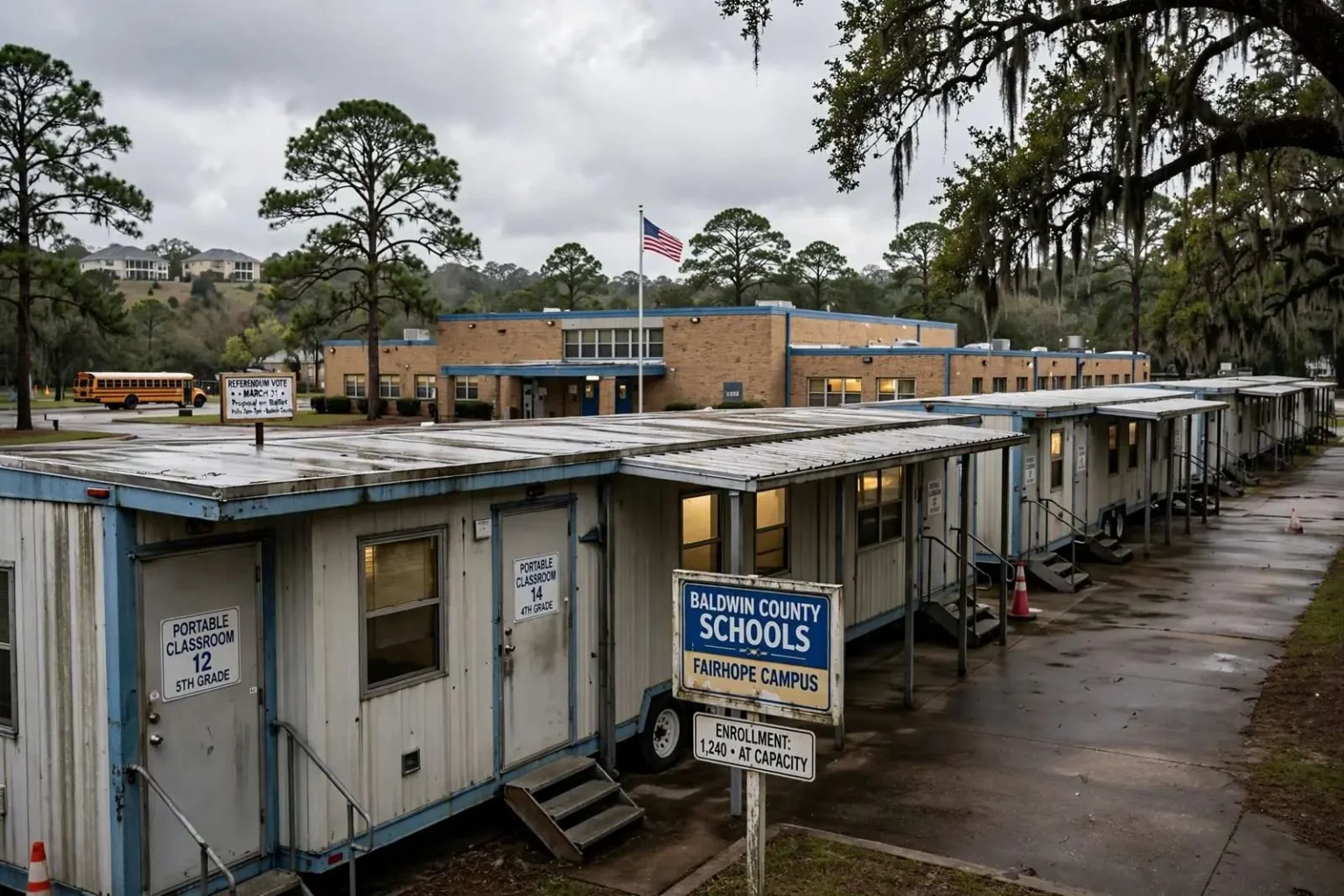
If only the renewal passed and the new 8 mills failed, Wilson said the system would continue operating much as it had been — leaning heavily on portable classrooms to manage overcrowding rather than building new permanent space.
Some residents had asked why the district couldn’t simply borrow the needed construction money instead of raising taxes. Wilson said the system’s bond rating depended on demonstrating a stable, long-term funding source, and with existing local sales taxes already levied to their maximum, a new tax was the only viable path to unlock additional borrowing capacity.
District spokesperson Terry Wilhite said that if only part of the proposed 8-mill increase passed — it was structured as separate 3-mill and 5-mill questions — the board would have to decide how to allocate limited construction dollars among campuses competing for relief.
Why the vote mattered so much
Baldwin County is the largest school district in Alabama by geography, spanning an area larger than some states’ entire systems, with campuses stretching from Bay Minette in the north to Gulf Shores and Orange Beach on the coast. That geography is central to the district’s dilemma: the county’s population has been growing rapidly for decades, but the growth is uneven, surging along the coastal corridor and in the eastern communities near the Mobile Bay bridge while older attendance zones in the northern part of the county hold steadier.
New subdivisions, drawn by the county’s beaches, its reputation for strong schools, and the pull of the Gulf Coast economy, have packed classrooms in Daphne, Fairhope, Spanish Fort, Foley and Gulf Shores faster than the district can build. Portable classrooms — the district’s stopgap of choice — have multiplied across campuses, and school officials have warned for years that modular units are a costly way to house students, depreciating quickly while doing nothing to expand cafeterias, gyms or core facilities.
The district’s funding structure made the referendum unusually consequential. Alabama school systems rely on a combination of state foundation funding and local revenue, and local property taxes are the primary tool districts control through their own voters. Baldwin’s existing 7-mill levy, first approved by voters decades earlier, required periodic renewal, and the lapse of even that baseline money would strip roughly $7 million a year from the operating budget — money that pays for day-to-day instruction rather than construction.
Constitutional language dating to Alabama’s 1901 constitution sets a floor of 3 mills for school property taxes in every system, and Wilson’s remark about “millage below what the constitution requires” reflected how unprecedented a rejected renewal would be. School districts across the state have gone to voters for new money many times, but a community voting to take away money it already levies — forcing its own schools to shrink — has essentially no precedent in modern Alabama history.
The case for the mills
Supporters of the full package argued that Baldwin’s growth left no real alternative. The 8 new mills, split into a 3-mill question and a 5-mill question so voters could approve part of the increase without all of it, were projected to fund a long list of new schools and expansions identified in the district’s facilities plan. At $35 million a year, the increase would have given the system the sustained revenue stream needed to support bonded construction — borrowing repaid over decades with the property tax revenue, the standard mechanism for school building programs.
That borrowing logic was the heart of Wilson’s answer to residents who asked about alternatives. Bond markets lend against predictable revenue; a district without a dedicated, voter-approved funding stream cannot borrow at reasonable rates, and Baldwin’s local sales taxes were already committed at their legal maximum. In practical terms, the referendum was the district’s only key to the construction money its growth demanded.
The politics of the vote were complicated by the county’s geography. Property owners in slower-growth areas questioned why they should help fund campuses on the coast, while coastal parents argued their rapidly multiplying neighborhoods were bearing the strain. Business leaders, real estate professionals and the county’s municipal governments generally backed the measure, viewing school quality as inseparable from the property values and population growth that drive Baldwin’s economy.
What each outcome would mean
The district laid out the scenarios plainly in the campaign’s final days. Full approval — renewal plus both new questions — would fund the construction program and stabilize the system’s finances for a generation, with the more than $1 billion in 30-year revenue flowing toward new campuses, expansions and relief for overcrowded schools.
Partial approval would leave the board making painful choices. With only some of the 8 mills in hand, Wilhite said, trustees would have to distribute limited construction money across a list of needs that exceeded the funding, deciding which overcrowded campuses got permanent relief and which continued stretching portable classrooms another cycle. Every scenario short of full approval left the district’s capital plan underfunded relative to its growth projections.
Renewal-only passage would freeze the status quo: no new building program, continued reliance on portable units, and rising enrollment absorbed year by year without a plan. And outright rejection — even of the 7-mill renewal — would trigger the do-over election required by Sept. 30, an election the district would have to pay for out of diminished funds, while its operating budget absorbed a $7 million annual wound.
The stakes extended beyond school walls. Baldwin County’s population growth has been among the fastest in Alabama, and the county’s real estate market explicitly markets its schools; agents along the Eastern Shore and the coast field questions about attendance zones before buyers ask about square footage. A system forced into retrenchment, officials and business leaders argued, would eventually show up in home values, commercial recruitment and the county’s competitive position against neighboring markets.
For the district’s employees, the renewal question carried the most direct danger. Operating money lost to a failed renewal cannot be replaced by construction borrowing, and a $7 million hole in a system the size of Baldwin’s would have meant reductions reaching into classrooms — larger class sizes, eliminated positions, pared programs — on top of the facilities strain.
Officials made their final case in the days before the vote with the straightforward arithmetic they had used all along: mills worth $3.5 million each, a renewal worth $7 million a year, a construction package worth roughly $35 million annually and more than a billion dollars across three decades, and a Sept. 30 deadline if voters said no to money the system already had. The March 31 ballots would decide which of those futures Baldwin County’s schools would live with.
The referendum also became a case study in how Alabama’s school funding rules shape local democracy. Because the state constitution caps and structures local tax authority, districts cannot simply raise money as needs arise; every increase requires a vote of the people, a supermajority of the local legislative delegation, or both. Baldwin’s two-question structure — 3 mills and 5 mills offered separately — was designed to give voters a middle path, and Wilhite’s comments about allocating partial funding reflected a board trying to plan honestly for every combination on the ballot.
The 30-year horizon in the revenue projection was not an abstraction. School bonds are typically repaid over 20 to 30 years, matching the lifespan of the buildings they finance, and the millage renewal itself ran on a multi-decade term. The billion-dollar figure, eye-catching as it was, represented what the county’s growing tax base would produce over that span — and what the county’s growing student population would require in classrooms, science labs and athletic facilities to keep pace.
However the vote came out, officials had made one thing explicit in the final days: Baldwin County’s schools could no longer absorb growth with temporary buildings and annual improvisation. The question posed to voters on March 31 was whether the county would pay to build for its future, renew what it already promised, or become the Alabama system that voted its millage down to the constitutional floor. No one involved in the district’s planning — not the CFO, not the spokesperson, not the board — expected that last scenario to end anywhere but uncharted territory.