Real Estate Roundup: Zaxby’s Rises in Gulf Shores as Acme Buys 120 Parking Spaces
A Zaxby's took shape on Alabama 59 in Gulf Shores, Orange Beach weighed beach-resort rezoning, and Acme Oyster House agreed to pay the city for 120 public parking spaces to meet zoning rules.
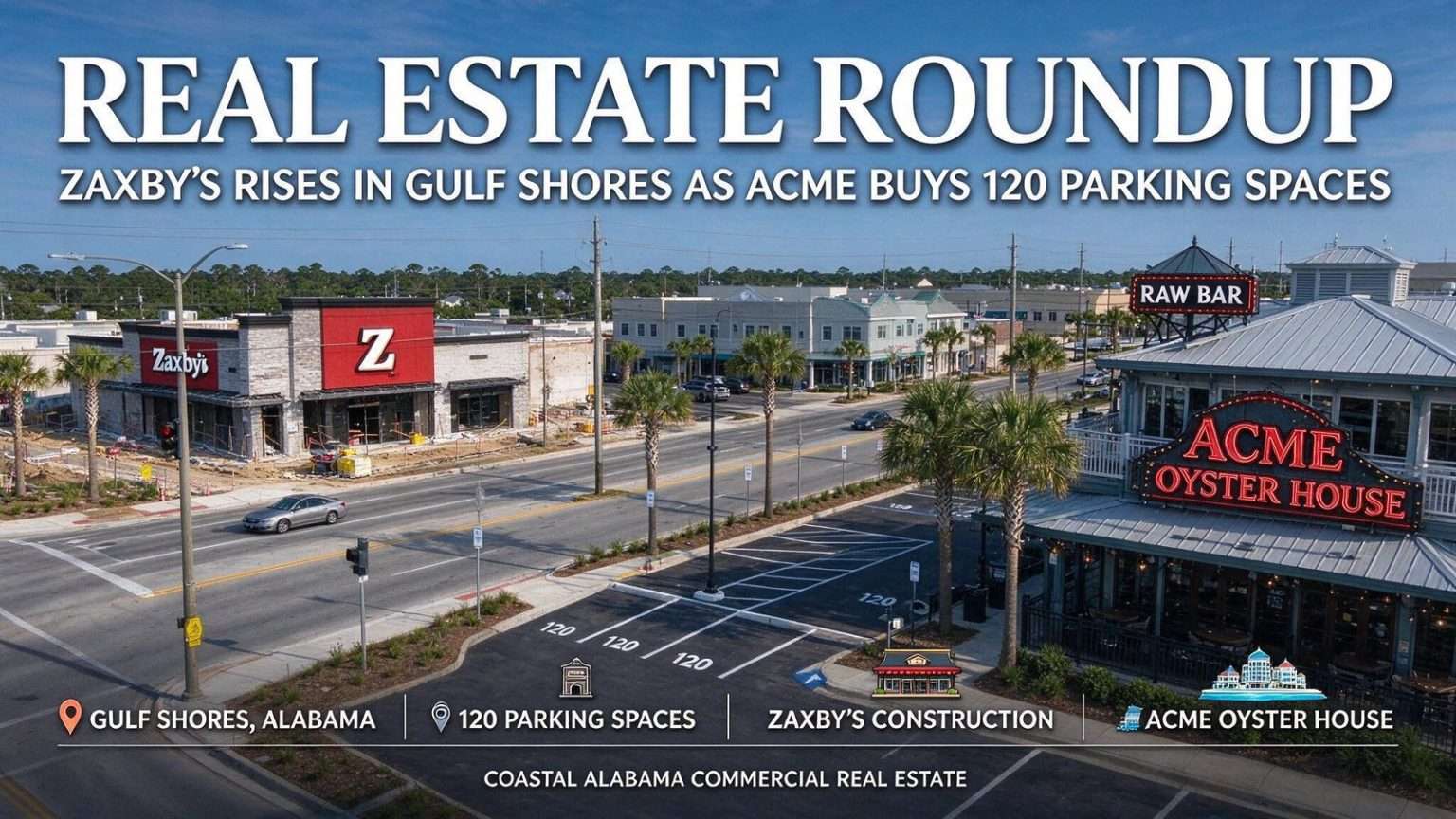
GULF SHORES, Ala. — A Zaxby’s, the chicken-finger chain, was under construction on Alabama 59 in Gulf Shores, on a lot in front of the Winn-Dixie Shopping Center, according to Tim Herrington of Herrington Realty, who handled the land lease. The deal added another national restaurant name to the highway corridor that serves as Gulf Shores’ main commercial spine, where chain restaurants, retail centers and tourist services line the route that carries visitors from the interstate toward the beach.
Alabama 59 — known locally as Gulf Shores Parkway — funnels virtually all of the city’s visitor traffic, and a restaurant site in front of an established grocery-anchored center puts a new dining option directly in the path of arriving vacationers. Outparcel leases in front of shopping centers have long been among the most sought-after commercial real estate deals in the beach towns, because the daily traffic count during tourist season dwarfs that of most inland Alabama locations.
Zaxby’s, the Georgia-based chain known for its chicken fingers and sauces, has expanded steadily across the Southeast, and Gulf Shores’ combination of year-round residents and seasonal crowds fits the profile the chain targets. The construction on the leased lot put the national brand alongside local businesses that have anchored the corridor for years.
Next door, Merchant & Marine Bank was undergoing a major renovation; the Mississippi-based bank had bought the former Heritage First Bank building in 2011. The renovation gave the bank a modernized presence on the Gulf Shores corridor as it extended its reach into the Alabama beach market from its home market across the state line.
Bank branch investments of that kind are read by commercial brokers as a signal of confidence in a market’s long-term growth, since banks commit to brick-and-mortar locations based on deposit and lending projections years out. Gulf Shores and the surrounding Baldwin County beach communities have been among Alabama’s fastest-growing markets, with property values, tourism revenues and permanent population all climbing steadily.
Orange Beach Rezoning: The owners of six beachfront lots on Perdido Beach Boulevard, southwest of Alabama 182 and 161 in Orange Beach, sought to rezone the property from multifamily residential to beach-resort high density, according to city records. The zoning would allow hotels and resort-related businesses.
The Gulf Coast Opportunity Fund LP owned those lots and two adjacent ones, paying more than $12 million the previous year for 10.5 acres with 1,005 feet of Gulf frontage, part of the former Mandalay Beach condominium site. Assembling that much continuous Gulf frontage in Orange Beach is a rare event, and the fund’s pursuit of a zoning change to beach-resort high density signaled its intention to develop the property at an intensity that residential zoning would not permit.
Perdido Beach Boulevard runs the length of Orange Beach’s Gulf shoreline, and its parcels have transitioned over the decades from small beach cottages and older condominium projects to large-scale resort developments. Zoning decisions along the corridor shape what that evolution looks like, and requests to upzone beachfront land — from residential to resort-commercial categories that allow hotels — are among the most consequential votes the city council takes, drawing participation from neighboring property owners and residents concerned about traffic, height and density.
Beach-resort high density zoning accommodates the hotel and resort-related development that drives the city’s principal economic engine: lodging, dining, entertainment and the sales and lodging tax revenues that fund municipal services. A 10.5-acre site with more than 1,000 feet of frontage could support a development of significant scale under such zoning, which is why the rezoning request drew attention in city records and among coastal real estate watchers.
Mobile Deals: A local investor paid $45,000 for a 6,400-square-foot former post office building on Caroline Avenue in Midtown Mobile, according to Pratt Thomas of the Merrill P. Thomas Company. The price reflected the condition and character of an older institutional building, and repurposing former post offices and similar civic structures has been a recurring theme in Midtown’s commercial revival, with buyers converting them into offices, retail and studio space.
German Automotive leased 2,250 square feet at 3747 Government St., near Interstate 65, according to Angela McArthur of the Prudential Cooper & Co. commercial division. Government Street’s stretch near the interstate has long served the city’s automotive service businesses, with visibility and access that suit repair and specialty shops drawing customers from across the metro area.
The German Automotive lease fit the pattern of specialty automotive businesses clustering along the corridor, where properties with drive-in access and service bays change hands less frequently than standard retail space and hold their value with working tenants.
Acme’s Parking Solution: Construction was expected to begin soon on the 12,179-square-foot Acme Oyster House at 216 E. 24th St. in Gulf Shores. To satisfy zoning requirements for a 408-seat restaurant, the owners agreed to pay the city $3,000 per space to use 120 spaces in a public parking area on East 24th Street.
The site itself was not large enough to accommodate both the restaurant and its required parking, so the $360,000 payment allowed Acme to count the public spaces toward its allotment and conform with city zoning laws. The arrangement — a private business paying to use public parking capacity to meet its code obligations — is one of the creative solutions that beach-town governments and developers work out when prime restaurant sites sit on lots too small for the parking ratios the zoning code demands.
Restaurant parking requirements are calculated from seating capacity, and a 408-seat restaurant generates one of the larger parking demands of any commercial use in a city’s code. Gulf Shores’ willingness to negotiate a shared-use arrangement reflects a broader principle in parking planning: a restaurant’s peak demand — typically evening hours — overlaps imperfectly with the peak demand of other nearby uses, so public lots can absorb a restaurant’s overflow at the times the restaurant actually needs it.
Acme Oyster House, a New Orleans institution known for its raw bars and fried seafood platters, brought a recognized Gulf South restaurant brand to the Gulf Shores market, where fresh seafood dining is both a tourist draw and a point of local pride. The East 24th Street location placed the restaurant in the heart of the city’s commercial district, minutes from the beachfront lodging strips where its customers would be staying.
Elsewhere in Gulf Shores, GooRoo’s Grill planned to open in the former Bella Luna building at 1209 Gulf Shores Parkway, city records showed. The turnover of restaurant space along the parkway is constant in a tourist market — brands rise and fall with the seasons, and second-generation restaurant spaces with kitchens and parking in place rarely stay vacant long.
Together, the deals traced a market in motion: national chains buying and leasing on the main highway, a Mississippi bank investing in its beach-market branch, an investment fund assembling rare Gulf frontage for a resort-scale play, and Midtown Mobile continuing its quiet recycling of older commercial buildings into new uses. For the brokers who put the deals together, the through-line was the same on both sides of Mobile Bay — coastal Alabama real estate remained a market where well-located property found buyers quickly.
Why the beachfront rezoning mattered
The Gulf Coast Opportunity Fund’s purchase of the former Mandalay Beach condominium site ranked among the largest beachfront land transactions in Orange Beach in recent years, and its scale explains the fund’s rezoning request. Land value on the Gulf is driven by frontage — the more linear feet of beach a parcel commands, the more units or rooms a resort development can build on it — and 1,005 feet of continuous frontage on Perdido Beach Boulevard represented a development canvas that comes to market perhaps once in a generation.
Former condominium sites carry their own complications. The Mandalay Beach site’s history as a multi-unit property meant the land already carried the infrastructure — utility connections, access points and seaward construction history — that developers look for, while its demolition cleared the way for a new project unconstrained by existing foundations. Cities generally welcome redevelopment of older sites at higher and better use, provided the scale fits the corridor and the infrastructure can absorb it.
The multifamily-to-resort zoning question also sits within a larger debate unique to beach communities: how much of the shoreline should house permanent residents in condominiums versus short-term visitors in hotels and resorts. Hotels generate lodging taxes that fund beach nourishment, public safety and tourism promotion, while condominiums contribute more to the permanent tax base and neighborhood stability. Orange Beach’s zoning map is the instrument that balances those interests, parcel by parcel along the boulevard.
Midtown Mobile’s steady conversion economy
The $45,000 sale of the former post office on Caroline Avenue underscored the price dynamics of Midtown Mobile’s older commercial stock. Buildings of that vintage — solid masonry, generous floor plates, distinctive architecture — sell for a fraction of replacement cost when they need renovation, and the gap between purchase price and finished value is what draws local investors into the district.
Caroline Avenue sits in the heart of Midtown’s neighborhood commercial grid, an area that has seen coffee shops, offices and specialty retailers move into buildings that once housed service stations, groceries and civic functions. Investors who buy at those price points typically budget renovation costs several times the acquisition price, but the finished product rents to tenants who value the district’s character and its proximity to some of the city’s most established residential neighborhoods.
The Government Street automotive lease completed the roundup’s cross-bay picture. From the beach highway in Gulf Shores to the old commercial spine of Midtown, the region’s deals in this cycle shared a common thread: older, well-located properties finding new economic lives, one lease and one rezoning at a time.