Gulf Shores Condotel Planned as Restaurants Fill Mobile Storefronts
An investor lined up a beachfront condotel in Gulf Shores while Chicken Salad Chick, Foosackly's, Stevie's Kitchen and other tenants signed leases across Mobile, reflecting steady demand for coastal and city commercial space.
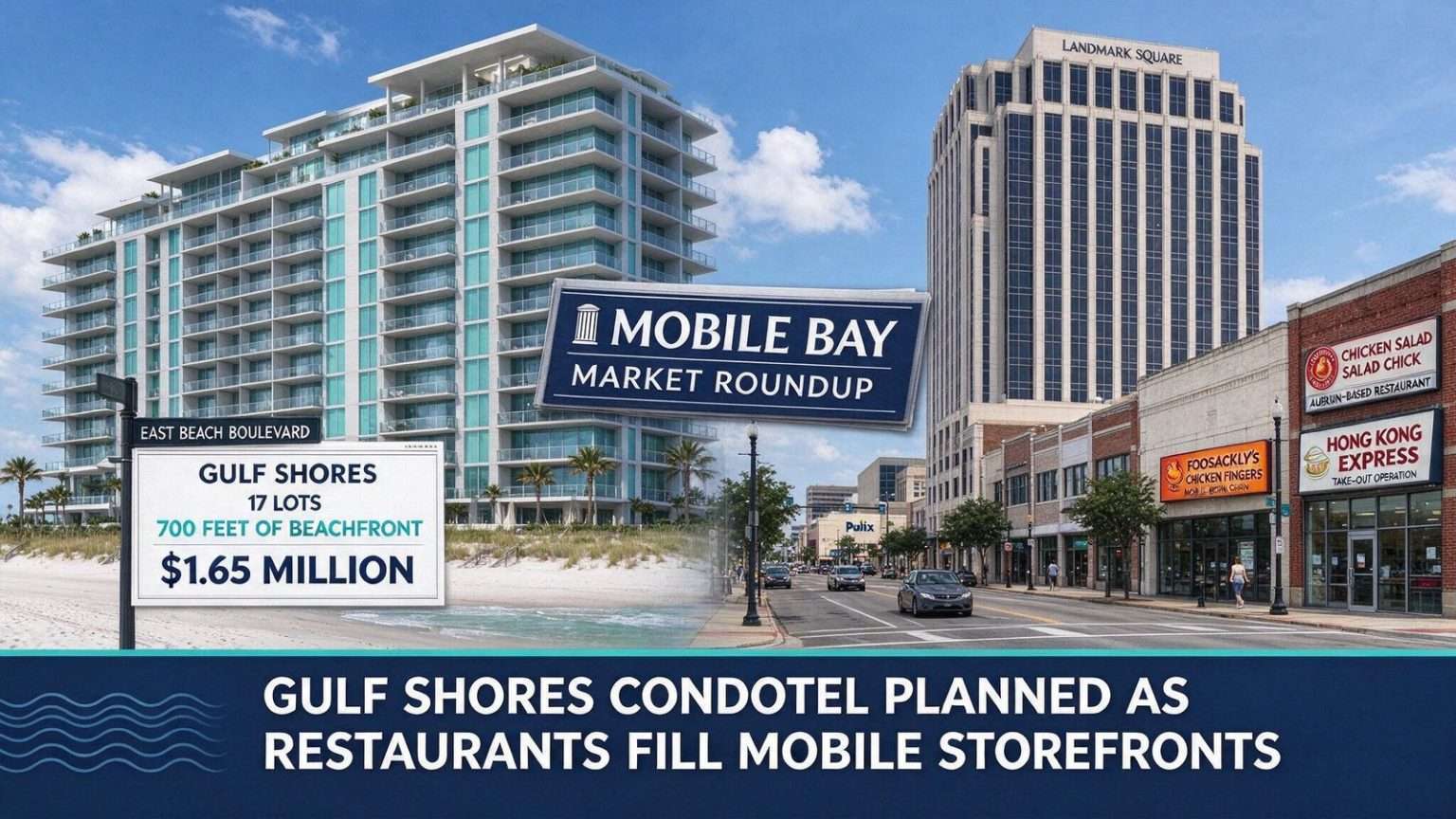
Commercial real estate across the Mobile Bay area stayed busy in the early summer, with an investor lining up a beachfront “condotel” in Gulf Shores and a string of restaurants and businesses signing leases in and around Mobile. The deal flow spanned the bay — coastal land assemblies on one side, downtown storefronts and west Mobile shopping centers on the other — and touched nearly every category of commercial property, from restaurant space to offices to a daycare.
A Condotel on East Beach Boulevard
An investor paid $1.65 million for 17 lots on East Beach Boulevard in Gulf Shores, directly across from The Colonnades, and was looking to build a condotel on the property, which fronts 700 feet on the boulevard and includes beach access. Ken Crabtree of REMAX Paradise represented the buyer, while Bob Shallow of REMAX Paradise worked for the seller.
A condotel is a condominium complex operated much like a hotel. Units are sold to individual buyers but rented out — typically through a central management operation — when owners are not using them, blending second-home ownership with hotel-style service. On a barrier-island beachfront, the format has long been a staple of the Gulf Shores market: buyers gain deeded beachfront property with rental income potential, and visitors get a lodging inventory beyond the traditional hotel and house-rental markets.
The assembled site’s dimensions explain the price. Seventeen contiguous lots fronting 700 feet of East Beach Boulevard — the main beachfront thoroughfare — with direct beach access represent a land assembly that rarely comes to market in one piece. Directly across from The Colonnades, one of the beach road’s established condominium addresses, the parcel sits amid the stretch of Gulf Shores most sought after by both condo buyers and rental guests.
In another coastal transaction, a local investor paid $180,000 for a bank-owned, 2,100-square-foot building on Cove Avenue in Gulf Shores, according to Pratt Thomas of Merrill P. Thomas Company. Bank-owned property sales of that kind, common in the years following the recession, gave local buyers opportunities to acquire buildings at below-replacement cost, and Cove Avenue’s location near the heart of the beach town made the building a candidate for retail or service uses.
New Tenants Downtown and in West Mobile
Dewberry, an architectural, engineering and consulting firm based in Virginia, leased 800 square feet in the Landmark Square building at 169 Dauphin St. in downtown Mobile. Thomas of Merrill P. Thomas Co. represented the firm, and Richard Inge of Inge & Associates worked for the landlord. The lease brought a national design and engineering brand to Dauphin Street’s growing roster of professional tenants, a sign that downtown’s revitalization had begun drawing firms whose work depends on proximity to clients and projects rather than highway visibility.
Chicken Salad Chick, the Auburn-based restaurant, leased 2,400 square feet in Hillwood Plaza at the northwest corner of Hillcrest and Cottage Hill roads. Tim Herrington of Herrington Realty, who represented the new franchisee, said the chain was expected to open additional locations in the area. David Dexter of White-Spunner & Associates worked for the landlord, and a new Publix Supermarket anchors the shopping center.
The Chicken Salad Chick lease illustrated how grocery-anchored centers have become the preferred sites for expanding fast-casual chains. A Publix anchor generates the daily traffic that restaurant concepts covet, and Hillwood Plaza’s position at a signalized intersection in west Mobile’s residential heart put the brand where its lunchtime customer base lives. Franchise growth of the kind Herrington described — multiple planned locations — signaled that regional chains saw the Mobile market as large enough to support several stores.
Foosackly’s Chicken Fingers planned to move from 3249 Dauphin St. to the nearby former Popeye’s site at Dauphin Street and Sage Avenue, according to Matt Cummings of Cummings & Associates. The restaurant intended to tear down the Popeye’s building and construct a new eatery on the leased land. The Mobile-born chain’s move — from an older inline space to a corner site where it could build to its own specifications — reflected the value quick-service brands place on drive-thru visibility and easy access along a corridor as heavily traveled as Dauphin Street.
Cummings also handled a lease for Hong Kong Express, which took 1,200 square feet in the former Hong Kong Island Chinese restaurant building in Dauphin Square for a take-out operation. The recycling of an existing restaurant building for a new concept kept a vacant space off the market and gave the take-out business an established kitchen footprint at a fraction of build-from-scratch cost.
Providence Academy leased 4,650 square feet at 1020 University Blvd. in west Mobile for a daycare center, a deal handled by Jeremy Milling of Milling Commercial Realty. Milling Commercial Realty also represented BBB Bail Bonding Company, which leased 1,760 square feet at 665 S. Conception St. downtown. The pair of deals showed the breadth of demand behind the market’s surface: a school operator needing classroom-scale space near University Boulevard’s family traffic, and a bail bonding business joining the cluster of legal-adjacent tenants that has long occupied the streets near downtown’s courthouses.
A New Kitchen at the BB&T Centre
Stevie’s Kitchen leased the 2,800-square-foot first floor of the BB&T Centre at Dauphin Street and Interstate 65 and planned to open in July. Harry Brislin of The Mitchell Company represented the landlord. The space was formerly occupied by The Red Brick Café, and owner Stevie Watford planned to serve breakfast and lunch.
The restaurant space at Dauphin Street and I-65 is among the most visible dining locations in the city, sitting where the interstate’s traffic merges with one of west Mobile’s principal commercial corridors. Office tenants in the BB&T Centre and neighboring towers provide the breakfast and lunch customer base that a weekday-only concept like Stevie’s Kitchen depends on, and the July opening timetable put the restaurant on track to catch the summer’s full office rhythm.
The turnover at the address — a closing café replaced by a new kitchen in the same suite — also illustrated the churn that defines urban retail. Restaurant spaces rarely stay vacant long in locations with that traffic profile, and landlords in such buildings price and maintain their ground floors with food-service tenants in mind: grease interceptors, venting and parking ratios already in place.
Taken together, the transactions pointed to steady demand for retail, restaurant and office space along the coast and across Mobile, from downtown storefronts to west Mobile shopping centers. Investors were assembling beachfront land for new lodging products, national and regional restaurant chains were committing to new stores, professional firms were taking downtown offices, and service businesses — from daycares to bail bondsmen — were filling spaces from Conception Street to University Boulevard.
For brokers, the breadth of the deal list was the story in itself. A healthy commercial market is measured not by any single transaction but by activity across categories, and the early summer had produced sales and leases at nearly every price point — a $1.65 million beachfront assembly at the top, an $180,000 bank-owned building near the bottom, and a steady middle range of restaurant, office and service leases binding the Mobile Bay area’s commercial corridors together.
Why Condotels Shape the Beach Market
The planned East Beach Boulevard condotel fits a product line that has defined Gulf Shores’ skyline for decades. Condotels allow developers to finance beachfront construction by pre-selling units, allow buyers to own a piece of the beach they could not afford alone, and allow the rental program to keep the rooms producing revenue year-round. The model flourished along the Alabama coast through successive building booms, and any new project on assembled land fronting the Gulf represents a bet that the demand underlying those booms remains intact.
For the city, condotel projects carry fiscal and practical weight. They add to the lodging inventory that generates tourist lodging taxes, they put high-value construction on the property rolls, and they concentrate investment along East Beach Boulevard, the strip whose appearance largely determines the image Gulf Shores presents to the millions of visitors who arrive each year. Land assemblies of 17 lots are also rare enough that their fate shapes the beachfront’s future in a way single-lot sales cannot.
The price paid — $1.65 million for raw beachfront acreage — placed the deal among the notable coastal land transactions of the period. Coastal land values along the Alabama Gulf Coast had been climbing steadily as the region’s tourism economy recovered, and buyers willing to assemble large parcels signaled confidence that new construction pencils out even at elevated land costs.
Reading the Market Through Leases
The leasing activity told its own story about the wider Mobile Bay economy. Restaurant signings — Chicken Salad Chick, Foosackly’s, Hong Kong Express and Stevie’s Kitchen in a single season — indicated that food-service operators were competing for locations rather than waiting for them, a posture businesses adopt when consumer spending feels dependable. Each new lease also represented construction or renovation jobs, from the demolition and rebuild at the former Popeye’s site to the kitchen fit-out at the BB&T Centre.
The Dewberry lease added another dimension: professional-services demand downtown. Architecture and engineering firms follow public and private construction, and a firm with Virginia roots choosing a Mobile office suggested confidence in the Gulf Coast project pipeline — everything from coastal restoration work to commercial development. Downtown’s Landmark Square gave the firm the address and walkability that professional tenants increasingly seek.
Service-sector leases round out the picture. A daycare operator taking 4,650 square feet on University Boulevard responded to west Mobile’s family demographics; a bail bonding office near downtown’s courts followed the geography of its trade. Neither makes headlines, but both fill space, employ residents and support the small-business layer on which larger commercial corridors depend.
Commercial brokers describe such markets in simple terms: when deals happen across every category and price point, the underlying economy is generating demand from many directions at once. The early summer’s ledger — a beachfront assembly, a bank-owned sale, a corporate office, four restaurants, a school and a service business — was exactly that kind of broad-based evidence for the Mobile Bay area.