
Video Premiere: Pine Hill Haints Frontman Jamie Barrier Goes Solo at Mobile’s 360 Jazz Cafe
Video premiere: Pine Hill Haints frontman Jamie Barrier performs a rare solo set at Mobile's 360 Jazz Cafe, featuring new solo material.
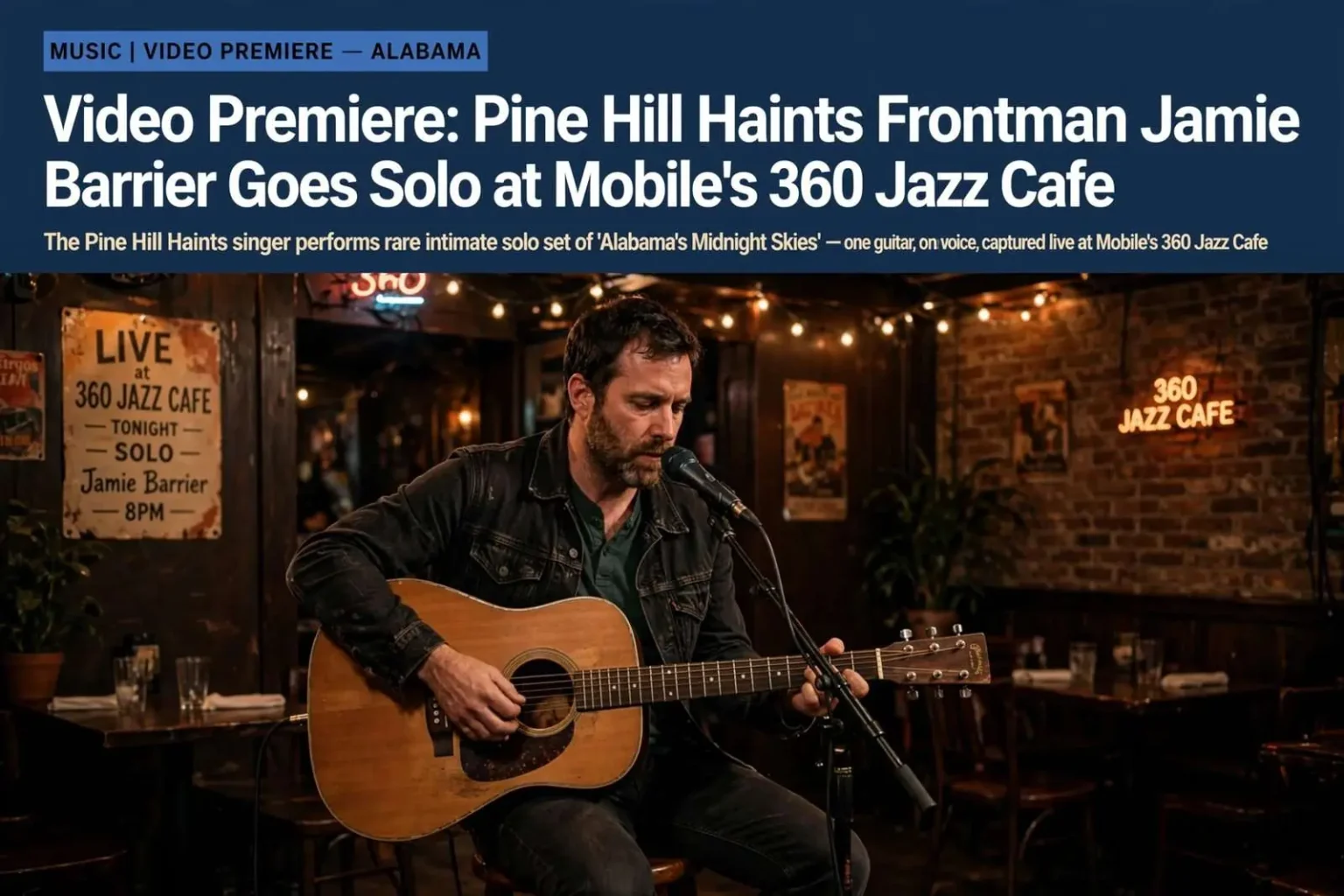
Jamie Barrier, the lead singer and guitarist behind legendary Alabama acts including the Pine Hill Haints, the Wednesdays and Rise Up! Howlin’ Werewolf, stepped away from his full-band duties for a rare intimate solo set at Live at 360 Jazz Cafe in Mobile — and the performance was captured on tape. The video premiere of that recording gave fans who missed the gig a chance to see one of the state’s most distinctive songwriters working in his rawest format: one voice, one guitar, and a room small enough that the music felt less like a show than a gathering.
A rare solo appearance
Barrier is best known as the driving force of the Pine Hill Haints, the ghostly Alabama roots outfit whose mix of rockabilly, folk and garage country has earned a devoted following far beyond the Gulf Coast. The band’s sound — equal parts back-porch folk, haunted balladry and stripped-down rock and roll — has made it a fixture of the Southeast’s independent music circuit, and its reputation has traveled by word of mouth through underground scenes nationally and internationally. Barrier writes and sings the bulk of the band’s material, and his voice and guitar sit at the center of whatever configuration the Haints take on stage in a given night.
Solo appearances like this one were uncommon, making the small-room show at the 360 Jazz Cafe a special night for local fans. Artists who lead full bands rarely strip their songbook down to its skeleton in public, and for good reason: a solo set exposes every song’s foundation, leaving no rhythm section to hide behind and no arrangement to carry the melody. Barrier’s decision to play alone was, in effect, an invitation to hear the songs the way they were written — before the Haints’ arrangements dressed them in fiddle, washboard, banjo or the other instruments the band folds into its sound.
The 360 Jazz Cafe itself fits the occasion. A small venue in Mobile, it hosts live performances in a setting far more intimate than the clubs where a touring band typically plays. Rooms of that size reward quiet, detail-oriented performance: the crowd can hear the fingers on the strings, the pauses between lines, and the conversational quality of a songwriter addressing a neighborhood audience rather than a festival field. For a catalog built heavily on ballads, murder songs and haunted folk numbers, the close quarters suited the material.
Barrier’s career spans several bands, each with its own character. The Wednesdays, an earlier project, established him as a songwriter of unusual range, while Rise Up! Howlin’ Werewolf pushed into louder, more aggressive territory. The Pine Hill Haints brought the combination that has endured longest — an uncanny blend of old-time styles delivered with the energy of a garage band. Across all three, the constant has been Barrier’s writing: songs rooted in Alabama landscapes, ghost stories, loves and losses, delivered in a voice that audiences either fall for immediately or never forget.
“Alabama’s Midnight Skies”
The recorded set features “Alabama’s Midnight Skies,” a song dating back to Barrier’s days with the Wednesdays, performed live that night in front of the cafe crowd. The song is one of the pieces his listeners have followed across his career — a number whose associations stretch from its original band context to the Haints’ repertoire and, now, to this solo setting. Hearing it with only guitar behind it changed its proportions: the melody and the words stood alone, and the audience at 360 heard a version of the song that only such a small, quiet room could produce.
That durability across bands is one of the hallmarks of Barrier’s writing. Songs that survive the breakup or evolution of one band and reappear in another tend to be the ones built on strong melodic bones and imagery that does not depend on arrangement. “Alabama’s Midnight Skies” belongs to that category — a song about the state’s nocturnal landscape that has traveled with him through different musical configurations, gaining layers of meaning with each new setting. In the solo video, viewers could trace the song back to its roots, with no overdubs, no effects, no band dynamics, just a writer and the song itself.
The video premiere
The video premiere offered viewers who missed the gig a chance to hear the longtime Alabama scene stalwart strip his songbook down to voice and guitar. For a band like the Pine Hill Haints, whose following is concentrated among listeners who discover them through touring and word of mouth, documentation of any performance is relatively scarce. A full solo set on video was therefore an event in itself — an archive of a night that only a few dozen people witnessed in person, made available to the wider audience that follows Alabama’s independent music scene from a distance.
Premiering the recording also served the regional scene in a practical way. Mobile’s independent music community depends on small venues, and small venues depend on nights like this one, when a well-known figure plays a room his band would normally outgrow. The video acted as both a document and an advertisement: evidence that the cafe can host performances of genuine artistic weight, and encouragement for audiences to come out for the next one rather than waiting for a larger production.
For followers of Mobile’s independent music scene, the clip was a document of one of the region’s most distinctive songwriters in his rawest format — no band, no effects, just songs that have traveled with him across three different bands. The archive of the Gulf Coast’s underground music has always been built on recordings like this one: informal, low-tech, focused on the songs rather than the production. Barrier’s night at the 360 Jazz Cafe, preserved on tape and released as a video, joined that archive and confirmed what his audiences already believed — that the songs stand on their own, whatever band — or no band — is behind them.
Why the small-room show mattered
Solo shows by bandleaders of Barrier’s stature carry a particular appeal for the local fans who fill rooms like the 360. The format collapses the distance between songwriter and audience: requests land differently, between-song talk becomes conversation, and the crowd hears the human machinery of the music — breath, string noise, the occasional restart. For a songwriter whose catalog is populated with ghosts, highways, and Alabama nights, that intimacy is not a reduced version of the art but arguably its purest expression.
The night also underscored the strength of the Gulf Coast’s music ecosystem. A region needs not only touring acts and festivals but small rooms where established artists can take risks, play new material, or revisit old songs without the obligations of a full production. Barrier’s willingness to give Mobile such a night — and the cafe’s ability to capture and share it — reflected a scene that sustains itself through exactly these exchanges between artists and audiences who know each other’s names.
Barrier’s position in Alabama music has been built over years of relentless regional touring and a catalog that treats the state itself as subject matter. The Pine Hill Haints’ songs borrow from gospel, blues, rockabilly and traditional folk forms without belonging cleanly to any of them, and that refusal of category has been central to their appeal. Listeners who found the band through its recordings often describe the discovery as unlike anything else in the regional catalog: music that sounds old and new at once, performed with a conviction that never winks at the audience.
The Wednesdays, the earlier project from which “Alabama’s Midnight Skies” dates, represented the first chapter of that body of work. The band built Barrier’s early following and established the melodic sensibility he has carried through every project since. Rise Up! Howlin’ Werewolf showed a heavier side, and the Haints synthesized the strands: the folk melodism of the Wednesdays, the garage energy of the Werewolf, and a haunted, distinctly Alabamian imagination all their own. A solo night drew from the whole arc, which is why the set list itself — a Wednesdays song at its center — read as a summary of a career rather than a promotion for one band.
For Mobile audiences, the evening at the 360 Jazz Cafe checked every box that local music lovers prize: an artist with national underground credibility, a room small enough to feel the performance physically, and material drawn from a songbook the audience knows well. The video that emerged from it preserved the night for everyone else — a document of a songwriter alone with songs that have accompanied him across three bands and however many hundreds of stages, still carrying the same charge in a cafe in his home state as they do anywhere else they travel.


