Attorney Dispute Complicates Upcoming Federal Trial for Mobile County Official
Federal prosecutors are challenging whether an attorney for Mobile County License Commissioner Kim Hastie can serve as both counsel and witness at trial.
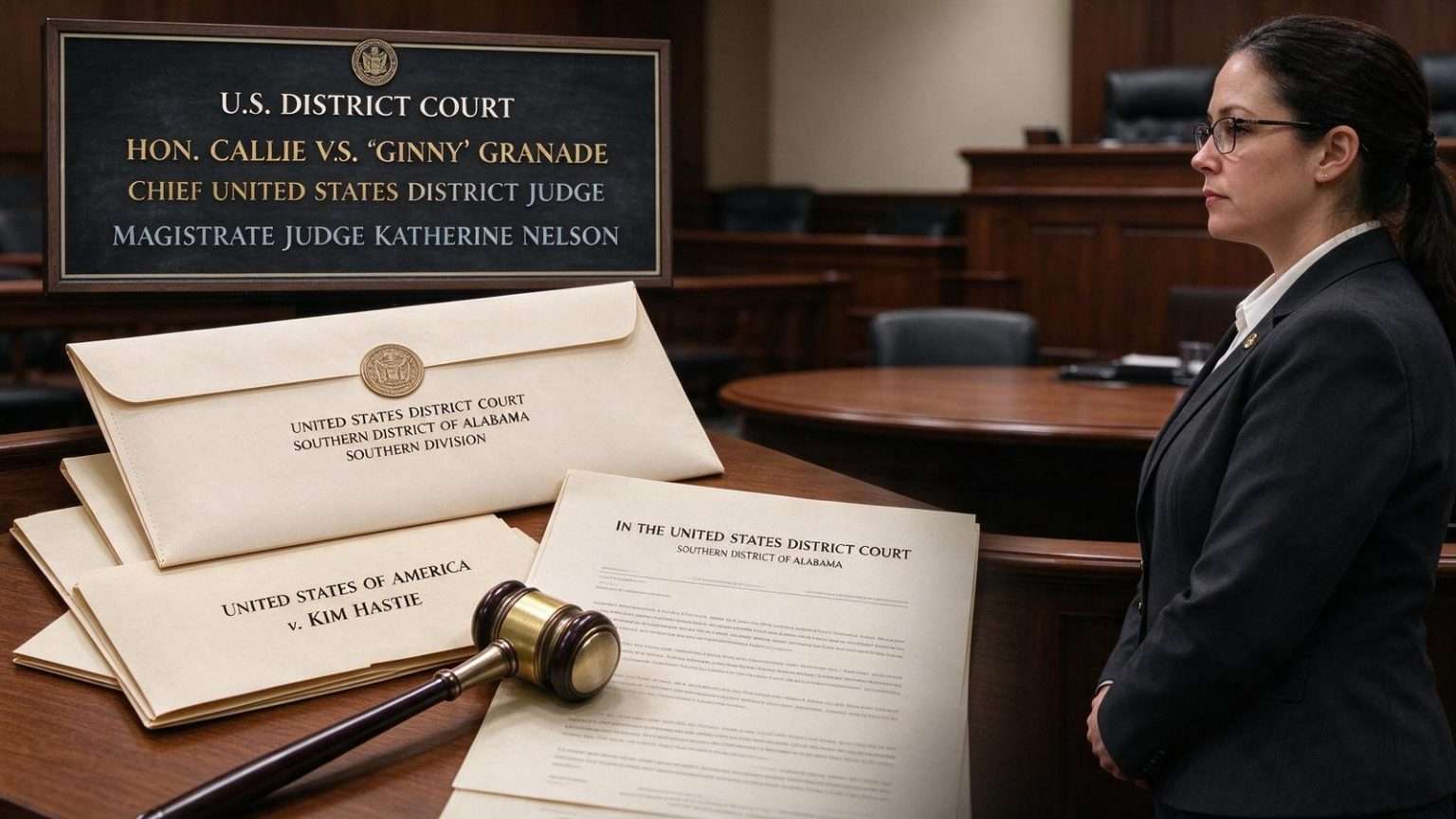
A dispute over legal representation is complicating preparations for the upcoming federal criminal trial of Mobile County License Commissioner Kim Hastie, after prosecutors raised concerns that one of her attorneys may need to testify as a witness in the case.
During a hearing in U.S. District Court in Mobile, Assistant U.S. Attorney Gregory Bordenkircher told the court the situation has grown more complicated the deeper prosecutors look into it. “We’ve been thrown into the briar patch,” he said, describing the tangled legal question of whether the attorney can continue representing Hastie while also potentially taking the stand.
At issue is a letter the attorney sent to Hastie and others last August, prior to her indictment, advising her against using money from a county fund to pay a lobbying firm for its services. According to prosecutors, the firm was paid $10,000 to draft legislation supporting Hastie’s push to merge the License Commission with the Mobile County Revenue Commission, a plan detailed in the indictment made public in November.
The letter sits at the center of the case because of what it shows about timing. If Hastie received written advice, before the payments at issue, that using county money for the lobbying purpose was improper, prosecutors can argue she proceeded despite knowing the problem. Defense lawyers see the same document differently, as evidence their client sought and relied on legal guidance before acting.
U.S. District Judge Callie V.S. “Ginny” Granade ruled earlier this year that the letter is a public record, rejecting arguments from Hastie’s defense team that it should remain shielded. Prosecutors plan to introduce the letter as evidence and to call its author as a witness, calling it a key piece of their case.
The briar patch of dual roles
Bordenkircher told the court he believes Hastie’s legal team may try to use the letter to argue that her subsequent actions were shielded because she received advice after the fact, calling that approach “a bootstrap method of trying to make a good faith argument.” The government’s concern is that a document obtained for trial evidence could be repurposed as the foundation of an advice-of-counsel defense, while the author of that advice sits at the defense table.
One of Hastie’s three defense attorneys, Neil Hanley, pushed back on the government’s position, saying he was “totally confused” by the effort to potentially disqualify counsel of Hastie’s choosing. “The bar should be very, very high when you disqualify an attorney,” Hanley told the court, citing constitutional protections for defendants to choose their own legal representation.
Hanley’s argument rests on a principle federal courts treat with real weight. A defendant’s right to counsel of her choice is protected by the Sixth Amendment, and courts disqualify attorneys only when a genuine conflict of interest or a serious risk exists, such as when an attorney is likely to be a necessary witness on a contested issue. The test is not whether the attorney might testify, but whether his testimony would be central to the case and whether the conflict would compromise the defense.
U.S. Magistrate Judge Katherine Nelson said she would issue a ruling on the matter by the end of the week, noting skepticism that the attorney could serve simultaneously as both witness and counsel without confusing a jury. “What the attorneys say is not evidence, except when the attorney takes the stand,” Nelson said, explaining her concern. Her framing captured the practical danger: jurors are instructed not to treat arguments and objections as evidence, but a lawyer arguing the case and then walking to the witness stand blurs a line jurors are asked to hold.
The witness-advocate rule exists to prevent exactly that confusion, but applying it is never mechanical. Courts must weigh the importance of the anticipated testimony, the prejudice to the defendant of losing chosen counsel, and the timing, since a defense that learns late that its own lawyer is a prosecution witness has fewer options to adapt. Nelson’s ruling would set the terms for how Hastie’s trial team is configured before jury selection begins.
For the trial schedule itself, the stakes are immediate. If the attorney is disqualified, Hastie would proceed with her remaining counsel or add new representation, and a new lawyer would need time to absorb a case already deep in preparation. If the attorney remains, prosecutors will have lost their push to separate the letter’s author from the defense table, though they can still call him as a witness under whatever limits the court sets.
The charges beneath the dispute
Hastie and her husband face federal charges alleging they failed to report more than $58,000 in income to the IRS from land transactions, timber cutting and land-clearing work. The tax charges center on income the government says flowed to the couple through property-related dealings and never appeared on their returns.
Additional charges filed earlier this year allege Hastie coordinated a scheme involving thousands of forwarded emails to a political consulting firm. Those charges broaden the case beyond the original tax allegations and connect to the lobbying activity at the heart of the letter dispute, since the forwarded emails allegedly fed the lobbying effort the indictment describes.
The case against a sitting county official carries institutional weight beyond the personal stakes. The Mobile County License Commission is an independent agency that handles vehicle registrations and related transactions across the county, and its relationship with the Mobile County Revenue Commission, the subject of Hastie’s merger push, has been a recurring question in local government. The indictment’s account of a $10,000 lobbying payment drawn from a county fund places that interagency debate at the center of a federal criminal case.
Federal tax cases of this kind typically turn on documents, transaction records, returns and correspondence, which is why a single letter has generated a week of hearings. Unlike cases built on witness memory, a documentary case lives or dies on the sequence of what each participant knew and when, and the August letter, dated before the indictment and addressed to Hastie and others, is precisely the kind of document both sides want to frame on their own terms.
The advice-of-counsel issue the government flagged operates under demanding rules. A defendant claiming reliance on legal advice generally must prove she fully disclosed all relevant facts to the lawyer and actually relied on the advice in good faith. Courts scrutinize these claims closely because the defense, if accepted, can negate the willfulness that many federal charges require, and prosecutors argue the bootstrap problem arises when the defense tries to manufacture that reliance claim from a document it first fought to keep sealed.
Granade’s ruling that the letter is a public record also shaped the battlefield. By treating the document as public rather than privileged, the court cleared the way for it to reach a jury, and the remaining fight over the attorney’s role is about who gets to stand beside Hastie while it does. A public record that its author’s firm wrote cannot be un-written; the question is only whether its author argues about it or testifies about it.
The end-of-the-week ruling from Magistrate Judge Nelson will set the trial’s footing, and whichever way it goes, the underlying dynamics will not change. Prosecutors will present the letter and the alleged $10,000 payment as evidence of intent; the defense will present the same record as proof of good faith and consultation. Mobile County residents watching the case will see their License Commissioner’s fate turn on a question that began with a piece of paper and now depends on where the man who wrote it is standing when the jury hears about it, at the defense table or on the witness stand.
What the merger fight was about
The dispute over the lobbying payment cannot be separated from the policy question Hastie was pursuing. Her push to merge the License Commission with the Mobile County Revenue Commission aimed at consolidating the county’s separate revenue-collecting agencies, a structural change that would reshape how vehicle registrations, ad valorem taxes and related functions are administered. Mergers of that kind have been debated in Alabama counties for years, with proponents promising efficiency and opponents pointing to job losses and loss of local control.
What turned that policy debate into a federal case, in the government’s account, was the funding mechanism: $10,000 drawn from a county fund and paid to a lobbying firm to draft legislation supporting the merger. The August letter warned Hastie against exactly that use of county money before the payment issue matured, and the indictment’s November release tied the payment, the legislation and the alleged email scheme into a single narrative for the grand jury’s charges.
The thousands of forwarded emails described in the additional charges give investigators a documentary trail that few white-collar cases offer. Email forwarding leaves server records, timestamps and recipient lists that can be reconstructed precisely, and a pattern of thousands of messages routed to a political consulting firm is the kind of evidence that either establishes coordination or, if the defense can contextualize it, shows routine administrative practice. Either way, the volume of the record means the trial will be fought in documents as much as in testimony.
The timeline ahead
With Nelson’s ruling expected by the end of the week, the case moves toward its trial preparations on a defined footing. Jury selection, pretrial motions and the final contest over evidence will follow, and the defense team’s composition is the first domino: everything from witness preparation to cross-examination assignments depends on who is standing where when the trial begins.
The husband’s charges also run on the same track, and family members charged together face complications of their own. Joint defendants sometimes need separate representation to avoid conflicts between their interests, and the same August letter and the same transactions will be examined from each defendant’s vantage point.
For Mobile County, the case is a test of how the justice system handles alleged misconduct by a sitting official without presuming the answer. Hastie remains the License Commissioner while the charges are pending, and the constitutional protections her defense invoked for counsel of choice are the same protections any defendant would claim. The process now underway, hearings, rulings and eventually a jury, is the mechanism by which those competing claims get resolved.
The briar patch Bordenkircher described has no obvious exit, which is what made the metaphor stick. An attorney who wrote key evidence, a defendant who claims she relied on it, and prosecutors who say the reliance is an invention all occupy the same few pages of the record. Federal courts untangle such knots every week, but rarely with a county commissioner’s career, a $10,000 lobbying payment and an agency merger fight all hanging on the ruling of a single magistrate judge by week’s end.