Mobile County License Commissioner’s Tax Trial Set to Open Without Key Defense Attorney
Mobile County License Commissioner Kim Hastie heads to federal trial on tax evasion charges after her defense attorney recused himself from the case.
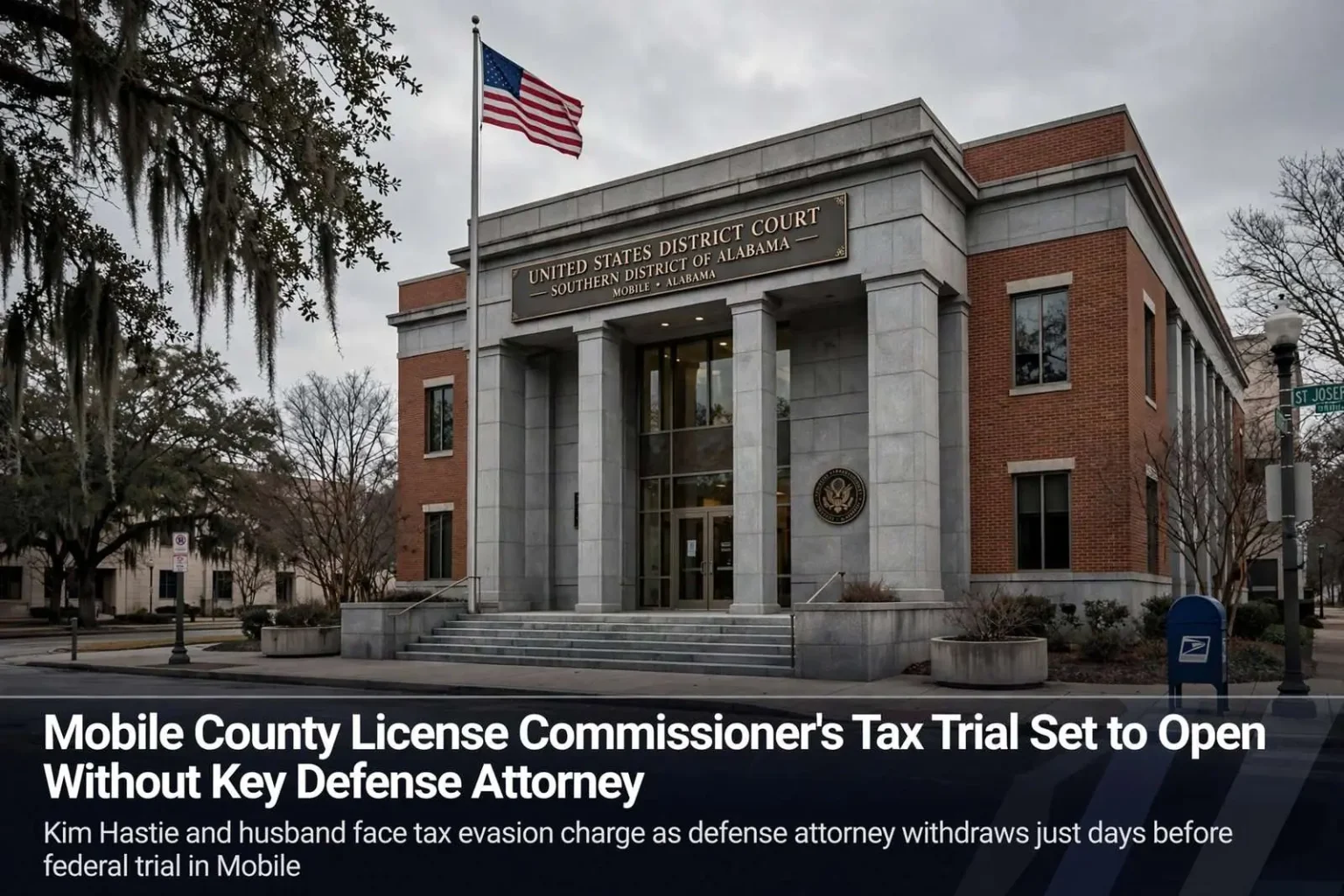
Mobile County License Commissioner Kim Hastie and her husband were set to head to federal court for the first phase of a lengthy criminal case, opening with a tax evasion charge just days after one of Hastie’s key defense attorneys withdrew from the case entirely. The attorney stepped aside from the proceedings after a federal judge ruled prosecutors could call him as a witness, given his past communications with Hastie regarding use of a government account. Court records show the attorney had previously advised Hastie in writing that she should not use taxpayer funds the way prosecutors allege she did, a letter jurors are expected to see during trial.
The withdrawal left the defense reshuffling its team on the eve of trial, a complication in a case already dense with overlapping proceedings. Under federal ethics rules, a lawyer who is likely to be a witness on a material issue in the case generally cannot also serve as trial counsel, and the judge’s ruling placed the attorney’s prior written advice — the very document prosecutors intended to highlight — at the center of the government’s theory. His testimony would go directly to what Hastie knew about the propriety of her spending, making his dual role untenable.
Hastie faces 18 total criminal counts spanning multiple alleged schemes. The trial opening this week covers a single tax evasion count tied to unreported income; a separate trial covering the remaining 17 counts was scheduled for late May. The same federal judge in the U.S. District Court in Mobile is set to preside over both proceedings. Splitting the case allowed prosecutors to move forward with the count they considered trial-ready while the more elaborate allegations awaited their own docket, but it also meant the community would watch the story unfold in installments through the spring.
Hastie and her husband were indicted earlier this year on allegations that they failed to report more than $58,000 in income to the IRS, stemming from land brokering and timber-clearing work. The charge at the heart of the first trial was narrow — a failure to report income — but prosecutors framed it as a window into the couple’s finances and their handling of money earned outside Hastie’s public salary as one of Mobile County’s independently elected constitutional officers.
The email scheme allegations
Additional charges filed in January accused Hastie of orchestrating a scheme to funnel thousands of residents’ email addresses, obtained through her county office, to a political consulting firm working for a 2013 Mobile mayoral campaign. The allegation drew particular attention because it touched the county office itself — the taxpayer-funded operation that every Mobile County resident with a car tag renewal passes through — and raised questions about how personal data collected for government services can be used once it is in the government’s hands.
The consulting firm’s chief executive has maintained that the campaign’s operations were entirely proper. Still, two Mobile residents filed a federal lawsuit days before the trial’s start, alleging Hastie and the consulting firm violated their privacy rights by releasing their email addresses without consent. The suit seeks tens of millions of dollars in damages and claims Hastie provided the firm with tens of thousands of email addresses gathered through her office.
Hastie’s remaining defense team declined to comment on the civil lawsuit, saying it had no bearing on the criminal proceedings set to begin. The consulting firm’s leader disputed the lawsuit’s allegations, saying the campaign operated transparently and within the rules throughout. The civil case put the dispute before a separate forum while the criminal trials moved forward, ensuring that questions about the email list would remain in the public eye regardless of what happened in the tax trial.
The merger charge and the county office
Separately, Hastie was charged last fall with improperly using taxpayer money in connection with a proposal to merge the county’s license and revenue commission offices, a change that would have resulted in a pay raise for her if approved. Prosecutors allege she used a government account to pay a consulting firm to help draft legislation supporting the merger. The proposal, which had circulated in Montgomery as a potential consolidation of two overlapping county offices, became the centerpiece of the government’s initial case and the source of the defense attorney conflict that reshaped the trial team.
The license commissioner’s office is one of the most visible pieces of Mobile County government, handling motor vehicle titles, registrations and renewals for a county of more than 400,000 residents. Whatever the outcome of the litigation, the allegations touched an office whose operations residents encounter directly, and the case became a recurring topic of conversation at county commission meetings and in local media throughout the winter and spring.
A deputy commissioner in Hastie’s office also faces separate fraud-related charges tied to the office’s operations. The parallel case added to the sense of an office under comprehensive scrutiny, with investigators examining personnel, spending and data practices that had received little outside attention before the first indictment. County officials in other offices watched the proceedings with the understanding that the standards being tested in federal court would shape how every elected row officer managed public resources going forward.
A case watched across the county
The case has drawn significant attention in Mobile County as it moves through multiple phases of pretrial motions, witness disputes and now trial, with the broader set of charges still to be litigated in the weeks following the opening proceeding. Each hearing has produced its own developments — rulings on evidence, disputes over witnesses, scheduling fights between prosecutors and a defense roster that had to be rebuilt midstream.
The unusual texture of the case — a sitting county official, a withdrawn attorney turned witness, a civil suit seeking tens of millions of dollars, and a second trial looming in May — made it one of the most closely followed federal dockets in Mobile. Court observers noted that splitting the counts into two trials gave jurors a simpler set of questions in each proceeding, but it also extended the public airing of the allegations across the better part of a year.
For Hastie, the stakes compound with each proceeding. A conviction on the opening tax evasion count would color the jury pool for the May trial on the remaining counts; an acquittal would strengthen her position heading into the second round. Her defense team, reorganized only days before the opening, now carries the burden of addressing both the government’s financial evidence and the prosecution’s plan to introduce the written advice of the very lawyer who had been expected to defend her.
Beyond the courtroom, the case has become a reference point in discussions of ethics reform at the county level. The allegations span three distinct kinds of misconduct — unreported personal income, use of a government account for political purposes, and transfer of resident data to a political operation — and each has prompted its own questions about oversight. County government in Alabama relies heavily on independently elected officials whose offices operate with substantial autonomy, and the Hastie case has been cited in local debates about whether that structure provides adequate checks.
The privacy lawsuit filed by the two Mobile residents added a dimension the criminal case does not cover: direct accountability to the residents whose information allegedly moved from a county database to a political consultancy. Their suit, whatever its outcome, has already changed the conversation, prompting other local governments in the region to review how they handle the personal information residents provide when they renew tags, pay taxes and transact routine business with county offices.
The timing of the civil filing — days before jury selection — did not go unnoticed. Civil suits built on the same facts as criminal prosecutions are a familiar feature of public-corruption litigation, and the plaintiffs’ decision to move while attention was fixed on the trial guaranteed that the email allegations would stay current through the spring. Any testimony in the criminal trial about how the addresses were gathered and transferred could be quoted back in the civil docket, where the standard of proof is lower and the damages claimed run into the tens of millions.
The case has also unfolded against the backdrop of Alabama’s long history of public-corruption prosecutions, which have touched legislators, county commissioners and city officials across the state for decades. Federal prosecutors in the Southern District of Alabama have made such cases a specialty, and local residents have learned to follow them in installments — indictment, pretrial skirmishes, first trial, appeal. The Hastie proceedings fit the pattern, but the presence of a sitting constitutional officer and the data-privacy angle gave them a profile beyond the usual corruption file.
As the first trial opened, the question before the Mobile jury was deliberately narrow: whether Hastie and her husband evaded taxes on unreported income from land brokering and timber-clearing work. But the atmosphere surrounding the trial — the packed proceedings, the withdrawn attorney, the lawsuit waiting in another courtroom — ensured that the case would be measured against something larger than a single count. For a county watching one of its elected officials stand trial, the spring of proceedings ahead would test not only one defendant’s conduct but the public’s confidence in the offices that serve it.