Citronelle’s James Taylor Reflects on Bear Bryant’s Advice Ahead of Hall of Fame Induction
Citronelle native and former Crimson Tide running back James Taylor joins the Mobile Sports Hall of Fame class of 2015 this week.
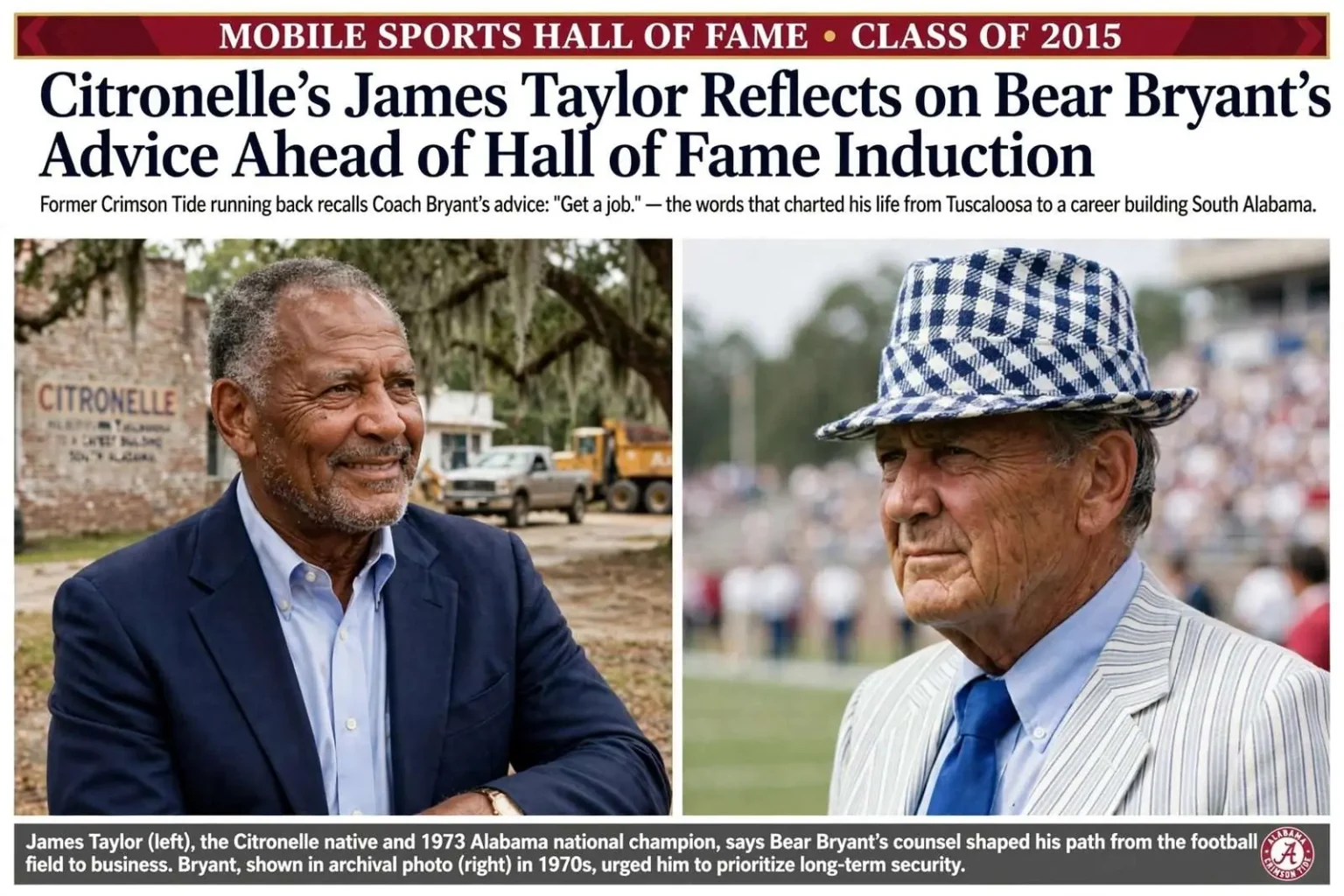
Before he became a member of the Mobile Sports Hall of Fame class of 2015, James Taylor was just a running back out of Citronelle trying to decide what came next after a standout career at Alabama. The advice that shaped that decision, he says, came straight from legendary Crimson Tide coach Paul “Bear” Bryant.
“Get a job. That’s what he told me,” Taylor said, a hint of a laugh in his voice, recalling the moment Bryant pulled him aside as he prepared to test his chances at pro football.
Bryant wasn’t dismissing Taylor’s talent. At one point Taylor held the highest per-carry rushing average of any running back in Crimson Tide history. Instead, Bryant was thinking about Taylor’s long-term security, and Taylor says he’s grateful for it all these years later.
The moment captured both men perfectly. Bryant, the gruff taskmaster whose craggy face looked down from billboards across the state, measured every player by more than yards gained. Taylor, the country kid from Citronelle who had reached Tuscaloosa on one season of high school football, listened — and built a life on what he heard.
From Citronelle to Tuscaloosa
Taylor’s path to Tuscaloosa started with a single season of high school football in Citronelle. He played only in 1971, but it was enough to earn All-County and All-State honors and a spot in the Alabama High School All-Star Game. From there, he joined Bryant’s program and became part of three SEC championship teams, appearing in three consecutive bowl games. The 1973 squad shared the national championship with Notre Dame, back when titles were decided by wire-service polls rather than a playoff.
The brevity of his high school career is the part of the story that still stuns people who hear it. One season — not four, not even two — was the entire recruiting file on a player who would end up in the record books of the most storied program in college football. Citronelle, a small town in the northern reaches of Mobile County built around timber and the rail line, was not a stop on the recruiting circuit, and a player who only appeared there as a senior might have gone unnoticed entirely.
What made him visible was the All-Star Game and a protective instinct from within the Alabama staff. Taylor made the All-Star Game anyway, in part because former Alabama linebackers coach Pat Dye didn’t want other programs getting a long look at him. Dye, who would later build his own legend as the head coach at Auburn, saw early what the Tide was getting — and made sure nobody else got the same view.
Once in Tuscaloosa, Taylor settled into a backfield rotation during one of the most sustained runs of excellence in school history. Three straight SEC titles and three straight bowl trips framed his years there, and the 1973 championship season remains one of the most celebrated in the program’s history — the year Alabama’s offense ran at a pace few defenses in the country could match and finished the polls ranked alongside Notre Dame at the top.
Bryant’s counsel
After graduation, both the New York Giants and New England Patriots showed interest in Taylor. But he came up in an era when players outside the first or second round of the NFL draft rarely saw big paydays. “Yeah, you probably weren’t going to make a lot of money,” Taylor said. “Coach Bryant told me if I went to the pros with no insurance and nobody to back me, I was taking a big risk.”
The calculus Bryant laid out was brutal and honest. Professional football in the early 1970s paid a fraction of what it does now, contracts were rarely guaranteed, and a running back’s body absorbed the worst of the game’s violence. A player who chased a roster spot and failed, or whose career ended in a preseason game, walked away with nothing but the injuries. Bryant, who had seen dozens of talented players pass through his program, wanted his running back to weigh the risk with clear eyes.
The stakes were personal. Taylor’s father died when he was 8 years old, leaving his mother, who had only a third-grade education, to raise 10 children largely on her own. Whichever of the kids could work did, which is part of why Taylor only played that one season of football in Citronelle before family responsibilities took priority.
That upbringing shaped everything that followed. A household where ten children pulled their weight taught Taylor the habit of work that Bryant’s program would only sharpen. It also explains why football, for all his talent, was never the whole plan — a lesson he absorbed at home years before Bryant delivered his version of it on the practice field.
Building a career back home
Taking Bryant’s advice to heart, Taylor moved into banking for a few years after football, then into trucking, focusing on dump trucks, before realizing the real opportunity was in general contracting. He built a career there instead, one he and his wife of 34 years, Susan, are now winding down.
The progression from bank teller to dump trucks to construction reads like a map of how South Alabama actually grew in those decades. The region’s economy ran on projects — roads, subdivisions, commercial buildings rising along the corridors between Mobile and Baldwin County — and a man who knew equipment, payroll and deadlines could build something durable. Taylor’s contracting business became exactly that, rooted in the same work ethic Bryant had bet on when he told him to get a job.
Football never left him entirely, either. The couple raised four children who went on to their own successful careers: a doctor, a nurse, a restaurant area manager and an assistant coach in professional football. For a man who chose security over the NFL, the path came full circle — one child back in the game at its highest level, working in a profession his father briefly considered before deciding the price was too steep.
Taylor’s induction into the Mobile Sports Hall of Fame this week caps a life that started on the practice fields of Citronelle and stretched through championship seasons in Tuscaloosa to decades of building a business back home in South Alabama.
The honor also places him in a lineage the Hall of Fame has always celebrated — the local athletes whose careers ran through the state’s two great college programs and back into the community, where they coached, built and raised the next generation. For Mobile, a city that has produced more than its share of professional stars, the Hall’s real work is remembering the fuller story: the players who mattered at Alabama and Auburn, then came home.
Taylor tells the story of Bryant’s advice with a laugh now, but the laugh carries the point. The most famous coach in Alabama history looked at one of the most efficient running backs the program had ever known and told him to get a job — and the running back took the advice, made a good living, raised four children and never regretted the trade.
The record still stands in the story, too. Whatever the pro scouts might have seen in him, Taylor’s per-carry average remains a mark of how effective he was every time the Tide handed him the ball in the early 1970s — a number that survived national championships, legendary teammates and the decades since.
Asked what the induction means, Taylor has tended to return to the same ground: the people who got him there. A mother raising ten children alone in Citronelle. A coach named Pat Dye who quietly steered him toward the All-Star Game. A legendary head coach who treated a young man’s future as seriously as his own. The Hall of Fame week, for all the nostalgia, is simply the latest chapter of a story about work — the kind done on football fields, and the kind that fills the years after them.
That may be the most Mobile part of the whole story. This is a city that honors its athletes, but it respects its builders more, and James Taylor managed to be both: a record-setting back in the greatest era of Crimson Tide football, and the contractor who came home, ran his trucks, raised a doctor, a nurse, a manager and a coach, and told anyone who asked that Bear Bryant’s four words were the best career advice he ever got.
The Hall of Fame weekend itself gave Citronelle a rare moment at the center of the Mobile sports world. The town, better known for its timber trucks than its trophies, has sent few athletes into the state’s spotlight, and locals who remembered the 1971 season — the whole of it — could claim what few communities anywhere can: that their single season of high school football produced a record-setter at Alabama and, five decades on, a Hall of Famer.