Bayou La Batre Refugee Advocate Sees His Own Journey in Mediterranean Migrant Crisis
A Bayou La Batre nonprofit director who fled Vietnam by boat as a child says he recognizes his own story in today's Mediterranean migrant tragedies.
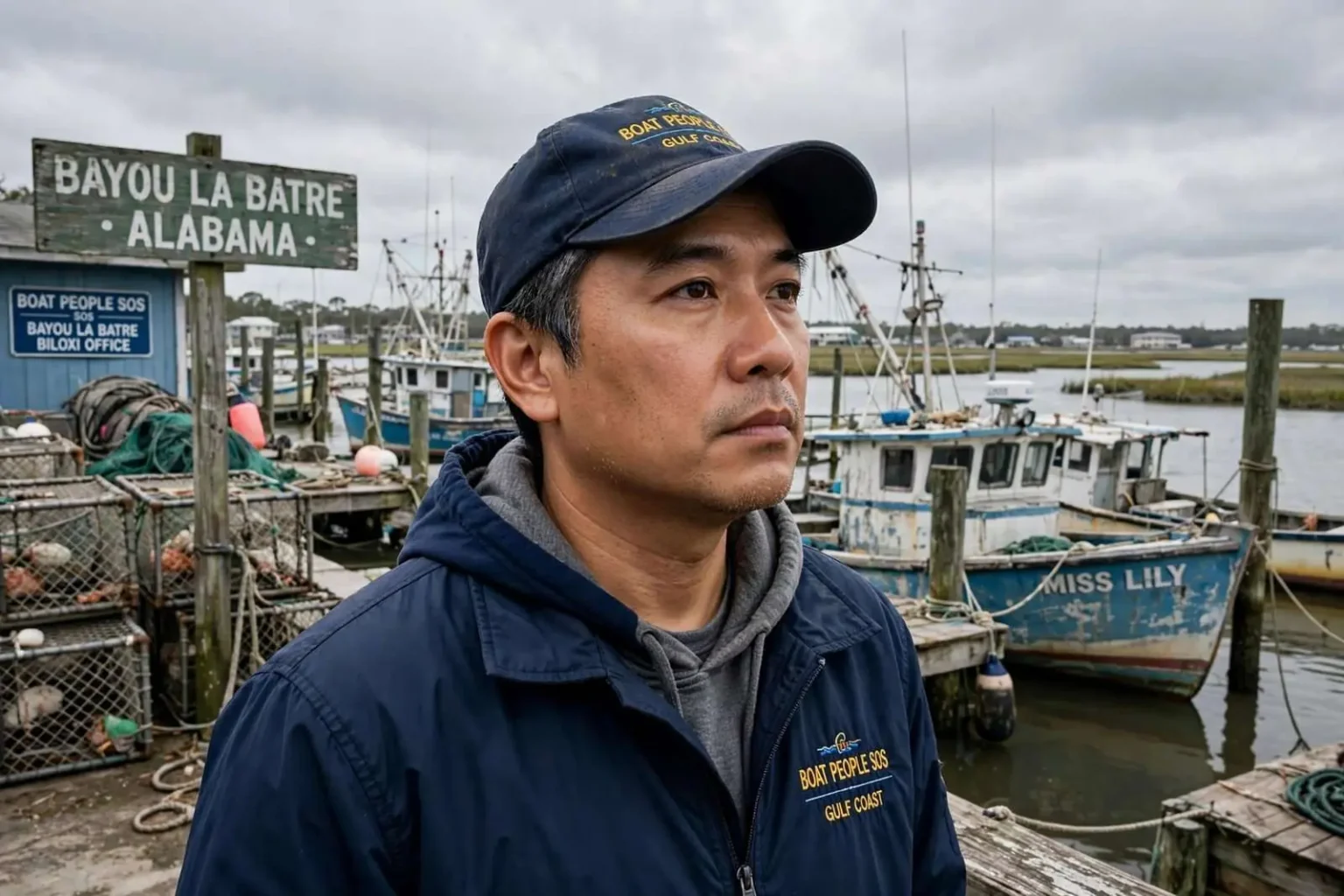
Daniel Le still remembers the night more than three decades ago as if it happened yesterday. As a boy of 7 or 8, he fled Vietnam with his parents and three brothers, the youngest only 8 months old, crowding into the bottom of a 30-foot wooden boat with a single engine and more than 100 other refugees. “We fled Vietnam in the middle of the night to avoid detection by the coast guard,” Le, now 46, recalled.
Today, Le runs the Bayou La Batre and Biloxi, Mississippi, offices of Boat People SOS, a nonprofit dedicated to supporting the Vietnamese-American community along the Gulf Coast. Watching news coverage of migrants risking their lives on overcrowded boats crossing the Mediterranean Sea, he said he sees unmistakable parallels to what his own family endured escaping Vietnam in the late 1970s.
The comparison gained new weight after an estimated 700 migrants drowned when a vessel carrying them from Africa toward Europe capsized in the Mediterranean, a disaster that drew condemnation from European leaders and Pope Francis and underscored the increasingly desperate conditions driving people onto dangerous overseas crossings.
Le said the core motivation looks the same across both crises, even if the timelines differ. His family’s exodus from Vietnam played out over roughly a decade, while the Mediterranean deaths are unfolding in a more compressed, sudden wave. “I can relate because the condition of the country where they live must be really horrible if they risk their lives for freedom,” Le said. “Freedom is really priceless.”
For the communities Le serves — the Vietnamese fishing families of Bayou La Batre, Alabama, and the established community across the coast in Biloxi — the images from the Mediterranean are not distant news. They are, in the faces of the survivors pulled from the water and the crowds waiting on foreign shores, a picture of what their own parents and grandparents lived through, played out on another sea in another generation.
The Escape
Le’s father had served as an officer in the South Vietnamese military and spent four years in a re-education camp after the war before his release. That experience convinced him his family would never truly be free under the new government, Le said, and he made the decision to escape.
The family’s boat journey took them from Vietnam west toward Thailand. On the fourth night at sea, pirates boarded the vessel and robbed the refugees of what little they carried, an ordeal Le’s family survived along with the rest of the passengers. The threat of piracy was a defining terror of the escape routes out of Vietnam — boats loaded with families and small children crossed hundreds of miles of open water, and armed attacks at sea were common enough that survivors’ accounts almost universally include one.
What followed for Le’s family, like for so many of the “boat people,” was a sequence of temporary refuges and uncertain waits before permanent resettlement. The Gulf Coast was not the only destination for the hundreds of thousands of Vietnamese who resettled in the United States after the war, but the seafood industry of south Alabama and coastal Mississippi became one of the community’s great anchors, offering work that required little English at first and rewarding the long hours refugee families were prepared to put in.
In Bayou La Batre, the Vietnamese arrival reshaped a small shrimp boat town. Families bought and repaired boats, crewed on local vessels, and eventually owned processing houses and fleets of their own. Over the decades the community became central to the town’s identity — its churches, groceries and restaurants a fixture along the bayou — even as hurricanes, the Deepwater Horizon oil spill and import competition tested it repeatedly. Each test, longtime residents say, the community absorbed and rebuilt.
Boat People SOS on the Gulf Coast
Boat People SOS, the organization Le now serves, grew out of the refugee resettlement era into a national network of offices providing services to Vietnamese Americans — assistance with citizenship and naturalization, translation and navigation of government systems, health outreach, and support for elders and newly arrived family members. On the Gulf Coast, its Bayou La Batre and Biloxi offices serve a population dispersed across two states but connected by language, history and the seafood economy.
Le’s work places him at the junction of two generations: elders who crossed the sea in wooden boats and young Vietnamese Americans for whom that history is a family story rather than a memory. He has spoken publicly about his own family’s escape in part, he says, because the Mediterranean coverage demands that people who survived a similar exodus bear witness to it.
The parallels Le draws between the two crises are specific. In both, he notes, families put to sea in vessels never built for the passage, trusting their lives to smugglers and the weather because remaining ashore had become the greater danger. In both, children made the crossing — he was a child himself, and his youngest brother an infant. And in both, the international response lagged behind the emergency, with warnings about overcrowded boats going unheeded until a single disaster fixed the world’s attention.
The Mediterranean disaster that sharpened his point — the capsizing that drowned an estimated 700 migrants — drew condemnation from European leaders and Pope Francis, and it became a symbol of a migration emergency unfolding along the southern edge of Europe. For Le, the coverage was a rerun of images he had seen in family photographs and heard in kitchen-table accounts for decades: an overloaded hull, a sea that shows no mercy, and a shoreline that represents either salvation or nothing at all.
“The condition of the country where they live must be really horrible if they risk their lives for freedom,” he said, returning to the point that anchors his account. No parent puts an 8-month-old baby in the bottom of a leaky wooden boat casually. The decision comes only when staying has become unbearable — a calculus he knows his own father made, and that families across the Mediterranean are making now.
What His Story Means Locally
Le’s reflections carry weight along the Gulf Coast because the Vietnamese-American community here is itself a monument to the refugee experience. From the shrimp docks of Bayou La Batre to the casinos’ kitchen lines and seafood houses of Biloxi, the community built prosperity from the same journey Le survived as a child — proof, he argues, of what refugees become when they are given the chance to land.
He wants that history remembered when policy and public opinion turn against the newest arrivals. The families who now own boats and businesses along the bayou were once the boat people, feared and unwelcome in the towns they eventually transformed. The Mediterranean’s millions, he suggests, deserve the same chance his family got — because freedom, as he learned at sea before he could fully understand the word, is really priceless.
The lesson, Le believes, is also practical for the communities that receive refugees. Resettlement works when newcomers find work that matches their skills and institutions that speak to them in their own language until they find their footing. The Gulf Coast’s seafood industry provided exactly that for the Vietnamese families who arrived with fishing traditions of their own — and the results are visible in every fleet and processing house the community now runs.
Le’s own trajectory tells the same story in miniature: a child smuggled across a sea in the hold of a wooden boat became a community advocate with offices on two sides of the Mississippi Sound, serving the elders and the young alike. His father’s four years in a re-education camp ended in the decision to run; his own life’s work has been to make sure the community that run produced is never left to fend for itself.
When he watches the Mediterranean news, he says, he does not see strangers. He sees his parents, his brothers, the 100 other passengers crowded into a 30-foot hull in the dark — and he sees the difference that a welcoming shore made in one family’s history, three decades and one ocean away.
The timing of his family’s escape placed it in the great wave of Vietnamese boat departures that followed the war’s end — a diaspora that eventually scattered families across the United States, Australia, France and Canada. Many of those who left paid for their passage with gold, handed over to organizers who packed boats far beyond any safe capacity. The departure itself was a crime under the government of the time, which is why families launched at night and why the coast guard’s searchlights were the first danger of the journey.
Survivors’ accounts from that era describe the same essentials Le remembers: water in the hull, engines that sputtered and died, navigation by the stars, and days of drifting before landfall or rescue. Some boats reached Thailand or Malaysia within a week; others wandered for months or were pushed back to sea by authorities who wanted no part of the burden. The uncertainty was total, and the families who made it often learned only afterward how close the outcome had been.
Against that history, Le reads the Mediterranean crossings almost literally frame by frame. The vessels are different — rubber dinghies and rusting freighters instead of wooden fishing boats — but the economics are the same: smugglers paid per head, capacity ignored, and the sea itself the final arbiter of who arrives. He has said he does not need reporters’ descriptions to imagine the scene below deck, because he lived a version of it before he was old enough to write his own name.
That lived memory is what Le brings to his advocacy, and it is why his account resonates with the elders he serves in Bayou La Batre and Biloxi. When he describes a night departure or a pirate boarding, the community’s grandmothers nod — they hold their own versions of the same story, mostly untold, from a sea on the other side of the world.