Judge Voids $4.2 Million Retirement Deal, Finds Bayou La Batre Housing Board Broke Open Meetings Law
A Mobile Circuit judge ruled the Bayou La Batre Housing Authority board violated Alabama's Open Meetings Act in approving contracts behind closed doors that created a $4.2 million retirement payout for two former executives.
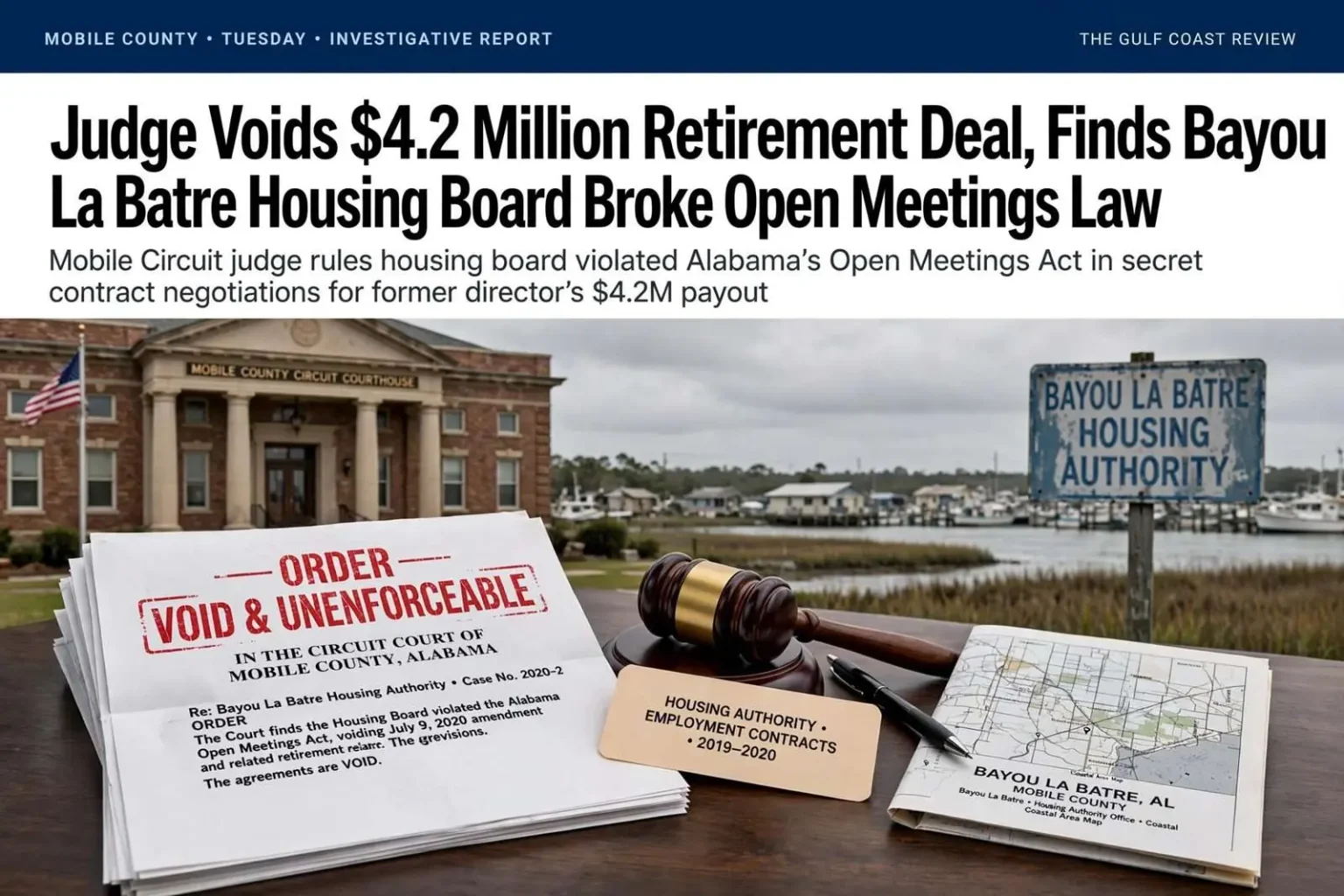
Members of the Bayou La Batre Housing Authority Board violated Alabama’s Open Meetings Act when they privately negotiated employment contracts that ultimately produced a multimillion-dollar retirement payout for the agency’s former director, a Mobile Circuit judge has ruled.
In an order published Tuesday, Judge Wesley Pipes found that board members discussed and agreed to new employment contracts for former director Virginia Huddleston and her husband, Darryl Wilson, during an executive session on Oct. 15, 2019. Alabama law expressly bars public bodies from discussing the “salary, compensation, and job benefits” of specific employees behind closed doors.
“Although they were later approved in normal session, there was no discussion, just a formal vote to ratify what had already occurred without any hint of what it was,” Pipes wrote.
How Alabama’s Open Meetings Act Works
The Open Meetings Act is the statute that guarantees Alabamians the right to watch their government operate. Public bodies may retreat into executive session, but only for a narrow list of enumerated reasons, such as discussing pending litigation or the good name and character of an individual.
Compensation is explicitly not on that list. The reasoning is straightforward. Deciding how much public money to pay a public employee is precisely the kind of decision citizens are entitled to observe. A vote taken in the open that merely ratifies a deal struck in private defeats the purpose of the law, and Pipes’ order makes that point directly.
Crucially, the statute provides a remedy with teeth. As Pipes noted, citing Alabama case law: “Agreements and actions taken in violation of the Open Meetings Act are void.” Not voidable, not subject to correction. Void.
The Contracts at Issue
The employment agreements sit at the center of a five-year legal battle between current and former Housing Authority officials over payments made to Huddleston and efforts to claw them back.
The dispute surfaced publicly in 2020, following a complete turnover of the Housing Authority board and the resignations of Huddleston and Wilson. Newly appointed board members released documents showing the couple’s employment agreements had been repeatedly amended over time to increase their salaries and expand their benefits.
Similar transparency concerns arose at a July 21, 2020, meeting, where the board approved another contract addendum without public discussion. Requests for copies of the contract made at that meeting were denied or ignored.
That addendum converted the retirement terms into lump-sum payments:
$2.52 million for Virginia Huddleston
$1.66 million for Darryl Wilson
$4.2 million combined
Pipes’ ruling found the entire July 9, 2020, amendment void and unenforceable, along with the retirement provisions contained in the 2018 and 2019 contracts.
The Bylaws Failure
The judge did not rest solely on state law. He also pointed to the Housing Authority’s own bylaws, which permit executive sessions only for purposes allowed by law and require the authority’s attorney to certify that a given session meets those legal requirements.
Pipes found that certification never happened.
The Attorney’s Affidavit
Huddleston, Wilson and several board members argued in their defense that the contracts had been created in cooperation with the board’s attorney at the time, Brent Day. Day’s own sworn statement contradicted them.
The defendants contended that “the Board approved all of these contracts and amendments, and that they were either drafted, reviewed, or approved by the Authority’s attorney,” Pipes’ order recounts. “Mr. Day provided an affidavit denying he did any of these things and points to a letter he wrote to the Board advising that the sale of Safe Harbor may violate any number of laws and threatening to resign.”
Huddleston and Wilson tried unsuccessfully to have that letter struck from the record, arguing that email records showed Day was copied on correspondence between Huddleston and board members discussing the contract terms.
Pipes was unpersuaded, and his reasoning is notable for how little it depended on the lawyer’s role at all.
“Day’s potential involvement does not affect the enforceability of the contracts. They are unconscionable and illegal regardless of his knowledge, approval, or ignorance of them,” Pipes wrote. He added that while Day’s involvement “might be relevant to Defendants’ claim they did nothing wrong and relied on the Authority’s lawyer to tell them if there was a problem,” none of the defendants raised advice of counsel as an affirmative defense, and it is “probably waived at this point in this five-year litigation.”
“A Windfall of Epic Proportions”
Pipes went beyond the open meetings findings, describing the couple’s steadily richer contracts as an “attempted fleecing” of a public housing program launched with federal dollars. “The terms of these agreements are overreaching and patently unfair to the citizens the Authority was created to serve, and that the board was supposed to protect,” he wrote. “They are the definition of unconscionable.”
The judge wrote that the authority’s five-member board “never exerted any restraint” as the salaries and benefits grew. “It is incredible that the board of directors of a non-profit housing authority would enter into a contract with two seven-year employees to effectively hand them virtually all of the assets of the authority in the form of retirement,” he wrote. “This payout is a windfall of epic proportions. It is the attempted fleecing of public money from a public authority with the apparent consent of the very Board appointed to protect it.”
How the Packages Grew
In 2013, Huddleston was paid $69,000 a year and Wilson an estimated $31,000. Wilson had left an unpaid seat on the authority board to work under Huddleston, whom he later married. By 2019, their salaries had risen to $120,000 and $80,000, respectively, along with extensive paid time off, lifetime health insurance and annual retirement payments of $100,000 for Huddleston and $70,000 for Wilson beginning in 2027.
The July 2020 amendment turned those terms into the $2.52 million and $1.66 million lump sums, an obligation Pipes noted was equivalent to the assessed value of Safe Harbor, the authority’s only asset, which would have had to be sold to pay it. “Even if the Authority had the means to pay this out monthly, over years, Huddleston and Wilson only worked for seven years,” Pipes wrote. “It would take decades to grow an IRA or 401k to comparable value in the private sector.” Citing data showing housing directors nationwide earn about $48,000 on average, he concluded “there is no way to argue these benefits are reasonable when the Authority must liquidate its holdings to pay them.”
Huddleston’s Defense
In her deposition, Huddleston acknowledged she requested the contract terms and defended them, saying the Bayou La Batre authority and Safe Harbor are “different than any other housing authority in the United States. There is no public funding. Every penny that has ever come in is from rent revenue, applications and background checks.” Describing her fight with the city for the authority’s survival, she said, “I know my worth, and I earned every penny of it.”
Why It Matters in Bayou La Batre
Bayou La Batre is a working seafood community of roughly 2,000 residents on the western shore of Mobile County. A housing authority in a city that size administers public housing for some of the most economically vulnerable families in the region, operating on federal subsidies and tight budgets.
Against that backdrop, a $4.2 million retirement package approved without public discussion represents a sum that dwarfs what many residents could imagine, drawn from an agency whose entire purpose is to serve people of limited means. The ruling voiding those provisions means the litigation over recovering the money can proceed on firmer legal ground.
Local Context: Bayou La Batre and the Open Meetings Act
Bayou La Batre, on the western shore of Mobile County, is a seafood-processing community whose identity is tied to the Gulf. Public bodies there, as elsewhere in Alabama, operate under the Open Meetings Act, the law at the heart of this dispute.
Housing authorities in Alabama are governed by boards that manage federally subsidized housing for low-income residents. Because they spend public money and serve vulnerable populations, their decisions are subject to both state open-government law and federal oversight.
The ruling that agreements struck in violation of the act are void carries weight beyond this case. It reinforces that a public vote taken in open session cannot simply ratify a deal negotiated in secret; the public must have the opportunity to observe the deliberation itself.
For residents of Bayou La Batre, where public resources are scarce, the decision affirms that the use of those resources is subject to scrutiny, and that the absence of public discussion is not cured by a later formal vote.
What Happens Next in the Case
Pipes’ order does not end the litigation. It removes the retirement payout provisions from the contracts on which Huddleston and Wilson had relied, and it gives the current Housing Authority board a clearer legal foundation to continue its effort to recover payments already made. The five-year history of the dispute, marked by board turnover, multiple contract amendments and repeated executive sessions, has slowed that effort considerably, and the court’s willingness to void the offending provisions outright is the kind of remedy that turns a long-running dispute into a concrete legal result.
The ruling is a critical blow to the couple’s counterclaim seeking to force the authority to honor the contracts, while leaving most of the authority’s own claims intact for a jury. The lawsuit, filed by newer board members in December 2020, accuses former officials of misusing public housing assets, approving excessive compensation and paying more than $150,000 to Huddleston and Wilson when they resigned. Claims against Huddleston, Wilson and former board members Marcia Stork and John Joyner continue toward trial, while summary judgment was entered against former board members Michael Goodwin and Annette Thornton, who never responded to the suit.
Criminal charges once brought against Huddleston over missing flooring material were dismissed last year at the board’s request. She has since sued Paul Burch, now Mobile County sheriff, and others over the related raid, seeking $2.5 million in damages. Attorneys for Huddleston and Wilson may also weigh an appeal of Pipes’ ruling.
For the broader community of public housing authorities along the Gulf Coast, the decision also functions as a warning. Alabama’s Open Meetings Act applies to every public body in the state, and the courts will treat compensation decisions negotiated in closed session as unenforceable, regardless of whether the formal vote was later taken in public. Boards that want to discuss personnel compensation must do so on the record, in the open, where residents can hear the reasoning and weigh in before a deal is approved.
Background on the Bayou La Batre Housing Authority
The Bayou La Batre Housing Authority is one of a network of small public housing agencies scattered across Mobile and Baldwin counties, each operating under federal Housing and Urban Development rules while answering to a local board of commissioners. The authority’s primary role is to administer subsidized housing for low-income families, and its operating budget is largely composed of federal dollars pass-through that come with strict accountability requirements.
Bayou La Batre, a fishing and seafood-processing community of roughly 2,000 people on the western shore of Mobile Bay, has long struggled with the kind of economic pressures that make any misuse of public money particularly visible. The city drew national attention in the aftermath of Hurricane Katrina, which devastated the local fishing fleet, and again following the 2010 Deepwater Horizon oil spill, which idled much of the seafood industry for months. Against that backdrop, decisions made by a board managing public housing carry weight far beyond the dollars involved.
The complete turnover of the Housing Authority board in 2020 was itself a response to public concern over how the agency had been run. The new board’s release of contract documents showing repeated amendments to Huddleston and Wilson’s employment terms was the action that put the dispute into the courts in the first place. Pipes’ ruling this week confirms the legal foundation of that effort.
For ordinary residents of Bayou La Batre, the case is a reminder that open-government laws are not abstractions. They are the mechanism by which a community of roughly 2,000 people can hold its public institutions accountable for how they spend the limited resources those institutions control.