Baldwin County Opens Search for New Circuit Judge After Wilters’ Retirement
Baldwin County has launched a public selection process to fill a circuit judge vacancy following Judge Robert Wilters' announced retirement in June.
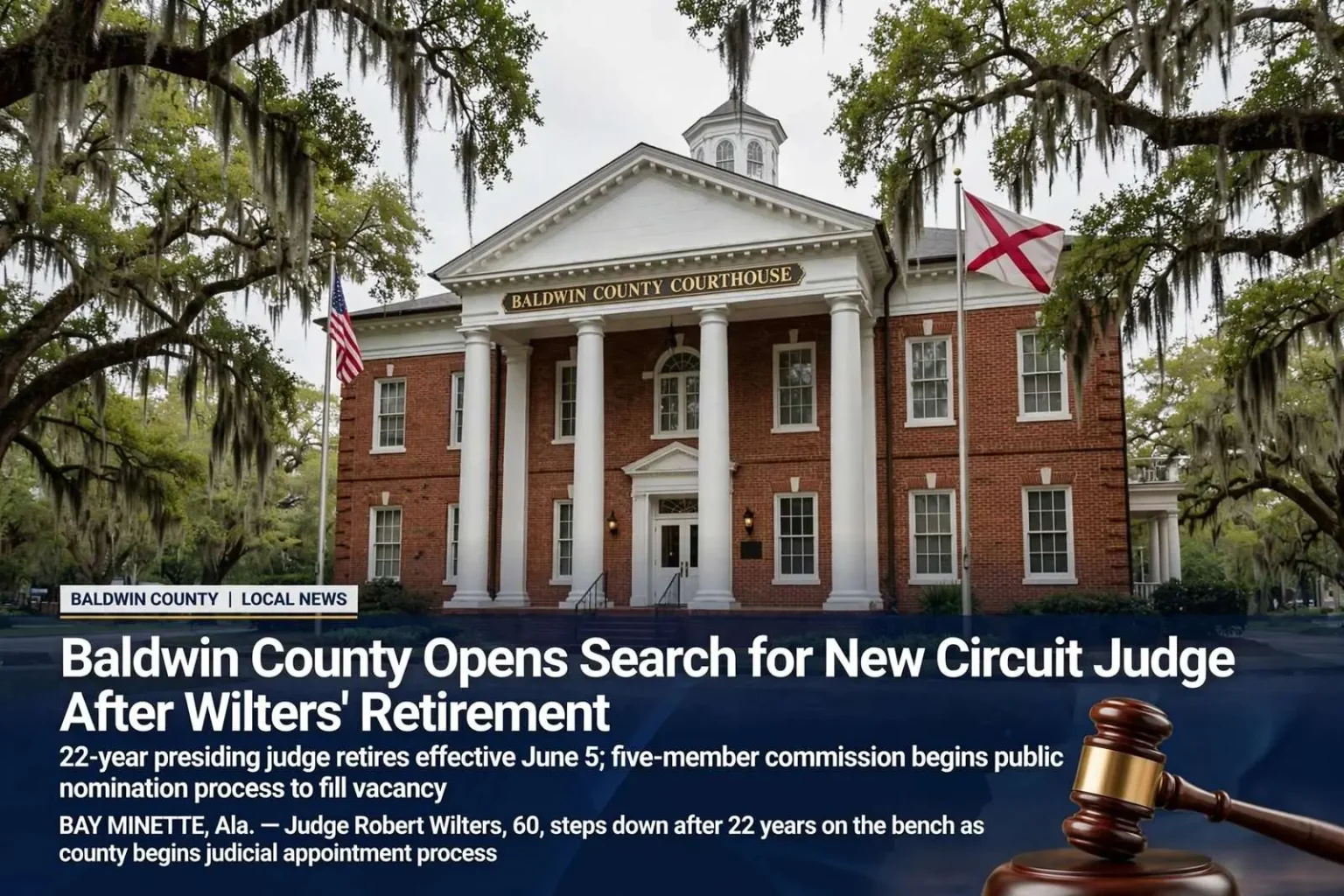
Baldwin County is beginning a formal search for a new circuit judge after longtime Presiding Circuit Judge Robert Wilters announced his retirement, effective June 5. The departure of a judge who spent more than two decades on the bench sets in motion Alabama’s structured judicial appointment process, one that will move through a local commission, a public comment period and the governor’s office before a successor takes the seat.
Wilters, 60, had served on the bench for 22 years, having first been sworn in back in 1993. Over that span, he presided over a court that grew alongside one of the fastest-growing counties in Alabama, handling civil dockets, criminal cases and the administrative duties that come with leading a circuit as its presiding judge. His retirement marks the end of a tenure that most Baldwin County attorneys now practicing have never worked without.
The vacancy will be filled through a public nomination process overseen by Judge J. Langford Floyd, who takes over as the court’s new presiding judge. Floyd’s role places him at the head of the circuit’s administrative operations even as the selection process determines who will ultimately fill the open judgeship, a dual transition of leadership and personnel that the court will manage simultaneously.
Qualified attorneys interested in the position had until April 28 to submit completed questionnaires for consideration. Copies of the questionnaire were made available through the circuit court’s website, the Baldwin County Bar Association and in hard copy at the Baldwin County Library in Bay Minette, giving candidates several routes to obtain the paperwork in a county where legal practice is spread across Bay Minette, Fairhope, Foley, Gulf Shores and the Daphne area.
How the Selection Process Works
Once the application window closed, the full list of nominees was set to be published publicly, opening a period for residents to submit comments about each candidate under consideration. That public comment step is a distinctive feature of the process, allowing the people who appear before the county’s courts — litigants, attorneys, victims, defendants and ordinary residents — to weigh in on the qualifications and temperament of those seeking the seat. Information contained within the individual questionnaires themselves remains confidential to the selection commission and is not released publicly.
Under Alabama’s judicial appointment process, a five-member Baldwin County Judicial Commission reviews the applications and narrows the field to three nominees, which are then forwarded to the governor for a final decision. The governor has 30 days from receiving the nominations to select an appointee; if no selection is made within that window, the responsibility shifts to the state’s chief justice. Either way, the decision will place a new judge on the Baldwin County circuit bench without an election first being held.
Whoever is ultimately appointed will serve in the role until the next judicial election, scheduled for 2016, at which point voters will decide whether to keep the appointee on the bench for a full term. That arrangement gives the public the final say on the appointment, while allowing the court to continue operating without an open seat in the years between now and the next election cycle.
Safeguards Around the Commission
Commission rules require members to operate independently of personal or partisan considerations. No commission member may commit to a vote before the formal selection process concludes, solicit votes from fellow commission members, or personally recruit prospective nominees, safeguards intended to keep the process focused strictly on candidate qualifications. The rules are designed to prevent the kind of back-channel maneuvering that can turn a judicial appointment into a contest of relationships rather than credentials, and they apply to every member from the first questionnaire to the final list of three.
The structure reflects Alabama’s hybrid approach to filling judicial vacancies. Rather than leaving the choice entirely to gubernatorial discretion or holding a special election, the state pairs a locally rooted nominating commission with the governor’s appointing authority, and adds a fallback to the chief justice if the deadline passes. For Baldwin County, the five-member commission is the stage where the real narrowing happens, since only the candidates it forwards can be chosen by the governor.
The confidentiality of the questionnaires, paired with the publication of the candidate list and the public comment period, attempts to balance two competing interests: protecting applicants from having their personal and professional disclosures aired publicly, while still giving residents enough information about who is under consideration to offer meaningful input.
What the Court Handles — and Why It Matters
The Baldwin County Circuit Court, based in Bay Minette, handles a broad range of civil and criminal matters for one of the fastest-growing counties in Alabama, making the judicial appointment a significant decision for the county’s legal system and the residents it serves. Felony prosecutions, major civil lawsuits, domestic relations cases and the appeals that flow up from the county’s district courts all pass through the circuit, and the caseload has expanded as the county’s population has grown along the Interstate 10 and Highway 98 corridors.
Baldwin County’s rapid growth in recent decades — driven by development along the Gulf Coast from Daphne and Fairhope south to Foley and Gulf Shores — has steadily increased demand on its courts, from criminal dockets swollen by a larger population to civil disputes tied to construction, real estate and insurance that follow growth. A circuit judge appointed now will inherit a docket shaped by that expansion, and the choice of who fills the seat will influence how the county’s courts manage it for years.
The presiding judge role that Wilters held adds administrative weight to the position. Presiding judges assign cases, manage the court’s calendar and coordinate with the clerk’s office and the other judges in the circuit, responsibilities that shape how efficiently the entire court operates. Floyd’s assumption of those duties ensures continuity, but the new appointee will still step into a bench with significant expectations attached.
The Bar’s Role and the Candidates’ Calculus
For Baldwin County attorneys, an open circuit judgeship is among the most consequential opportunities in the local legal community, and the questionnaire process formalizes what would otherwise be an informal scramble for support. Candidates must lay out their qualifications, experience and judicial philosophy in writing for the commission, knowing that only three names will advance. The availability of the forms through the bar association as well as the court’s website underscored that the process is meant to be open to any qualified attorney in the county, not only those with connections inside the courthouse.
The April 28 deadline compressed the timeline considerably. With Wilters’ retirement effective June 5, the commission, the governor’s office and whoever is appointed have a defined window to complete the transition without leaving the circuit shorthanded. The county’s court calendar continues throughout, meaning pending cases must be reassigned or managed by the remaining judges in the interim.
The End of a Long Tenure
Judge Wilters’ departure marks the end of more than two decades on the Baldwin County bench, and county officials say the selection process is designed to ensure a smooth transition for the court’s ongoing caseload once his successor is named. A judge who was sworn in back in 1993 presided over an era in which Baldwin County transformed from a largely rural county into one of the state’s population and economic centers, and the court he led grew in size and sophistication along with it.
Longtenured judges leave a mark that outlasts their individual rulings. They set the tone of a courthouse, mentor newer judges and shape the practices — from docket management to courtroom procedure — that attorneys and litigants come to expect. Wilters’ 22 years made him one of the defining figures of the Baldwin County judiciary, and his retirement prompted the county’s first experience with the full appointment process in some time. Attorneys who began practicing when he first took the bench in 1993 have spent entire careers appearing in his courtrooms, and the docket habits, scheduling conventions and courtroom standards he established will not change overnight simply because the seat changes hands. Succession on a circuit bench is as much an institutional event as a personnel one, and the county’s legal community is watching the process with that in mind.
For residents, the practical effect of the coming months is straightforward: a new judge will be named without an election, will serve until the 2016 judicial election, and will stand before the voters then for a full term. Between now and that vote, the five-member commission’s three nominees, the governor’s choice and the public comments submitted along the way will determine who holds a seat on one of Alabama’s busiest and fastest-growing circuit courts — a decision that will shape how justice is administered in Baldwin County long after the transition is complete.