Judge Drops Burglary Charge in Elberta Elementary Gun Incident Case
A Baldwin County judge dropped a burglary charge but sent attempted murder charges to a grand jury in the Elberta school gun incident case today.
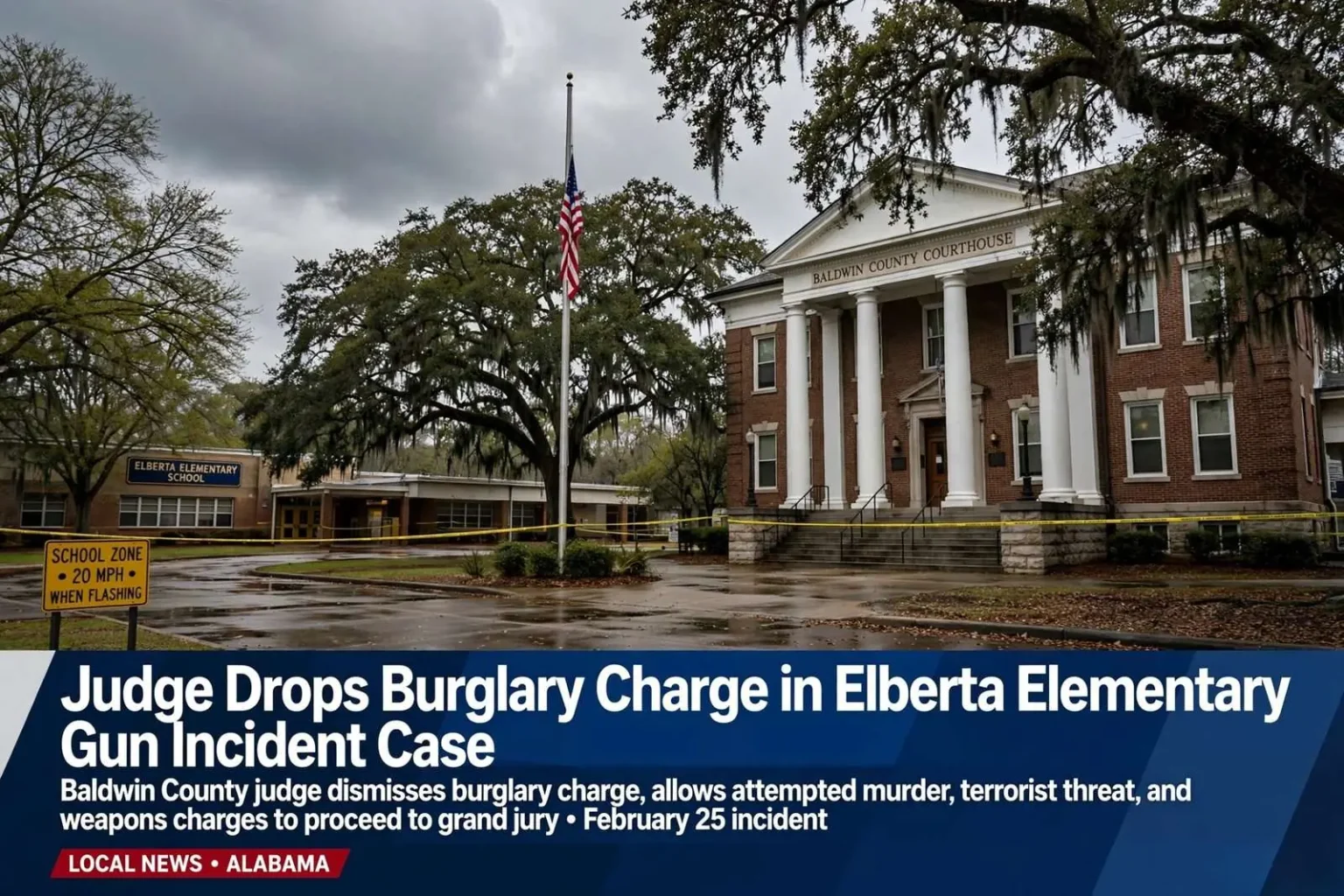
A Baldwin County Circuit Court judge dismissed a burglary charge Friday against the Foley woman accused of entering Elberta Elementary School armed with a handgun in February and threatening her sister, while allowing more serious charges to proceed to a grand jury. Judge Scott Taylor ruled there was enough evidence to send charges of attempted murder, making a terrorist threat, and possessing a deadly weapon on school grounds forward for grand jury review against 51-year-old Barbara Grice, who was indicted last month in connection with the Feb. 25 incident.
Dropping the burglary charge represented a modest legal win for Grice, whose attorney, John Beck, also unsuccessfully argued to have the attempted murder charge dismissed as well, contending there was no testimony that a shot had been fired at or toward any specific person. The argument turned on what the state could prove about intent — prosecutors do not have to show that a bullet struck anyone for an attempted murder charge to survive, only that the evidence supports an intent to kill, and Judge Taylor evidently found the testimony sufficient for jurors to weigh that question. The remaining charges now head to a Baldwin County grand jury, which will decide whether the case proceeds to trial.
Grice is separately facing federal charges of possessing a firearm in a school zone and discharging a firearm in a school zone. That parallel track means the case could ultimately play out in both state and federal court, a common arrangement when conduct crosses into areas — like firearms near schools — that Congress has also criminalized. Federal gun charges carry their own potential penalties regardless of what the state process produces.
What Investigators Described
According to testimony from Baldwin County Sheriff’s Office investigator Andrew Ashton, Grice entered the school through a back door near the cafeteria that had a history of not closing properly. A school employee who spotted Grice outside alerted Grice’s sister, who worked in the cafeteria, that something seemed wrong. The sister locked herself inside a back office as Grice made her way into the building. The account underscored how quickly the situation unfolded inside a campus that was occupied by students and staff at the time.
Once inside, Grice brandished a .38-caliber revolver and made a direct threat, according to Ashton’s testimony. Authorities later recovered one bullet and four shell casings from inside the building, with photographic evidence showing the bullet had ricocheted off two walls and passed through two stacks of plastic plates before coming to rest in the kitchen, where a janitor found it roughly a week later. The path of the bullet became a focal point of the hearing, given the defense’s argument that no testimony tied the shot to a specific target.
When officers took Grice into custody in the school’s courtyard, her revolver had one live round left in its five-shot cylinder and the hammer was cocked. That detail — a cocked hammer indicating the weapon was ready to fire again — formed part of the picture prosecutors presented about the danger of the moment. Grice initially told investigators she was upset when she arrived at the school that morning, according to the account presented in court, and authorities have said the confrontation centered on her sister, who worked inside the building.
How the Grand Jury Step Works
The dismissal of one count while others advance is a routine feature of Alabama’s preliminary and pretrial process, but the grand jury stage that follows carries real weight. In Baldwin County, a grand jury — a panel of citizens convened by the district attorney’s office — hears the evidence behind each felony charge in secret sessions and votes on whether probable cause exists to indict. An indictment is not a finding of guilt; it is the formal determination that the case is strong enough to be tried. For Grice, the three surviving charges now await that review, and the burglary count will not be part of it unless prosecutors pursue the issue through other channels.
Legal observers note that attempted murder charges are among the more demanding for prosecutors to carry to a jury, because the state must establish a specific intent to kill rather than mere recklessness or danger. That is the standard Beck was invoking when he argued no shot was fired at or toward any particular person. The counterargument, which prevailed at Friday’s hearing, is that firing a revolver inside an occupied school building — with a cocked hammer, spent casings scattered through the kitchen, and a direct threat made against a named family member — allows a jury to infer intent from the circumstances themselves.
The Charges and the Law Behind Them
The charge of possessing a deadly weapon on school grounds rests on Alabama law that makes it a felony to bring a firearm onto a public school campus, a prohibition that applies regardless of whether the weapon is fired or whether anyone is threatened. The terrorist-threat charge, likewise, criminalizes threats made with the intent to cause panic, evacuation, or serious public inconvenience — a statute that has taken on renewed attention in an era of heightened concern about school violence. Together with the attempted murder count, the charges expose Grice to a potential sentence measured in decades if she is convicted on all counts.
The federal charges run on a separate track under the Gun-Free School Zones Act, the federal statute that makes it a crime to possess or discharge a firearm within a school zone. Federal prosecutors in the Southern District of Alabama have the option of pursuing that case independently of the state court proceedings, and the two cases can move at different speeds. Defendants in dual-track prosecutions sometimes resolve one case before the other reaches trial, and the outcome of one can influence sentencing discussions in the other, though the sovereigns are distinct and neither is bound by the other’s result.
School Safety in Baldwin County
The incident has kept attention on security practices in Baldwin County’s public schools, the fastest-growing district in Alabama. Elberta Elementary, which serves young students in the growing southern end of the county, is one of dozens of campuses where exterior doors, visitor check-in procedures, and staff vigilance form the first line of defense. The detail that Grice entered through a back door with a known problem closing properly has resonated with parents and school officials alike, since it illustrates how a small mechanical failure can become a security gap in an otherwise controlled building.
Since the February incident, district officials across Baldwin County have continued to emphasize layered security measures — locked perimeter doors, cameras, resource officers, and protocols requiring staff to challenge or report unfamiliar adults on campus. The quick action of the school employee who spotted Grice outside and alerted her sister inside is exactly the kind of human-layer response those protocols are designed to produce, and it likely prevented the confrontation from spreading beyond the cafeteria area of the building.
What Comes Next in the Case
With the burglary count dismissed and the remaining charges bound over, the case now moves toward the grand jury session where prosecutors will present their evidence in full. If the grand jury returns indictments on the attempted murder, terrorist threat, and weapons counts, Grice would face arraignment and the case would be set for trial in Baldwin County Circuit Court in Bay Minette. The federal weapons case, filed separately, would proceed on its own calendar, and it remains to be seen whether the two prosecutions resolve through plea agreements, trials, or some combination of the two.
The February incident began as a family dispute that spilled onto a public school campus, but the charges it produced reflect how seriously Alabama law treats firearms in school settings. What might otherwise have been a domestic confrontation became a felony case spanning two court systems the moment a loaded revolver entered an elementary building and a shot was fired inside it. For the Elberta community, the legal proceedings in the months ahead will determine accountability for a morning that no one at the school is likely to forget.
For parents across Baldwin County, the case is also a reminder of the practical realities of school security. Locked doors, alert staff, and fast communication worked as intended at Elberta Elementary — an employee saw the danger, warned the person at risk, and the threat was contained to one area of the campus — but the incident showed how narrow the margin can be. School administrators in the district have repeatedly urged families to report concerns early, and the outcome of this case will be watched for what it says about how the justice system weighs a threat made inside a building full of children.