Tuscaloosa Man Charged in Baldwin County Gang Killing Found Dead
A man indicted in a Baldwin County motorcycle-gang killing was found dead at his father's home, with investigators awaiting autopsy results.
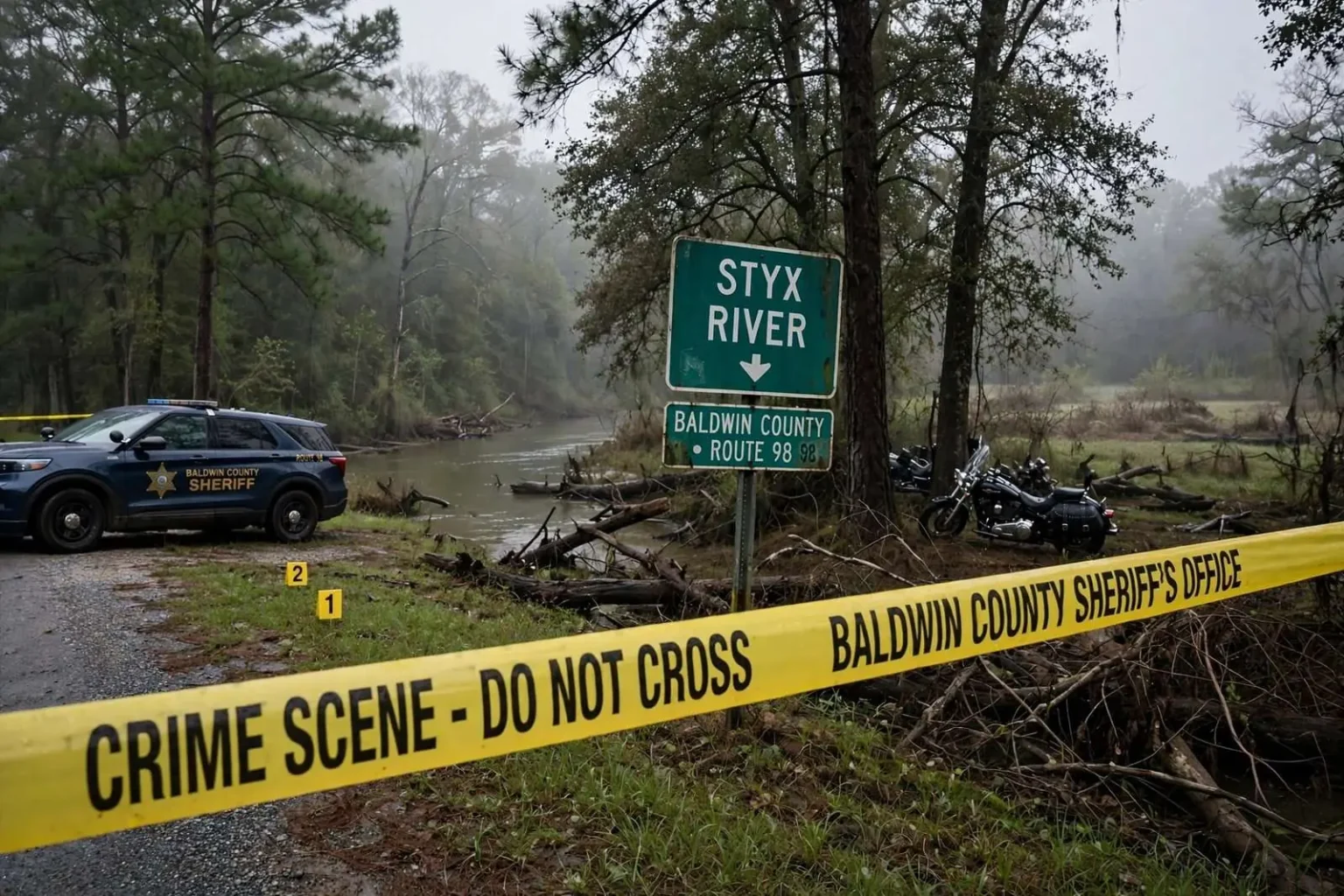
A Tuscaloosa man who had been indicted on charges connected to a 2012 killing tied to a motorcycle gang’s Baldwin County clubhouse has been found dead, and investigators say the cause of his death remains uncertain. Adam Mayton, 31, was discovered unresponsive around 1 a.m. on June 24 by his father and sister at his father’s home in Tuscaloosa County, according to the Tuscaloosa County Metro Homicide Unit. Investigators said there were no visible signs of trauma, and an autopsy was ordered to determine how he died. Officials noted that Mayton had a history of substance-abuse issues and some health problems, leaving open the possibility of an accidental overdose or a natural death. Until the autopsy and any toxicology work are complete, investigators cannot say what killed him.
The discovery ended Mayton’s personal involvement in one of the more unusual criminal cases to connect Tuscaloosa and Baldwin County in recent memory. His death came while he was awaiting further proceedings on an indictment that had already been scaled back once, and it leaves prosecutors with questions about how the remaining case will move forward. Law enforcement agencies on both sides of the state now face the task of sorting out what his death means for the defendants still charged in Dixson’s killing.
The 2012 Baldwin County Killing
Mayton had been indicted by a Baldwin County grand jury on a charge of hindering prosecution stemming from the 2012 death of Samuel Dixson, 54, a member of a motorcycle club’s Gulf Coast chapter. Dixson’s body was found near the Styx River, off a Baldwin County roadway, in September 2012, days after investigators believe he was shot inside a mobile home on Northcutt Lane that served as a clubhouse for the club’s Tuscaloosa chapter. The Styx River winds through the southern reaches of Baldwin County before joining the Perdido River, and the land around it is rural, wooded and lightly patrolled — the kind of terrain where a body can remain undiscovered for days. That appears to be what happened in Dixson’s case.
The shooting reportedly occurred during a gathering marking the chapter’s first anniversary, after which the mobile home was set ablaze. Investigators have worked from the theory that the killing and the fire happened in a single violent episode at the clubhouse, with the body then moved south to Baldwin County. The distance between the two counties — roughly four hours apart by highway — complicated the investigation from the start, requiring cooperation between deputies, investigators and prosecutors in Tuscaloosa and Baldwin counties.
Six people, including Mayton, were arrested in connection with the killing. Mayton was initially charged with murder, but a grand jury later reduced the charge to hindering prosecution. His attorney said the reduction had brought some optimism to the case shortly before his death. The lesser charge carried significantly less potential prison time and suggested prosecutors believed Mayton’s role was in covering up the killing rather than carrying it out. That distinction mattered both to Mayton’s defense and to the broader shape of the case.
What Investigators Said in Court
At a preliminary hearing held in late 2012, a former Baldwin County Sheriff’s Office investigator testified that Mayton was a member of the motorcycle club’s Tuscaloosa chapter and that he admitted being present in the mobile home when Dixson was killed. Mayton reportedly identified another man as the shooter; that man, a Northport resident, faces a murder charge in the case. The testimony gave prosecutors a map of the evening — who was in the clubhouse, who left, and who investigators believed pulled the trigger — though defense attorneys have contested parts of that account.
Several other defendants tied to the case, including residents of Theodore, Elberta and Wilmer, were charged with hindering prosecution for their alleged roles after the killing. Those communities sit in the southern half of Baldwin County, along the corridor investigators believe was used to move Dixson’s body toward the Styx River. The spread of defendants across two counties underscored how far the case’s reach extended, pulling in people from the Gulf Coast communities where the club’s Gulf Coast chapter operated.
Baldwin County prosecutors have said the case against the remaining defendants depends on a web of testimony, physical evidence and cooperation among the people charged. Hindering prosecution charges typically allege that defendants helped conceal a crime or obstruct its investigation, which can include helping move a body, providing false statements or discouraging witnesses from coming forward. Proving those allegations often requires piecing together statements from multiple defendants, several of whom face their own legal exposure in the same case.
What Mayton’s Death Means for the Case
A Baldwin County Sheriff’s Office major said the agency planned to meet with the county’s district attorney to discuss how Mayton’s death might affect the ongoing prosecution strategy. Prosecutors will have to decide whether Mayton’s statements and prior testimony can still be used, and how much the case depended on him as a witness against the alleged shooter. In cases where a key witness dies before trial, Alabama courts can sometimes allow prior testimony to be introduced under limited circumstances, but the rules are strict and defense attorneys typically challenge such attempts.
The Tuscaloosa County Metro Homicide Unit, which investigated Mayton’s death, is a multi-agency unit that handles unexplained and suspicious deaths across Tuscaloosa County. Its investigators stressed that the case remains open pending the autopsy. Deaths of people awaiting trial — particularly deaths with no visible trauma and a documented history of health problems and substance abuse — are often resolved as accidental or natural, but investigators routinely treat them as unexplained until toxicology results come back. Those results can take weeks, and officials have given no timeline for when a cause of death will be officially determined.
For Dixson’s family, the development adds another layer of delay to a case now more than a decade old. Relatives of homicide victims in cases that stretch across years often describe the experience as a second burden layered on top of the original loss, with trials postponed, charges reduced and defendants dying before facing a jury. Whether the alleged shooter in the Dixson case will ultimately stand trial remains the central open question for prosecutors in Baldwin County.
Motorcycle Clubs and Rural Crime in South Alabama
The case is one of several in recent Alabama history in which motorcycle club activity has intersected with serious violent crime in rural counties. Clubhouses in unincorporated areas — mobile homes, metal buildings, lots off country roads — can host large gatherings that draw members from multiple chapters, and investigators have repeatedly noted that such gatherings complicate witness interviews, since many attendees are reluctant to speak with deputies. Baldwin County, with its mix of growing suburbs and remote backroads between Mobile Bay and the Perdido River, has seen this dynamic play out in several cases over the years.
The Northcutt Lane property where Dixson was killed is the kind of location that shapes how these investigations proceed. Rural crime scenes lack cameras, close-range neighbors and often a quick 911 call, which means investigators depend heavily on physical evidence and on whoever eventually talks. In the Dixson case, that meant reconstructing a night that began at an anniversary gathering in Tuscaloosa and ended with a body near the Styx River — a sequence prosecutors have had to prove piece by piece across two counties.
Mayton’s death does not close the file on the 2012 killing. The Northport man charged with murder still faces prosecution, and the remaining hindering prosecution defendants are still part of the case, at least for now. What has changed is that the state lost one of the people who was inside the clubhouse the night Dixson died, and with him went a firsthand account that prosecutors can no longer develop through questioning in court. How Baldwin County proceeds will be shaped by the meeting between sheriff’s officials and the district attorney’s office, by what Mayton’s autopsy ultimately shows, and by what a jury is eventually allowed to hear.
The June 24 discovery also renewed attention on how long the Dixson case has taken to reach a resolution. More than a decade has passed since the body was found near the Styx River, and in that time the case has moved through arrests, a preliminary hearing, grand jury action that reduced Mayton’s charge, and repeated scheduling delays. Cases that span multiple counties and multiple defendants commonly move slowly, but investigators in Baldwin County have acknowledged that the passage of time has made witnesses harder to find and memories harder to trust.
Death investigations in Tuscaloosa County follow a defined path once a person is found unresponsive. The Metro Homicide Unit documents the scene, interviews family members, and orders an autopsy through the state’s forensic system. Toxicology testing, which screens for drugs and medications, is often the decisive evidence in deaths where there is no trauma, and its results typically drive the final classification of the death as natural, accidental, or otherwise. Officials have not said when those results are expected in Mayton’s case.
For now, the 2012 killing remains an active prosecution in Baldwin County, carried by the defendants who are still living and the evidence that remains admissible. The sheriff’s office has said only that it will work with the district attorney to determine the best path forward — a process that may include revisiting which charges can still be sustained and how the trial of the alleged shooter will proceed without one of the state’s key firsthand accounts.