Baldwin County Teacher Found Guilty on Drug Charges in 2008
A 2008 WKRG report covered the drug conviction of a Loxley Elementary math teacher and the school-system response.
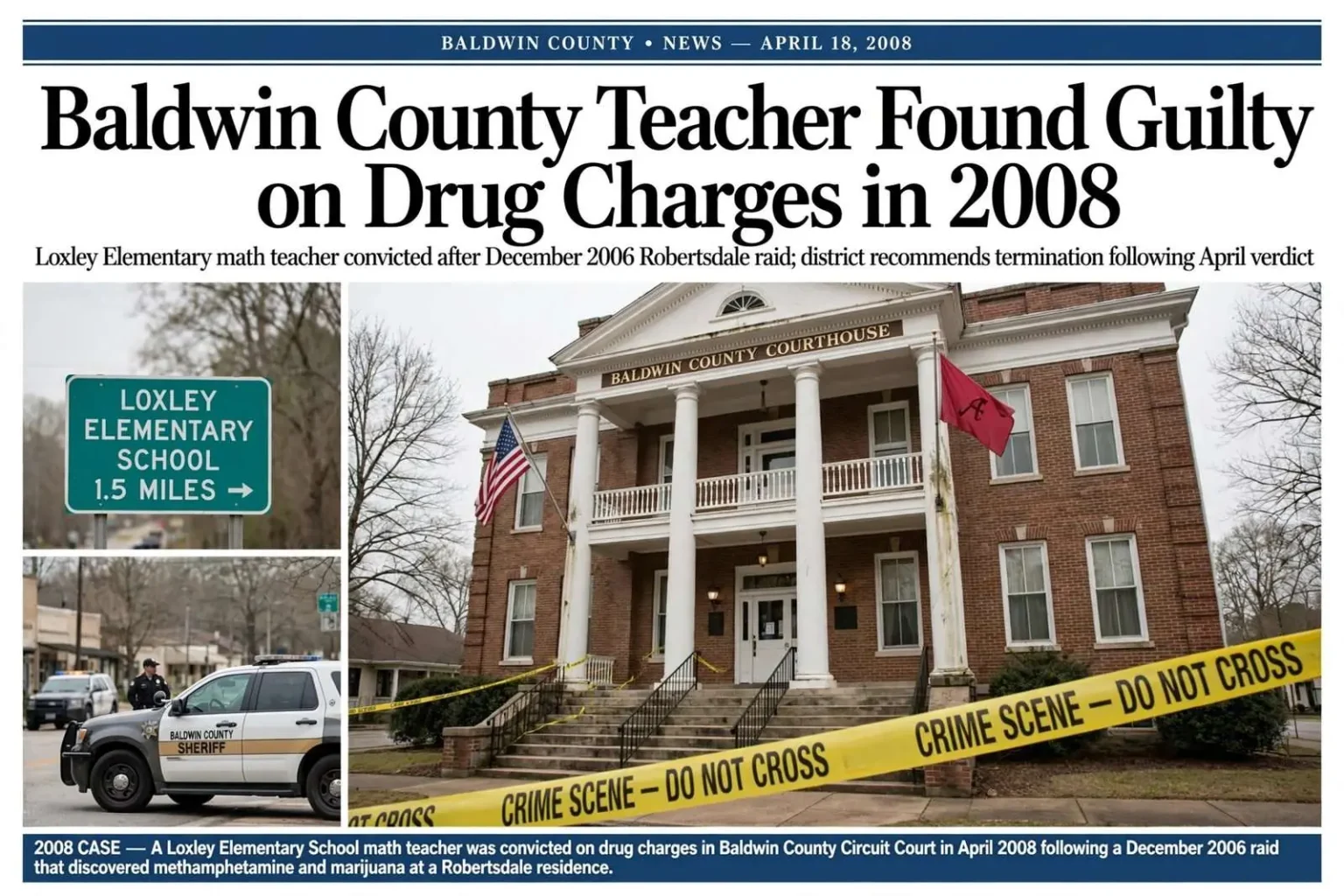
BALDWIN COUNTY, Ala. — A Loxley Elementary School math teacher was found guilty on drug charges in a Baldwin County courtroom in April 2008, according to a local station’s report at the time. The conviction closed a case that had begun more than a year earlier, when the Baldwin County Drug Task Force raided the Robertsdale home of Christy Byrd Philips and found methamphetamine and marijuana on the property.
Philips had been on paid administrative leave from her teaching position since her arrest in December 2006, and school-system officials said following the trial verdict that then-Superintendent Faron Hollinger would recommend terminating her contract with the district. The case unfolded in one of Alabama’s fastest-growing school systems, where the news that an elementary math teacher stood convicted of drug offenses landed as both a personnel matter and a community shock.
The December 2006 Raid
According to the report, agents with the Baldwin County Drug Task Force executed a search warrant at Philips’ home in Robertsdale in December 2006 and recovered methamphetamine and marijuana during the search. The task force, a multi-agency unit drawing personnel from local police departments, the Baldwin County Sheriff’s Office, and prosecutorial support from the district attorney’s office, had for years concentrated on methamphetamine investigations across the county’s rural and small-town communities, where the drug’s spread in the early and mid-2000s had made it a top enforcement priority.
Meth cases in Baldwin County during that era typically began with tips from neighbors or informants, moved through undercover purchases or surveillance, and ended in search warrants executed by the task force. The raid on the Robertsdale home fit that mold, and the discovery that the residence belonged to a public school teacher added a dimension that quickly attracted news coverage.
Administrative Leave and School System Policy
When a Baldwin County school employee is arrested, district policy and state administrative rules dictate the immediate response: the employee is placed on leave pending the outcome of the criminal process, with pay intact until an adjudication or internal investigation justifies further action. That is the course the district followed in Philips’ case. From her December 2006 arrest through the April 2008 trial, she remained on paid administrative leave — a span of roughly 16 months during which she neither taught nor drew a teaching schedule, but remained formally employed.
Paid leave in such circumstances is not a favor; it reflects the due-process balance Alabama school boards operate under. An arrest is not a conviction, and districts that summarily fire employees on accusation alone risk wrongful-termination liability. The trade-off is that taxpayers fund salaries during the interim, a fact that reliably draws community criticism whenever the case is high-profile. Once the guilty verdict arrived, that calculus changed: with a criminal conviction on the record, the superintendent’s recommendation that the board terminate the contract became the standard next step.
The Trial and Verdict
Philips’ case moved through the Baldwin County court system in the spring of 2008, and a local station reported her conviction on drug charges in April 2008. Trial convictions in meth cases of this type generally rest on the seized evidence, the chain of custody maintained by task force agents, and testimony from the agents who executed the warrant. Defense counsel in such cases typically challenge the validity of the search warrant, the scope of the search, and the handling of the evidence, though the report does not indicate which issues were raised at trial.
Baldwin County’s Methamphetamine Era
To understand the case’s context, it helps to recall what Baldwin County — and Alabama generally — was confronting in the mid-2000s. Methamphetamine had swept through rural and small-town Alabama in the preceding decade, prompting the state to enact some of the country’s toughest restrictions on pseudoephedrine sales in 2005. Pharmacies began logging purchases and moving cold medicines behind counters, and the legislature’s action was credited with a sharp decline in home meth labs in the years that followed.
The Baldwin County Drug Task Force was part of that statewide response. Multi-agency task forces like Baldwin’s pooled resources from municipalities that could not individually sustain drug units, and their case files from that era are filled with raids on residences in Robertsdale, Summerdale, Bay Minette, Foley, and the unincorporated crossroads communities in between. The task force’s work in the Philips case — from tip to raid to seizure — was the standard workflow of the period.
What made the case unusual was never the drug activity itself but the defendant’s profession. Teachers occupy a position of public trust, and when one is charged with a drug offense, the school system’s handling of the case becomes a story of its own, watched by parents who send their children to the teacher’s school each morning.
Loxley Elementary and the Community Response
Loxley Elementary School serves the town of Loxley, a community in central Baldwin County along the U.S. 59 corridor north of Robertsdale and Foley. In 2008 the school enrolled students from kindergarten through the upper elementary grades, and its math instruction — the subject Philips taught — is one of the core accountability areas on Alabama’s standardized assessments.
Parents and school staff learned of the arrest when news coverage followed the December 2006 raid, and the district’s decision to place Philips on leave immediately reassigned her classroom duties. By the time of the 2008 verdict, she had long since ceased any contact with students, and the superintendent’s termination recommendation was aimed at formally severing an employment relationship that had been suspended in practice since the arrest.
How Alabama Teacher Discipline Works
Under Alabama law, a tenured public school teacher can be terminated only for specified causes, which include conviction of a felony or a crime of moral turpitude, and the process runs through the local superintendent’s recommendation and a vote by the elected school board. The employee is entitled to notice and, in some circumstances, a hearing before the board. A drug conviction of the kind reported in the Philips case falls squarely within the grounds the state’s tenure laws recognize, which is why districts following a guilty verdict characteristically move to terminate rather than negotiate.
The two-year arc of the case — from the December 2006 raid, through paid leave, to the April 2008 conviction and termination recommendation — illustrates the timeline such cases follow. Criminal cases move at the pace of the court system, while the school district waits, salary accruing, for an outcome that determines the employment decision it can lawfully make.
The Wider Picture in Baldwin County Schools
The Baldwin County Public Schools system is one of Alabama’s largest, spanning communities from Bay Minette to Gulf Shores and employing thousands of teachers across dozens of campuses. Personnel cases involving criminal charges are rare relative to the size of the workforce, but when they occur, the system’s procedures are consistent: leave pending adjudication, then board action on the superintendent’s recommendation once the courts have spoken.
The mid-2000s were a period of rapid growth for the system, as Baldwin County’s population boom along the Alabama Gulf Coast filled new schools in Daphne, Spanish Fort, Foley, and Gulf Shores. Rural campuses like Loxley Elementary grew alongside them, and the district’s hiring expanded to match. In a workforce that size, the Philips case stood out precisely because it was exceptional — the day-to-day story of the system was one of new construction, growing enrollment, and academic accountability under the state’s testing regime.
Drug Enforcement in Baldwin County After 2008
The task force model that produced the Philips case continued to operate in Baldwin County in the years after the conviction, though the drug landscape shifted. Home meth labs declined following the pseudoephedrine restrictions, and enforcement attention gradually broadened to prescription drug diversion, then to the heroin and fentanyl wave that arrived in the following decade. The Baldwin County Drug Task Force’s basic structure — local, county, and prosecutorial partners working cases across municipal lines — remained the county’s primary instrument for that work.
For the schools, the case became part of the institutional memory that shapes policy: background checks for new hires, procedures for handling employee arrests, and the administrative-leave protocol that the district followed to the letter in the Philips matter. Alabama’s school systems, like those nationwide, conduct criminal background checks on prospective employees, and a conviction of the type entered in this case would bar future certification and employment in the state’s public schools.
A Historical Case, Recorded as It Happened
Because this article records events reported in 2008, the details here are limited to what the original report documented: the April 2008 guilty verdict, the December 2006 raid on the Robertsdale home, the discovery of methamphetamine and marijuana, the period of paid administrative leave, and the superintendent’s recommendation to terminate the teaching contract. Subsequent records — the precise sentence imposed, the final board vote, and Philips’ later history — were not part of the original report and are not recounted here.
What the case illustrated then, and still illustrates now, is the standard path an Alabama school-employee criminal case travels: the raid and arrest, the suspension with pay, the months of court proceedings, the verdict, and the personnel action that follows. For the Loxley Elementary community in 2008, it was an unsettling episode that resolved the way the system is designed to resolve — with the courts deciding the criminal question and the school board, on the superintendent’s recommendation, deciding the employment one.