Loxley Teen Charged in Friend’s 2007 Shooting Death
A 2007 WKRG report covered the murder arrest of an 18-year-old in the shooting death of a 19-year-old near Loxley.
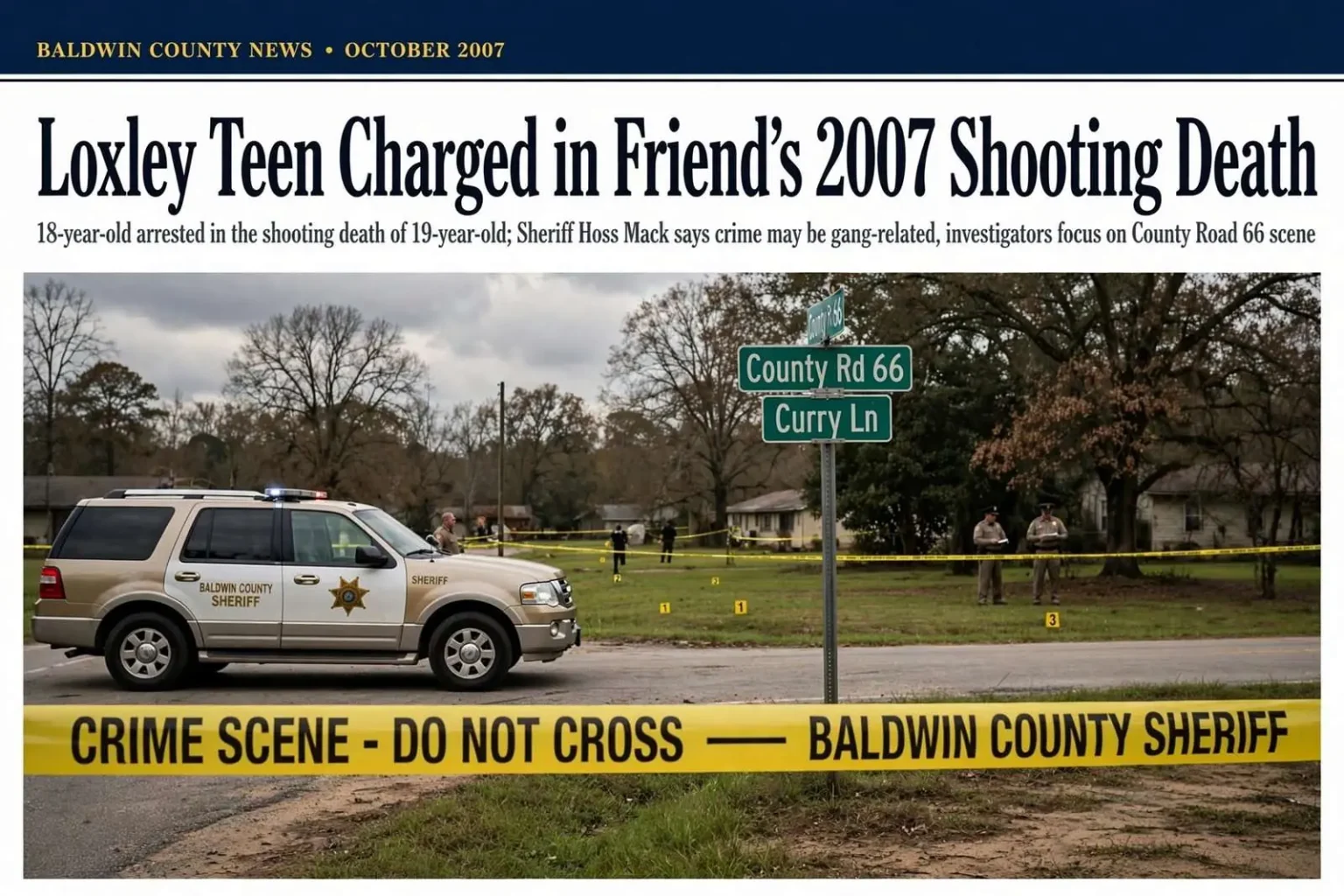
The Baldwin County Sheriff’s Office arrested 18-year-old Brandon Hackworth and charged him with murder in October 2007, according to a local station’s report at the time. The arrest followed the death of 19-year-old Jesse Dade, whom investigators described as Hackworth’s friend. Authorities said they believed Hackworth shot and killed Dade during an argument, turning a dispute between two young men who knew each other into one of the county’s most serious criminal cases of that fall.
Dade’s body was found in a yard near County Road 66 and Curry Lane in Loxley, a growing community in central Baldwin County along the Interstate 10 corridor. The location, a residential stretch away from the town’s main intersections, became the focal point of the investigation as deputies processed the scene and detectives began reconstructing the events that ended in the teenager’s death.
Sheriff Hoss Mack said Dade had been shot several times. Mack, who was serving in his first year as Baldwin County’s sheriff in 2007, also said investigators believed the crime might be gang related, a factor that shaped how the sheriff’s office approached both the investigation and the warning it issued to the public about the case.
The setting: Loxley and the County Road 66 corridor
Loxley in 2007 was a small Baldwin County town finding itself in the path of rapid growth. Sitting just off Interstate 10 between the Mobile Bay area and the beaches, the community had begun to see new subdivisions and commercial development spread along its county roads, even as older neighborhoods and rural lots remained. County Road 66 and Curry Lane were part of that mix, quiet local roads where a violent death was an unfamiliar event.
For the sheriff’s office, a body found in a residential yard in that setting triggered a standard but intensive response. Deputies secured the area, detectives canvassed nearby homes for anyone who heard or saw anything, and crime scene personnel documented and collected physical evidence. In a case where the suspect and victim knew each other, much of that early work goes into confirming the sequence of events and the relationship between the people involved.
The fact that the victim was 19 and the suspect 18 placed the case squarely within a concern that Gulf Coast law enforcement agencies were voicing in that period: young men, disputes, and guns. Investigators in Baldwin County had been watching regional gang activity move into suburban and rural communities along the I-10 corridor, and Mack’s comment that the crime might be gang related reflected that wider context rather than a detail about Loxley alone.
How the sheriff’s office built the case
An arrest on a murder charge within days of a death indicates the speed at which the investigation moved. Detectives working a case of this kind typically pursue several threads at once: interviews with people close to both the victim and the suspect, examination of the scene and physical evidence, and the background work needed to establish motive. When investigators said they believed the shooting followed an argument, that assessment came from the accumulation of those interviews and evidence.
The sheriff’s office also carries the responsibility of presenting its case to prosecutors. In Alabama, a murder charge arising from a shooting death is reviewed before charges move forward in court, and the investigation file becomes the foundation of the prosecution’s work. The October 2007 report captured the moment of arrest and the allegations as investigators stated them at the time, which is a different stage of the process than a trial or a final disposition.
That distinction matters for readers of the historical record. An arrest and a charge are formal accusations, not findings of guilt, and cases can resolve in many ways after the initial report. The historical account of the Hackworth arrest preserves what deputies and Sheriff Mack said in October 2007; it does not state the final court outcome, and none should be assumed from the charges alone.
Gang concerns along the I-10 corridor
The suggestion that the Loxley killing might be gang related placed it in a regional conversation that Baldwin County leaders were having throughout the 2000s. As the county’s population grew quickly, law enforcement officials reported that street gang influence, historically associated with larger cities, was appearing in smaller communities along the interstate corridors. Suburban towns that had never considered themselves affected began seeing the graffiti, associations and disputes that detectives track as gang indicators.
Sheriff’s offices and police departments in the region responded by building intelligence-sharing habits, training deputies to recognize gang activity, and coordinating with neighboring agencies across county lines. Crimes that might be connected to gang activity are investigated with that wider pattern in mind, because a single violent incident can be tied to disputes that span multiple jurisdictions.
For residents of communities like Loxley, the mid-2000s discussion of gang activity was often their first exposure to the issue. The death of a 19-year-old in a residential yard, with investigators saying the crime might be gang related, brought the abstract regional concern to a specific street corner, and it was the kind of case that shaped how local officials talked about growth, youth and public safety in the years that followed.
Violence between acquaintances
The account that the shooting followed an argument between two friends fits a pattern that criminologists and investigators describe repeatedly: a large share of homicides arise from disputes between people who know each other, escalating in a short span of time rather than unfolding as a planned attack. Arguments that begin over small matters can turn lethal in seconds when a firearm is present, which is why dispute-related killings receive sustained attention from both investigators and violence-prevention efforts.
For investigators, the acquaintance dynamic changes the shape of the work. Instead of searching for an unknown attacker, detectives document the relationship’s recent history, the circumstances of the argument, and the physical evidence that establishes what happened at the scene. The proximity of the people involved often means witnesses exist, and the investigative focus shifts to corroborating accounts and testing them against the forensic record.
For the community, cases like this one carry a particular weight. The loss of a 19-year-old at the hands of someone described as his friend reverberates through families, schools and neighborhoods in a small town, and the questions that follow, about how an argument escalated and what could have interrupted it, are the same questions communities along the Gulf Coast continued to grapple with as the decade went on.
The historical record of the case
The October 2007 report stands as the preserved account of the arrest and the investigators’ statements at that time. It records the identities as released, the location where Dade’s body was found near County Road 66 and Curry Lane, the description of the fatal injuries that Sheriff Mack provided, and the investigators’ belief that the crime might be gang related. Those are the elements that local news preserved from that week in Baldwin County.
What the report does not contain is any final court outcome, and the historical account deliberately avoids inventing one. Criminal cases proceed through stages that can take months or years, and the public record of an arrest is only the beginning. Readers consulting this history should treat the charges and the investigators’ allegations as statements from October 2007, not as adjudicated facts about what ultimately happened in the case.
The episode remains part of the documented history of law enforcement in Baldwin County during a decade of fast growth, when the sheriff’s office under Sheriff Hoss Mack was building its response to violent crime and to the gang activity that officials believed was spreading along the corridor. The Loxley case, involving an 18-year-old charged in the death of his 19-year-old friend, was one of the incidents that defined that period for the county.
The work of a county sheriff’s office
The Hackworth case also offers a look at how a county sheriff’s office differs from a municipal police department. The Baldwin County Sheriff’s Office holds primary law enforcement responsibility across the unincorporated county and the smaller towns that do not maintain their own investigative capacity, which means a death in a community like Loxley falls to sheriff’s detectives rather than a city force. The office investigates everything from rural burglaries to homicides across an area of well over a thousand square miles.
Homicide response at that scale depends on a limited pool of specialized investigators. Detectives who work major cases handle scene work, interviews, warrants and courtroom preparation, often on several matters at once, while patrol deputies supply the first response and scene security. Coordination with the district attorney’s office, the coroner and the state’s forensic facilities is part of every death investigation, regardless of where in the county it occurs.
The agency’s leadership matters in cases that draw public attention. Sheriff Hoss Mack, elected in 2006 and in his first year in office when the Loxley case broke, spoke publicly about the investigation and the possibility of gang involvement, the kind of communication sheriffs use to keep communities informed while an investigation is under way. His account of the victim’s injuries and the investigators’ gang assessment became the public record of the case in its opening days.
What the case meant for a growing community
For Loxley, the October 2007 killing was the kind of event that alters a small town’s sense of itself. A body found in a yard on a local road, a young suspect arrested within days, and investigators pointing to gang activity combined to force conversations among residents, town officials and parents about what was changing along the I-10 corridor. Growth brought new roofs and new businesses, but it also brought the anxieties that come with unfamiliar problems.
The case became part of the backdrop against which Baldwin County communities evaluated public safety through the late 2000s. Schools, churches and civic groups in the area responded to gang concerns with programs aimed at young people, and law enforcement agencies expanded the intelligence and prevention work they had begun. A single homicide never tells the whole story of a community, but specific cases like this one often anchor the local memory of an era.
Preserving the account accurately is what makes it useful history. The known facts, an 18-year-old charged with murder, a 19-year-old victim found near County Road 66 and Curry Lane, an argument identified by investigators as the trigger, multiple gunshot wounds, and a possible gang connection stated by the sheriff, form the documented core of the October 2007 report. Everything beyond that core belongs to the court record, not to the summary of what local authorities said at the time.