Elberta Fundraiser Rallies Support for Baldwin County Baby Born With Rare Condition
An Elberta fundraiser drew about 150 supporters for a Baldwin County infant born with a rare condition, raising money to help with his medical care.
Families from across Baldwin County gathered at Elberta Town Park on a recent Saturday for a catfish-plate fundraiser supporting a newborn boy facing a rare medical condition. The infant, born in early March without a nose, has captured attention far beyond South Alabama since his story first spread online just weeks earlier, turning a small-town park fundraiser into the local expression of support for a family that strangers around the world have been following.
The baby was delivered at South Baldwin Hospital in Foley before being transferred to a Mobile children’s hospital, where he spent more than three weeks receiving specialized care. Doctors diagnosed him with a condition known as complete congenital arhinia, an extremely rare anomaly that affects roughly one in 197 million births, a figure so rare that most physicians will never encounter a case in an entire career. Aside from missing an external nose and possibly part of his nasal passages, physicians say the child is otherwise healthy, a blessing his family does not take for granted given how little medical literature exists on the condition.
Five days after birth, the infant underwent a tracheotomy to assist his breathing, a procedure that created a surgical airway below the site of the anomaly. His mother has since become known locally for her determination to nurse him despite the surgical airway, an unusual feat that hospital staff say they rarely see attempted, let alone accomplished. The achievement matters beyond its rarity: babies with complex airways face steep feeding challenges in their first months, and a mother able to nurse her child removes one of the many obstacles between him and ordinary infancy.
How the Story Spread
Word of the family’s situation spread quickly through a social media page created by friends to share updates and photographs. An accompanying online fundraiser climbed from a few thousand dollars to more than $40,000 within days of the story reaching national outlets, and a dedicated account was later opened at banks nationwide to accept additional donations for the child’s ongoing medical needs. The pace of the giving surprised even the family, who watched a private crisis become a public cause in the span of a news cycle.
The pattern has become familiar in the social media era: a rare diagnosis, photographs of a remarkable child, and an outpouring from people who have never met the family but feel connected to the story nonetheless. For the family, the money arrived alongside something less measurable, the knowledge that thousands of strangers were pulling for their son, checking the page for updates and praying through the surgeries and setbacks.
A Saturday in Elberta
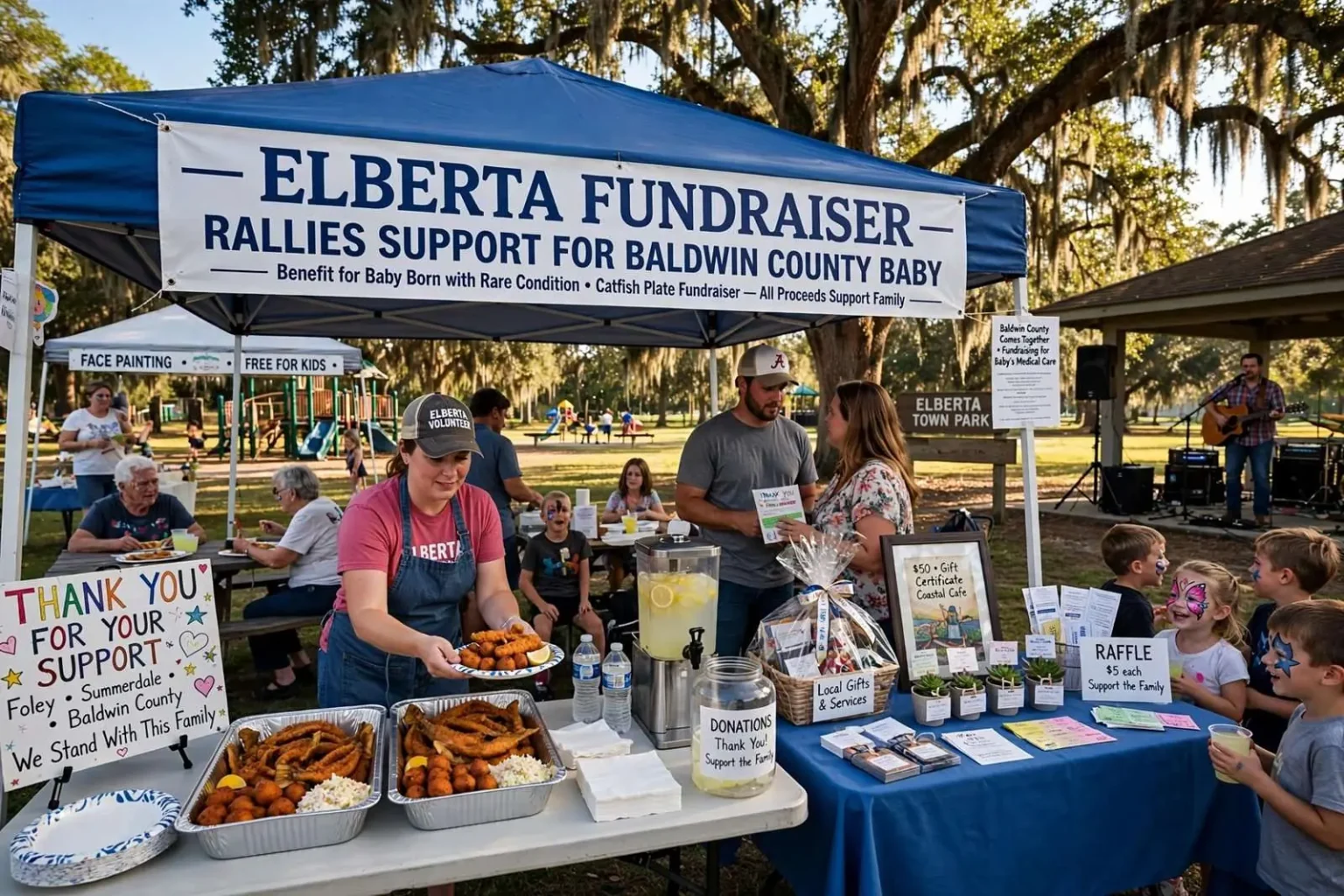
At Saturday’s event, roughly 150 people turned out for plates of catfish, face painting for children, a raffle and a silent auction, raising close to $3,000 for the family. In a town the size of Elberta, a crowd that size fills the town park, and the fundraiser’s homegrown format, fried fish, raffle tickets and a silent auction table, was the Gulf Coast’s traditional way of answering a neighbor’s need. Every plate sold and every raffle ticket bought added to a total that will help cover the travel, equipment and medical bills that insurance does not reach.
A local band performed classic country and beach tunes throughout the afternoon as attendees mingled with the baby’s parents and extended family, many of whom had followed the child’s progress online for weeks and finally met them in person. The music kept the afternoon’s tone warm rather than mournful, in keeping with the family’s own public message that their son is thriving despite his diagnosis.
A Family Adjusting to New Attention
The family, who splits time between Foley and Summerdale, said the past month has been a whirlwind of hospital visits, media requests and well-wishes from strangers around the world. For parents who were expecting an ordinary birth three months ago, the pace has been relentless, and they have had to learn quickly how to answer reporters, manage a public fundraising page and decide which moments of their son’s early life stay private.
A national television newsmagazine crew spent several hours filming the family at a relative’s home in west Mobile in the days before the fundraiser, with a segment expected to air later in the month. The national exposure brings more attention to the family’s fundraising account, but it also brings scrutiny and a level of recognition the family never sought, a trade-off relatives say they accept as the price of support for a child whose care will be expensive and long-running.
Despite the outside attention, relatives say daily life has settled into a routine of feedings, naps and the ordinary business of caring for a newborn. The tracheotomy requires careful management, but the baby’s days now look much like any infant’s, structured around meals and sleep rather than hospitals, and family members describe that ordinariness as the goal they fought for through the weeks of intensive care in Mobile.
Understanding Arhinia
Complete congenital arhinia, the condition Elberta’s fundraiser benefited, is among the rarest anomalies in medicine, affecting roughly one in 197 million births. Children born without an external nose face challenges that begin with breathing and feeding in infancy and extend through childhood to questions of surgical reconstruction, which surgeons generally approach in stages as the child grows. Because the condition is so rare, there is no standard playbook, and families typically assemble a team of specialists, learning as they go alongside physicians who may be treating their first case.
What families who have walked this road tend to emphasize is that the diagnosis itself does not define a child’s outlook. The baby’s healthy development apart from the anomaly, which physicians noted from the start, is the single most important fact in his story, and his mother’s success nursing him through a surgical airway offered early evidence of the resilience his care team and family will build on. Follow-up testing in the months ahead will determine the full scope of his condition and shape the treatment decisions to come.
The Long Road of Follow-Up Care
The child’s mother said she has been especially grateful for the wave of community support, noting that donations both large and small have made a tangible difference as the family manages ongoing medical appointments and follow-up testing to determine the full scope of his condition. Care for a child with a rare anomaly means regular trips to specialists, and for a family splitting time between Foley and Summerdale, that means long drives and complicated schedules layered onto the ordinary demands of a newborn.
Organizers of the Elberta fundraiser said they hope the outpouring of support continues as the family navigates the months ahead, with additional community events being discussed for later in the year. In a small community like Elberta, a fundraiser is rarely a single event; it is the first commitment in an understanding among neighbors that lasts as long as the need does, and the town park crowd on Saturday signaled that this family will not walk the road alone.
For the baby’s parents, the season since his birth has held more attention, generosity and worry than most families encounter in a lifetime. What they describe now is simpler: a son who eats, sleeps and grows, a community that keeps showing up, and the quiet confidence of parents who have already watched their child survive more in his first month than most people face in a lifetime.
Fundraising in Small-Town Alabama
The catfish-plate fundraiser is an institution along the Gulf Coast, and Elberta’s version on Saturday followed the form faithfully. Volunteers fried fish and served plates to a line that moved steadily through the afternoon, children with painted faces ran between the raffle table and the playground, and the silent auction offered donated goods and services from area businesses. Events like this one double as social gatherings, where neighbors who follow the family’s story online finally get to help in person, and where the simple act of buying a $10 plate carries the weight of saying we are with you.
The roughly $3,000 raised Saturday is a modest figure next to the $40,000 the online fundraiser drew, but local organizers describe the two efforts as different in kind. Online donations came from strangers moved by the story; the park fundraiser came from the community the family lives in, the people who will still be there years from now when the cameras and the news cycles have moved on. Both matter to the family, and both are reflected in the dedicated account opened at banks nationwide to handle the child’s ongoing medical needs.
The Hospital Journey Behind the Story
The baby’s first weeks trace a path familiar to South Alabama families facing serious diagnoses: delivery at South Baldwin Hospital in Foley, then transfer to a Mobile children’s hospital for the specialized care a community hospital cannot provide. The more than three weeks he spent in Mobile care involved the tracheotomy at five days old and the daily management of an airway anomaly in a newborn, work performed by pediatric specialists whose fields see arhinia so rarely that much of the care planning is done case by case.
His mother’s success nursing him through a surgical airway stands out in that journey. Hospital staff said they rarely see nursing attempted in such circumstances, let alone accomplished, and the achievement gave the family an early victory to build on. Breastfeeding a baby with a tracheotomy requires persistence and support from nurses and lactation specialists, and families in similar situations often describe it as the first moment they felt like parents rather than patients, an ordinary act made possible through extraordinary effort.
As the news coverage and the fundraisers continue, the family’s days have settled into the pattern they describe with some relief: feedings, naps, appointments and the ordinary work of loving a newborn. The national newsmagazine segment expected to air later this month will introduce their son to a wider audience, but the core of his story remains what it has been since early March, a healthy baby born with a rare condition, a family that refused to be defined by it, and two communities, Foley and Summerdale, joined by a town full of strangers in Elberta who fried catfish on a Saturday afternoon to prove it.