Passenger Killed After Truck Flips on I-65 Near Flomaton
A pickup truck passenger was killed early Saturday after the vehicle left Interstate 65 and flipped near Flomaton, state troopers said.
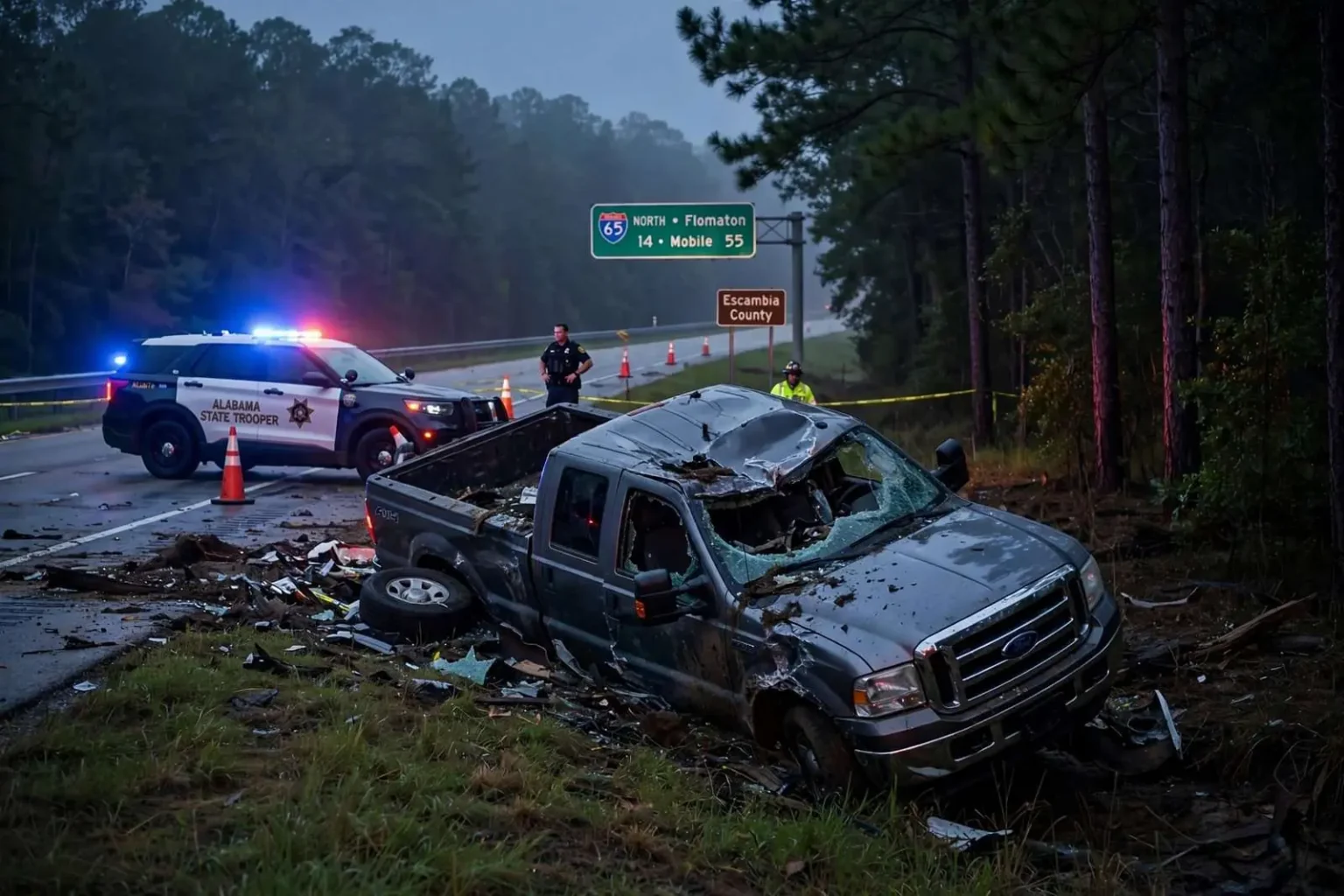
A pre-dawn crash on Interstate 65 near Flomaton left one man dead after the pickup truck he was riding in left the roadway and rolled over, according to Alabama State Troopers.
The crash happened around 4:15 a.m. Saturday when a 2010 Ford F250 drifted off the interstate about 14 miles northwest of Flomaton in Escambia County, troopers said. The passenger, 29, was not wearing a seat belt at the time and was ejected from the vehicle during the rollover. He was pronounced dead at the scene.
The driver, also 29, was taken to a local hospital for treatment of injuries sustained in the crash. Troopers have not released information on what caused the truck to leave the roadway, and the investigation remains open.
Names of those involved were withheld in the preliminary report, and no citations had been announced as troopers worked to determine why the truck left the interstate in the dark. Investigators in crashes of this kind examine the roadway for gouge marks and tire impressions, inspect the vehicle for mechanical problems, and await toxicology results before reaching a final finding.
A Corridor Between Two Worlds
The stretch of I-65 near Flomaton sits along a heavily traveled corridor connecting South Alabama to the Florida Panhandle, and state troopers routinely patrol the area given its mix of long-haul truck traffic and late-night travel. The interstate carries beach traffic toward the coast in season, freight between Montgomery and Mobile, and a steady flow of vehicles crossing between Alabama and Florida at all hours.
Northwest of Flomaton, the interstate crosses rolling, wooded country where the roadway rises and falls through cuts and curves. It is a section drivers can drift through without much to mark the miles, and it is exactly the kind of terrain where a moment of inattention at 4 a.m. — fatigue, a lapse in focus, or an overcorrection when a tire drops off the shoulder — can send a vehicle off the road and into a rollover.
Troopers who work the corridor describe a distinctive rhythm: commuter and commercial traffic through the day, then long-haul trucks and late-night travelers after dark, when speeds climb and the traffic thins. The hours before dawn combine the lowest visibility with some of the fastest traffic, and the crashes that occur in that window tend to be severe.
Escambia County’s stretch of I-65 sits far from urban trauma care. When a serious crash occurs, the injured face a long ambulance run toward hospitals in Brewton, Atmore, or across the state line toward the Pensacola area — a geography that makes survival, in many rural wrecks, a question of the first minutes rather than the first hour.
Ejection and Rollover Risk
Alabama Law Enforcement Agency officials continue to stress the importance of seat belt use in preventing fatalities during rollover crashes, noting that ejection significantly increases the likelihood of serious injury or death in single-vehicle wrecks. The physics are unforgiving: a rollover subjects an unbelted occupant to forces that can throw them from the vehicle entirely, often through a window that breaks or opens during the sequence, leaving them exposed to the rolling vehicle and the ground.
Pickup trucks add their own chapter to that story. The F250 involved in Saturday’s crash is a heavy, high-riding vehicle, and while such trucks protect occupants well in frontal impacts, a rollover changes the equation — the same height and weight that make a truck stable in a slide make it violent once it trips and begins to overturn. Occupants who remain belted inside the cab are typically confined to the vehicle’s protective structure; occupants who are ejected have no protection at all.
Alabama law requires seat belt use for front-seat occupants, and troopers say compliance remains the single greatest factor they can influence in rural fatal crashes. Enforcement campaigns along I-65 and other south Alabama corridors target unbelted drivers and passengers precisely because the rural crashes that turn fatal so often involve someone who was not restrained.
The Pre-Dawn Hours
The 4:15 a.m. timing places the crash in the window that safety researchers flag as among the most dangerous on rural interstates. Drivers on the road at that hour are disproportionately fatigued — shift workers heading home or to work, travelers pushing through the night, truckers running against the clock. Fatigue slows reaction and erodes judgment in ways drivers routinely underestimate, and a vehicle that drifts at 70 miles per hour reaches the shoulder in barely a second.
Darkness compounds the problem. Headlights illuminate a limited corridor of the roadway, and when a wheel drops off the pavement onto the soft shoulder, the sudden change in traction can pull the vehicle sideways. The natural reaction — steering back toward the road — can be the fatal one if it comes too fast, tripping the vehicle into a rollover. Troopers train drivers to ease off the accelerator and steer back gradually, a lesson repeated in safety campaigns but rarely heeded until it matters.
No evidence has been released suggesting impairment or any other specific factor in Saturday’s crash, and troopers cautioned against drawing conclusions before the investigation concludes. The preliminary facts, though, follow a pattern the agency has documented many times: a rural interstate, a dark hour, a single vehicle, and a rollover that killed the one occupant who was not belted in.
How the Response Unfolded
When the crash was reported before dawn, Escambia County’s rural geography shaped the response. The wreck site, 14 miles northwest of Flomaton, sits in a stretch of interstate where the nearest fire departments and rescue squads are volunteer-staffed and the nearest hospitals are small county facilities. Responders arriving to find an ejected occupant with fatal injuries and a driver with non-fatal wounds had to triage the scene while managing a live interstate roadway in the dark.
The driver was transported to a local hospital, where his condition was being evaluated. Troopers closed or restricted the crash lane while investigators documented the scene, a routine that on rural stretches of I-65 can delay traffic only modestly given the light volumes at that hour but that nevertheless puts responders alongside passing traffic for an hour or more before the roadway is cleared.
Wreckers removed the truck, and by daylight the interstate was back to normal flow — the highway retaining little evidence of the crash beyond marks on the pavement that investigators had already photographed and measured.
What Investigators Will Examine
The open investigation will proceed along lines that ALEA follows in every fatal single-vehicle wreck. Investigators will reconstruct the vehicle’s path from tire marks and damage, determine the speed at the time of the departure, and inspect the truck for tire failures, steering or brake defects, and load shifts that might have contributed. Toxicology results, which typically take weeks, will address impairment questions. Weather records for the pre-dawn hours will be checked, though no weather factor has been mentioned in the preliminary report.
Only when those elements are assembled will troopers issue a final report — one that may identify contributing factors ranging from fatigue to a mechanical failure to simple inattention, or may conclude that the cause cannot be determined. Either way, the charges that follow, if any, depend on findings the investigation has not yet reached.
No further details about the circumstances leading up to the crash had been released as of this week. Troopers say the investigation into the exact cause remains ongoing, and they have asked anyone who witnessed the truck before it crashed to contact the agency.
Flomaton and the Border Country
Flomaton sits just below the Alabama-Florida line in Escambia County, a small railroad town where U.S. Highway 29 crosses into Florida and I-65 passes a few miles to the west. The town is used to the interstate’s presence — travelers stop there for fuel and food, and the highway is part of the local landscape — but the crashes on the corridor touch the community personally. Volunteer responders from the area answer the calls, and the victims of serious wrecks are often passing strangers rather than neighbors, which changes little about the weight of the work.
The 14-mile marker northwest of town places the crash in a section of interstate that serves as a funnel between Alabama and the Panhandle’s beaches and military installations. Traffic on the corridor swells on summer weekends and holiday periods, but the deadliest hours are often the emptiest ones — the dark early mornings when the road belongs to truckers, night-shift commuters, and travelers who misjudged the distance to their destination.
A Familiar Warning
Troopers have used fatal crashes on the corridor for years to renew the same two warnings: watch your speed and your fatigue on the late-night runs, and buckle up every time. The Saturday crash, in the agency’s telling, makes the second warning with terrible clarity — a vehicle carrying two young men, a rollover on a dark interstate, and a passenger who survived the initial crash only to be killed by ejection.
For the family and friends of the 29-year-old who died, the investigation’s eventual findings will matter less than the loss itself. For everyone else who drives the corridor between South Alabama and the coast, the crash stands as the most recent evidence for a rule that costs nothing to follow and, on the night it matters most, is the only protection a passenger has.