Wider Driveway at Hutchens Elementary Set to Ease Westlake Road Traffic Jams
A $210,000 driveway expansion at Hutchens Elementary, backed by Mobile County funding, is nearly finished and aims to cut morning traffic backups.
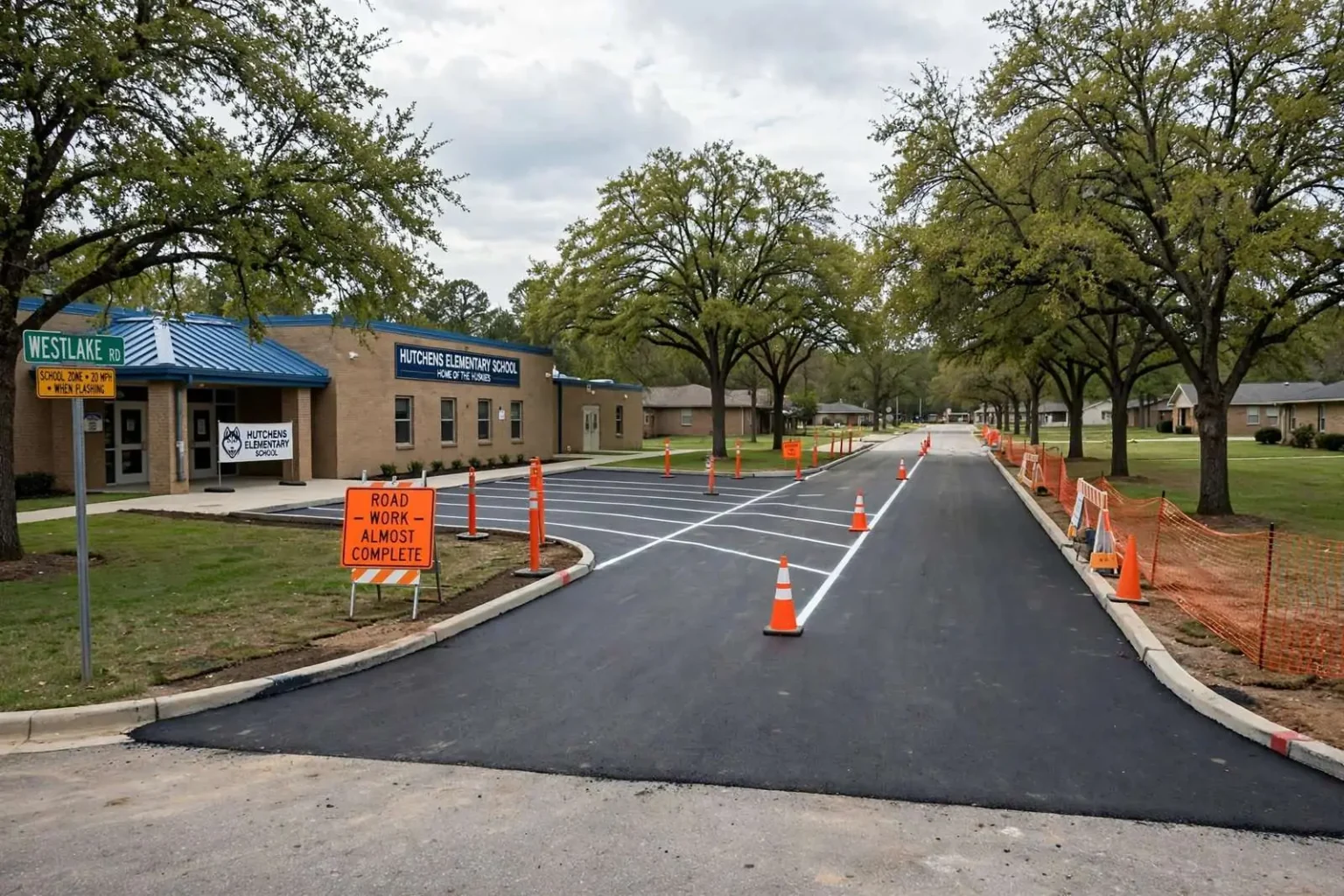
Parents dropping off and picking up children at Hutchens Elementary School are about to get some relief from one of the more frustrating parts of their daily routine. Construction on a widened driveway in front of the school is nearly finished, with county officials expecting it to open within about two weeks. The improvement targets a bottleneck that has defined arrival and dismissal times at the school for years, when a single narrow access point funnels hundreds of vehicles into a queue that spills onto the surrounding roadway. For families who have timed their mornings around the backup, the opening of the wider driveway promises a small but meaningful change to the shape of the school day.
The project has been years in the making. Mobile County Commissioner Jerry Carl said the effort to fix the bottleneck dates back at least a year and a half, after he saw firsthand how badly traffic backed up on Westlake Road during arrival and dismissal times. County commissioners in Mobile County routinely field complaints about traffic around schools, where population growth has outpaced the capacity of older roads, and Carl said the Hutchens situation stood out. Rather than wait for a larger road project to address the problem, he moved to direct county resources toward the driveway itself, the point where the daily congestion was actually generated.
Carl said he helped secure $140,000 toward the $210,000 total cost of the improvement, with the remainder covered through other project funding. “I think it’s great use of tax dollars,” Carl said. “As small as that may seem, to those families having to drop those kids off and pick them up, it will make their life a little bit easier.” The funding split reflects the way many neighborhood-scale transportation fixes are financed in Mobile County, with a commissioner’s discretionary contribution anchoring a project that would be too small to headline a major road program but too important to the surrounding community to leave unfunded.
How the New Layout Works
Mobile County hired Speaks and Associates to oversee the work. Jerry Luker, an engineer with the firm, said the wider driveway and an added stacking area are designed specifically to keep vehicles from spilling out onto Westlake Road while waiting to load or unload students. The engineering challenge at school sites of this kind is rarely about moving cars quickly; it is about giving them somewhere to wait. A stacking area allows a line of vehicles to queue entirely on school property, holding them clear of through traffic until each one reaches the loading zone in turn. Under the previous layout, cars lined up along the roadway itself during peak drop-off and pick-up windows, creating hazards for both drivers and pedestrians near the school.
Traffic engineers generally treat school arrival and dismissal as among the most demanding short-duration traffic events a local road faces, concentrating a school’s entire enrollment into two windows of a few dozen minutes each. When the queue exceeds the available curb space, the backup extends into travel lanes, where it slows through traffic and forces students exiting vehicles to step into or near an active roadway. Widening the drive and adding dedicated stacking space attacks both problems at once, and county officials have pointed to the Hutchens design as a template for how a modest investment can produce outsized safety gains.
The timing of the opening matters for families as well. The two-week estimate places the new configuration in service while the school year is still in session, meaning parents will get immediate, practical experience with the new traffic pattern rather than adjusting after a summer break. School traffic patterns work best when drivers learn them gradually, and the county’s expectation is that the widened drive will be functioning normally well before any transition period ends. Parents are typically advised to follow staff directions during the first days of a new pattern while the flow settles into a routine.
Part of a Longer-Term Plan
Carl said the driveway work is only one piece of a longer-term plan for the area. County officials have also discussed extending Westlake Road through to Oyler Road, a project that could further ease congestion by giving drivers another route in and out of the school zone. Additional connectivity is the standard long-term answer to school-zone congestion, because it distributes traffic across more than one approach and gives commuters an alternative to funneling past the school itself. For the neighborhoods around Hutchens Elementary, a through connection would also shorten everyday trips that now require circling on the existing grid.
For now, though, Carl cautioned that any larger road extension remains a distant prospect. “Road building is a slow process,” he said. New road segments require planning, right-of-way acquisition, design and environmental review before construction can begin, and funding for a substantial extension would have to be identified through channels far more competitive than a driveway widening. The commissioner’s caution was a reminder that the swift, visible progress at the school itself does not guarantee a similar timeline for the larger vision, even when there is broad agreement that the eventual project would help.
The Hutchens Elementary project reflects a broader pattern across Mobile County, where county commissioners have increasingly directed discretionary funds toward small-scale traffic fixes near schools rather than waiting on larger, more expensive road overhauls. The logic is straightforward: a school-zone improvement delivers a daily, measurable benefit to a defined group of families for a comparatively modest outlay, while a major corridor project can consume years and many multiples of the cost before residents feel any difference. Commissioners have found that these targeted projects also build public confidence in county government, because constituents can see the result every school day.
The approach is not without trade-offs. Small projects address symptoms rather than underlying capacity, and critics of the strategy note that spreading discretionary dollars across many small fixes can leave larger needs unmet. But in fast-growing suburban and rural-interface areas of Mobile County, where new subdivisions have filled in along older two-lane roads, the pattern of school-related congestion has repeated itself at site after site, and the county has treated the school-access projects as a practical response. Hutchens Elementary, which serves families in the growing western reaches of the county, fits the profile precisely: a school whose enrollment success created a traffic problem its original access was never designed to handle.
For a school like Hutchens Elementary, where the daily crunch of buses, parent vehicles and foot traffic converges on a single access point, even a modest widening project can make a meaningful difference in safety and convenience. School administrators generally report that clearer traffic patterns reduce near-misses in the loading zone, shorten the time buses spend idling and make the jobs of crossing guards and staff considerably easier. Parents, for their part, measure the benefit in minutes saved each morning and in the peace of mind that comes from watching children step out of cars onto a calmer curb.
The money behind the project also illustrates how county-level transportation funding works in practice. A commissioner’s discretionary allocation, in this case the $140,000 Carl helped secure, functions as seed money that makes a project viable enough for other funding sources to complete it. County engineering staff then manage design and construction through the same professional channels used for larger projects, which is why a firm like Speaks and Associates could be retained for a job of this size. The result is a project category that moves at a speed residents can actually see, in contrast to the multi-year horizons of major programs.
School officials did not indicate a firm opening date beyond the two-week estimate, but families in the Hutchens Elementary community can expect the new driveway configuration to be in use well before the end of the current school year, giving them a smoother routine for the final stretch of drop-offs and pick-ups. County officials have said they will monitor how the widened drive performs during the heaviest arrival and dismissal windows and make operational adjustments as needed, such as staffing and signage tweaks that cost little but can fine-tune the flow. For the parents who have spent years idling on Westlake Road twice a day, the opening will be the visible end of a project that Carl began pushing a year and a half ago, and a signal that the longer-term conversation about roads around the school is continuing.
Residents with questions about the project or about the proposed Westlake Road extension are directed to the commissioner’s district office, which has handled constituent communication throughout the construction period. County officials have indicated that updates on the larger road plan will come as funding and engineering work advance. In the meantime, the widened driveway stands as a completed example of the kind of improvement residents often ask for and rarely see delivered quickly: a fix to an everyday problem, funded locally, designed around the people it serves and opening on a timeline measured in weeks.