Baldwin County Prosecutors Weigh Upgraded Charges in Bay Minette-Area Murder Case
Baldwin County prosecutors are reviewing whether a Foley man accused of killing his stepfather could face an upgraded capital murder charge.
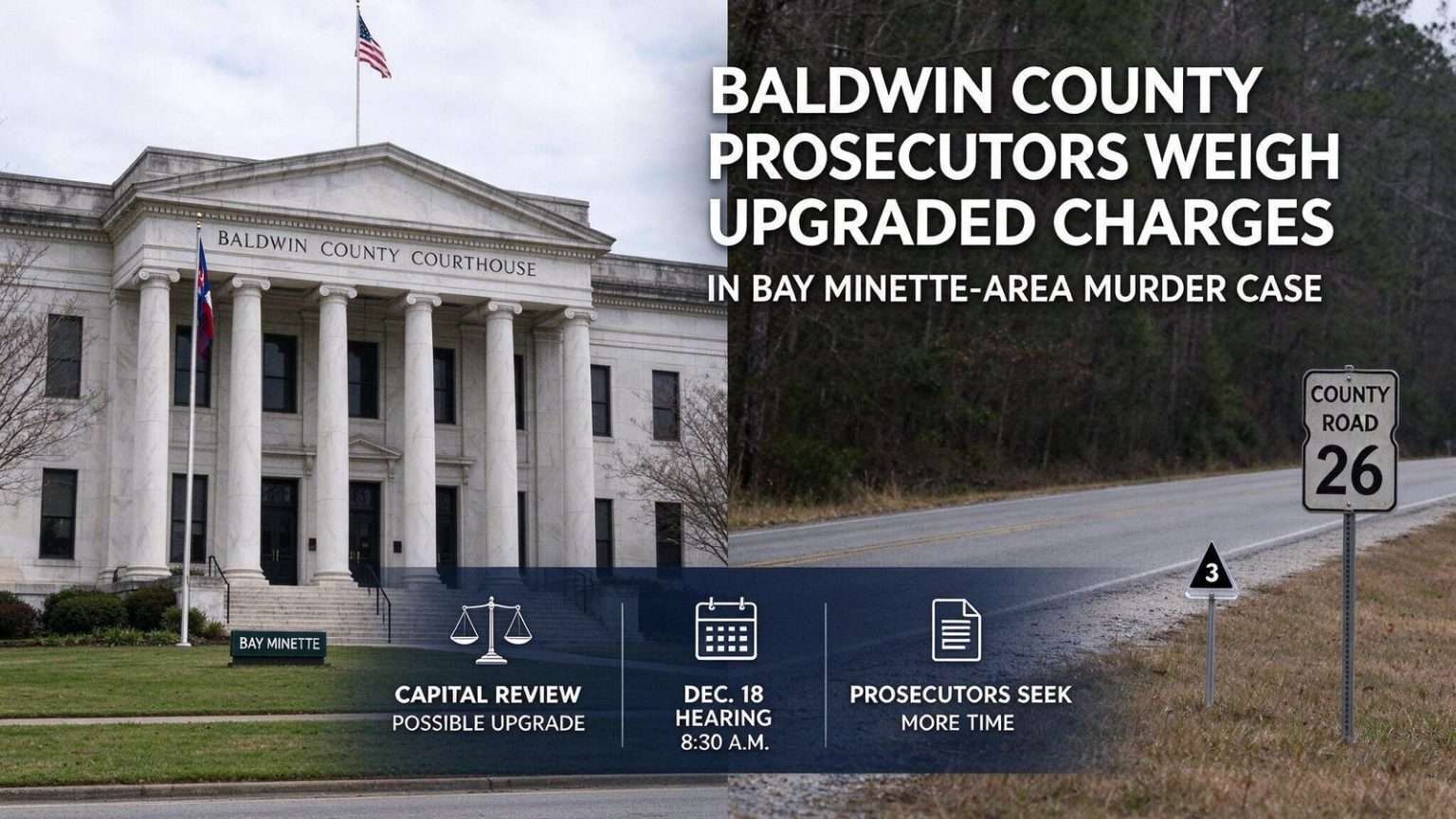
A Baldwin County murder case took a procedural turn this week after prosecutors asked for more time to determine whether the charges against the defendant should be increased. The request postponed a preliminary hearing in one of the county’s most closely watched cases, adding two weeks to a schedule that had been set only after the discovery of human remains along a rural county road last month.
A preliminary hearing that had been set for this past Thursday in the case against William Minton, 55, of Foley, was pushed back two weeks to Dec. 18 at 8:30 a.m. in the Baldwin County courthouse in Bay Minette. Circuit Judge Scott Taylor is presiding over the case, and the rescheduled hearing will be held in the same courthouse where the county’s felony matters begin their way through the court system.
According to a court motion filed by Assistant District Attorney Megan Webb, prosecutors are continuing to build their case against Minton and want additional time before the hearing moves forward, citing the possibility that the charges could be revised or elevated. Such motions are not unusual in complex cases, but they carry added weight when prosecutors are weighing a capital designation, because the decision shapes every later stage of the prosecution.
The charges and the allegations
Minton faces charges of murder and abuse of a corpse stemming from the Nov. 6 death of his 87-year-old stepfather, Kenneth Hood. Investigators allege Hood was killed by blunt force trauma inside a home on Russet Court that the two men shared, and that his body was later dismembered and portions were left along County Road 26 south of Magnolia Springs.
The allegations span two ends of Baldwin County — the Foley-area residence where the elderly man lived out his final years, and the quiet stretch of County Road 26 in southern Baldwin County where searchers located remains days after the killing. Investigators have worked to reconstruct the movement between the two, and the evidence gathered from both scenes now forms the backbone of the state’s case.
Abuse of a corpse is a separate felony charge in Alabama, and it is often filed alongside homicide charges when the handling of a victim’s remains goes far beyond the killing itself. Prosecutors treat such charges as part of the full accounting of a defendant’s conduct, and juries weighing a murder case can consider them independently.
Weighing a capital upgrade
District Attorney Hallie Dixon said following a Nov. 14 bond hearing that her office was examining whether the murder charge could be upgraded to capital murder, an offense that can carry the death penalty in Alabama. Dixon has noted separately that Minton’s prior criminal record could make him eligible for a sentence of life without parole even without a capital designation.
Alabama law recognizes 18 distinct circumstances under which a homicide can be prosecuted as capital murder, and it remains unclear whether the facts of this case would meet any of those criteria. The statutory list covers killings committed during certain other felonies, killings of particular classes of victims, murders of multiple people, and killings carried out in especially defined circumstances — each of which must be proven beyond a reasonable doubt for a capital conviction to stand.
The victim’s age is among the factors prosecutors consider under the capital statute, which includes the murder of a person aged 70 or older as a capital offense. Whether that circumstance — or another on the list — fits the evidence in the Hood case is precisely the question Dixon’s office has not yet answered publicly, and the delay requested in Webb’s motion signals that the review is not finished.
The two-track possibility Dixon described — capital murder on one hand, or a non-capital murder conviction paired with a habitual offender enhancement on the other — gives prosecutors multiple paths to a life-without-parole outcome if they choose to pursue one. Capital prosecutions, with their heightened procedural requirements, expanded jury selection and automatic appeals, take years to resolve; a non-capital murder case moves faster while still potentially removing the defendant from society permanently.
What the preliminary hearing decides
Minton remains held in the Baldwin County Jail on $1 million bond as the case proceeds. Bond was addressed at the Nov. 14 hearing, and the amount reflects both the severity of the allegations and the flight risk prosecutors argued at that stage.
The rescheduled preliminary hearing will determine whether there is sufficient evidence for the case to move forward toward a grand jury. In Alabama’s system, a preliminary hearing is not a trial: a judge hears a preview of the state’s evidence and decides only whether probable cause exists to believe a felony was committed and that the defendant committed it. If the judge finds probable cause, the case is bound over to the grand jury, which votes on formal indictments; if not, the prosecution can still pursue an indictment directly.
For prosecutors, the hearing is also a first public test of the evidence — a moment when defense counsel hears the state’s case in open court for the first time. Delaying that moment, as Webb’s motion does, keeps the full picture out of the defense’s hands a little longer, a consideration prosecutors weigh whenever charging decisions remain open.
A community watching
The case has drawn attention in Baldwin County, where residents in the Foley and Magnolia Springs areas have followed developments closely since the initial discovery of human remains along the rural county road last month. The discovery along County Road 26 prompted a significant investigative response, and the identification of the remains as Kenneth Hood connected the southern Baldwin search area to the quiet Foley-area street where he and Minton shared a home.
The killing of an 87-year-old man, allegedly by his own stepfather, has been difficult for residents of both communities to absorb, and the dismemberment alleged in court documents has only deepened the sense of shock. Court officials say further hearings will be scheduled as the investigation and charging decisions progress, and the Dec. 18 hearing in Bay Minette will be the next public checkpoint in a case that has already reshaped the holiday season for two Baldwin County communities.
The people and offices behind the case
The cast of the proceedings spans the institutions that handle Baldwin County’s major prosecutions. District Attorney Hallie Dixon leads the office responsible for charging decisions, and her public comments after the Nov. 14 bond hearing were notable for laying out the capital review before it had concluded — an acknowledgment of the case’s severity that also signaled the office’s willingness to take whatever time the evidence requires.
Assistant District Attorney Megan Webb, who filed the motion for the delay, is handling the case at the hearing level, and Circuit Judge Scott Taylor’s assignment to the matter puts it before a judge who will manage its early stages through the probable cause determination. The Baldwin County courthouse in Bay Minette houses those early proceedings because Alabama’s county seats remain the venue for preliminary hearings even in cases originating elsewhere in the county.
The Baldwin County Jail in Bay Minette is where Minton will remain during the pendency of the case absent a bond reduction, and the $1 million set at the November hearing means he is unlikely to post bond while facing murder and abuse of a corpse charges with a possible capital upgrade pending.
How the capital decision typically unfolds
Capital charging decisions follow a pattern prosecutors across Alabama know well. After an arrest on murder charges, the district attorney’s office reviews the evidence against the statutory list of aggravating circumstances, consults with investigators, and often presents the question to a review committee before announcing whether a case will proceed capitally. The decision can come before indictment, with the grand jury, or in rare instances later, and once made it triggers a separate set of procedures — specialized defense representation, extended discovery, and the bifurcated trial process in which a jury that convicts then weighs punishment.
The deliberate pace Dixon’s office is taking is consistent with that process. Announcing a capital charge prematurely, only to withdraw it later, carries consequences for the prosecution; waiting while the evidence is assembled preserves flexibility. Defense counsel, for their part, prepare for both possibilities when a capital review is open, since the defense strategy differs sharply between a death-eligible case and an ordinary murder prosecution.
What December 18 will bring
When the hearing convenes at 8:30 a.m. on Dec. 18, the judge will hear testimony and argument sufficient to establish probable cause — typically a fraction of the full case, presented through investigators and key evidence. The proceeding is expected to be brief by trial standards, but it will be the most complete public account of the allegations yet, and the courtroom in Bay Minette is likely to be closely watched by residents of Foley and Magnolia Springs who have followed the case since November.
Whatever the hearing produces, the larger questions — whether the case proceeds capitally, how the grand jury rules, and how the trial calendar ultimately shapes up — remain ahead. For now, the two-week delay is the system working as designed in a case where the prosecution has made clear it intends to get the charging decision right before locking it in.