Fairhope Investigated Barnwell Homicide in 2008
A 2008 WKRG report covered the initial Fairhope Police investigation after a man was found stabbed inside a boat in Barnwell.
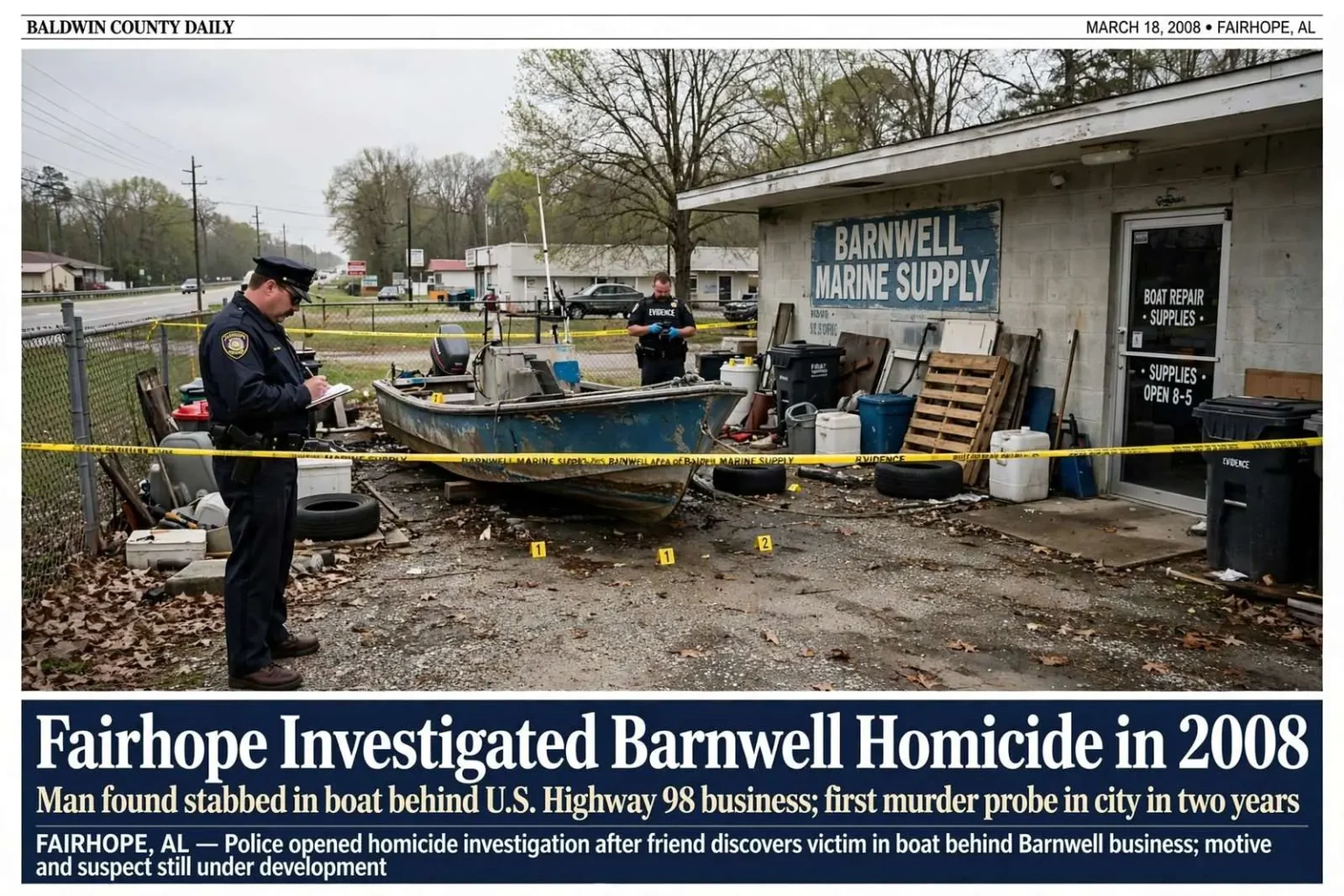
Fairhope police opened a homicide investigation in the Barnwell community in March 2008 after a man was found stabbed inside a boat behind a business on U.S. Highway 98, according to a local station. Police said a friend discovered the victim after going to visit him. Investigators said they were still developing motive and suspect information, and the report noted that it was Fairhope’s first murder investigation in two years.
The discovery turned a routine spring week in southern Baldwin County into a working crime scene. The boat sat behind a business along the U.S. Highway 98 corridor that runs through Barnwell — the stretch of commercial storefronts, shops and work yards between Spanish Fort and Fairhope — and the man inside had died of stab wounds. It was a friend, arriving to check on him, who made the find and brought police to the scene.
For the Fairhope Police Department, the case carried a weight beyond its circumstances: the department had gone two years without a murder investigation. Fairhope, a bayfront city of modest size, does not average many homicides in a given year, and when one lands — particularly just outside the city’s core, in the unincorporated-feeling commercial strip of Barnwell — it draws attention across the county. Detectives began the unglamorous early work of any stabbing case: canvassing neighboring businesses for witnesses, tracking the victim’s recent movements and associations, and waiting on autopsy results from the state to fix the cause and manner of death.
The Barnwell community and the Highway 98 corridor
Barnwell sits along U.S. Highway 98 in southern Baldwin County, one of the small communities the highway strings together on its run toward the beaches. Its identity is largely commercial and rural-residential: businesses front the four-lane, with homes and acreage branching off behind them. That geography matters in a case like this. Businesses along the corridor have their backsides hidden from the road — storage yards, parking areas, loading doors — and a boat parked behind one of them could sit for hours without anyone taking a second look.
That seclusion cuts both ways in an investigation. It can shield activity from view, as it evidently did in the hours before the victim was found. But it also narrows the universe of people with reason to be there. Detectives working a scene like the one behind the Highway 98 business would focus on who worked at or visited the business, who else kept boats or equipment in the area, and who had been seen in the vicinity in the hours before the discovery.
The friend’s role as the finder also became an early thread. Discoveries by acquaintances are common in cases where a victim frequents a particular spot, and one of the first tasks for investigators is to account for that person’s movements and relationship to the victim — not from suspicion alone, but because the finder is often the person who can last place the victim alive and establish the timeline police must build.
An early-stage investigation
In the days after the body was found, police were candid about where the case stood: motive was undeveloped, no suspect had been named, and investigators were still assembling basic facts. That posture is typical and deliberate. In the first hours and days of a homicide case, detectives guard details tightly — the facts known to police but withheld from the public become a screening tool, letting them test whether a tipster or interview subject actually knows something about the crime rather than something about the news coverage.
The March 2008 report reflected that discipline. What was released was the minimum needed to inform the public and invite tips: a man was dead, the death was a homicide, the scene was behind a business on U.S. 98 in Barnwell, and the police wanted to hear from anyone with information. Nothing in the early account indicated how long the victim had been dead, what relationship, if any, connected him to the business, or what led investigators toward the stabbing as the mechanism of death.
Baldwin County’s other law enforcement agencies stood ready to assist, as they do for municipal departments handling serious crimes. The Baldwin County Sheriff’s Office, the district attorney’s office and the state’s forensic capabilities all factor into any homicide prosecution that grows out of an investigation like this one. But in the opening week, the work belonged to Fairhope’s detectives — two years’ worth of quiet in the city’s murder ledger suddenly broken.
Fairhope and its crime profile
Fairhope in 2008 was a city of roughly 15,000 residents perched on the bluffs of Mobile Bay, better known for its flower-lined streets, its pier and its reputation as an artists’ and retirees’ haven than for serious violent crime. The city’s police force handled the volume and variety of a growing Baldwin County municipality — traffic, thefts, domestic disputes, the seasonal surge that comes with tourists and second-home owners — but homicides were rare enough that a single case reset the department’s collective memory. The two-year gap cited in the March 2008 report was a fair measure of that rarity.
The city’s growth during that decade made policing it a moving target. Baldwin County was one of Alabama’s fastest-growing counties through the 2000s, and Fairhope’s population and commercial footprint expanded along with it. The Barnwell area, just west of the city center along the highway, was part of that expansion — more businesses, more traffic, more activity along the corridor than a generation earlier. Growth brought revenue and vitality, and it also brought the kinds of incidental opportunities for crime that come with busier, more anonymous commercial strips.
For residents, the case’s most unsettling feature was likely the setting. A stabbing behind a business in daylight-familiar surroundings — a highway people drive every day — reads differently than a violent crime downtown late at night. It was the sort of case that prompted conversations in shop break rooms up and down the highway, and that put pressure on the department to show steady, visible progress.
How Baldwin County homicide cases move
The arc of a case like this one follows a pattern Baldwin County residents have seen in other investigations. The early days belong to scene work and canvass: forensic technicians process the boat, the ground around it and the business for physical evidence, while detectives interview everyone with a reason to have been nearby. The state department of forensic sciences performs the autopsy, establishing the number and nature of the wounds and, with them, clues about the weapon and the struggle.
Next comes the timeline. Investigators map the victim’s last known day — where he was, who saw him, what calls or transactions he made — looking for the window in which the attack occurred and the people who could account for it. In a case where the body lay behind a commercial building, the canvass of nearby businesses’ hours, deliveries and employees becomes central. Anyone who drove past and noticed the boat, or noticed people around it, is worth a conversation.
Only after that groundwork firms up do investigators speak publicly about suspects or motive, if they do at all. The March 2008 report caught the case at the stage before any of that was settled — the point where a department holds its cards and asks the public for help. The report did not state a final case outcome, and this historical account preserves the investigation as it was known in 2008, not as it later concluded.
What the case left behind
Two decades on, the Barnwell homicide investigation stands as a snapshot of small-city policing in Baldwin County at the height of its growth years. A friend’s visit ends in a discovery; a highway business becomes a crime scene; a department that had gone two years without a murder case starts one from scratch. The mechanics have barely changed since — what has changed is the technology available to detectives, from cameras along commercial corridors to cellular location records and increasingly sensitive DNA methods.
The account also preserves a piece of the Highway 98 corridor’s history that most drivers never knew. Behind one of the businesses that line the road through Barnwell, a life ended violently in March 2008, and for a season the corridor was a place of evidence markers, interviews and police activity rather than errands. For the victim’s family and friends, the case was not a curiosity but a rupture — and the department’s early, careful public statements reflected an understanding that everything it said would be read closely by people grieving and by a community watching its first murder case in two years.
As reported at the time, Fairhope police continued developing the investigation in the weeks that followed the discovery, and residents with information were urged to come forward. What became of the case after those early days is not recorded in the archived report — a reminder of how local news preserves the openings of stories whose conclusions sometimes never reach the archive.