Gulf Shores Police Lead Alabama in Body Camera Use as More Agencies Follow
Gulf Shores police have used body-worn cameras since 2010, and Fairhope and Daphne are following suit as departments across Baldwin County adopt the technology.
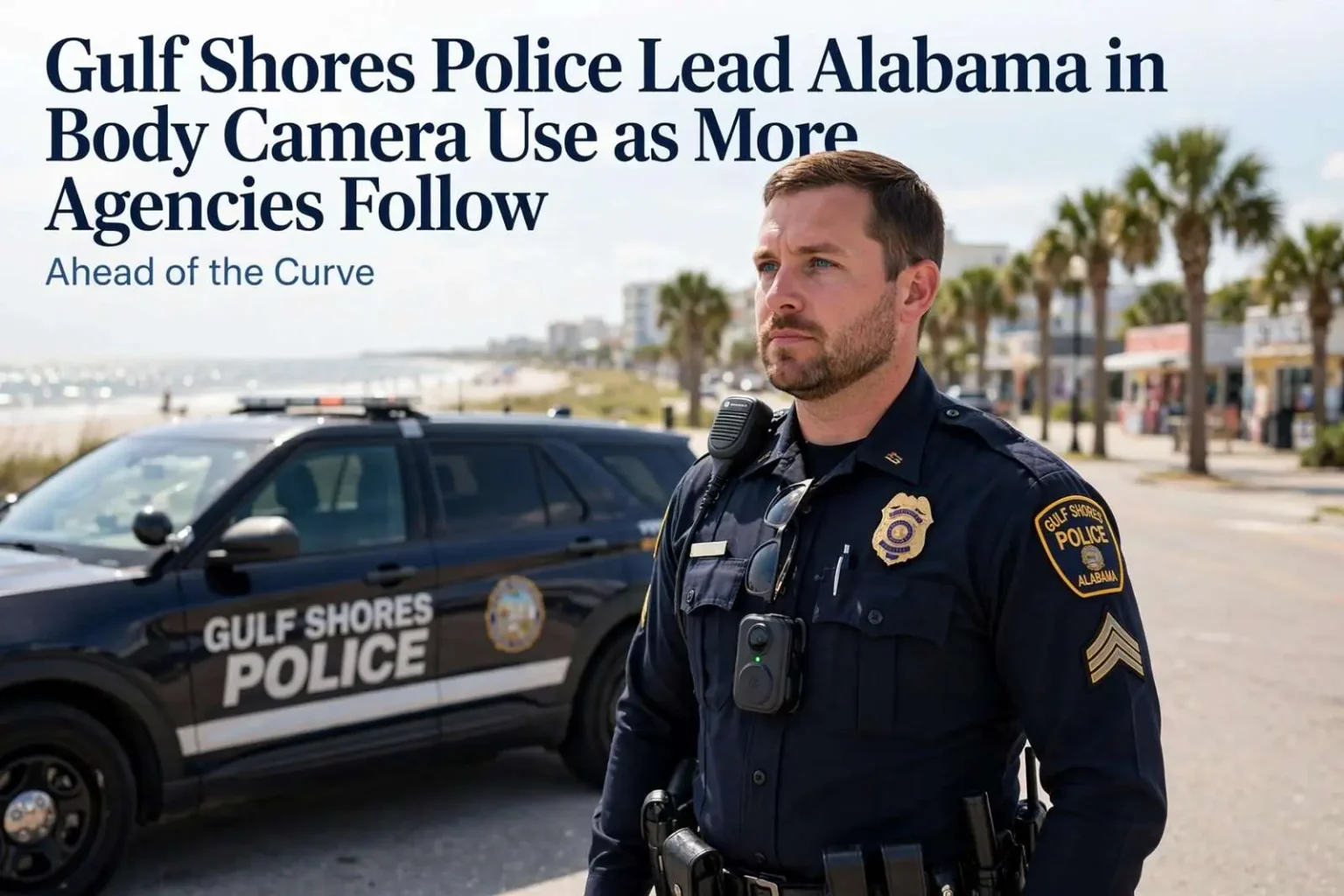
Ahead of the Curve
As national debate grew in late 2014 over equipping police officers with body-worn cameras, Baldwin County departments were already ahead of the curve, with the Gulf Shores Police Department among the earliest adopters of the technology in Alabama. By the time the devices became a fixture of nightly news broadcasts and city council agendas across the country, Gulf Shores officers had been wearing them for years.
Gulf Shores officers have carried body cameras since 2010, years before the practice drew national attention following high-profile police shootings elsewhere in the country. What began as a local experiment with a small clip-on device had, by mid-decade, hardened into routine procedure — as unremarkable to the officers carrying them as the radios on their shoulders.
A corporal with the department said the cameras have become as routine as carrying a firearm. “For us, it’s part of the job. Issue your gun, issue your camera,” he said. The framing captured how quickly an unfamiliar technology can fade into the background of a profession: officers who once had to be persuaded to wear a recorder now treat the device as standard equipment issued at the start of a shift.
The department has fielded frequent requests from other agencies interested in learning from its experience, drawing questions from departments across the region weighing the cost, storage demands and policy questions that come with the technology. Gulf Shores’ years of practical use — through four tourist seasons by the time national attention arrived — gave the department a track record few agencies could match.
Nearby departments were moving in the same direction. Fairhope’s police chief said his department planned to have cameras on every officer within days, following a short training session for staff on the new equipment. Daphne police also use body cameras, and the city of Mobile was exploring the idea at the time — a sign of how quickly the Baldwin County approach was spreading across south Alabama.
How the Devices Work in Practice
Gulf Shores officers described how the devices work in practice: a small camera clips to an officer’s uniform and is activated by sliding down a lens cover, with an indicator light letting the officer know it is recording. The design is deliberately simple — no buttons to fumble with, no menu to navigate — so that a device that might capture evidence in a traffic stop or a scuffle can be started with a single motion.
Officers said that while the cameras sometimes draw curiosity from younger residents, most people focus on the situation at hand rather than the device itself. The worry that a visible recorder would inflame every encounter, in other words, did not match what officers reported experiencing on the street; after a moment’s notice, the camera recedes and the contact proceeds as it would have anyway.
Footage captured by the cameras uploads to a secure department server, where officers can add notes, categorize video and determine how long it should be retained. The organizational work happens quietly after the shift ends, turning hours of recorded contact into a searchable archive that can be retrieved when a case goes to court or a complaint needs review.
Access to recordings is restricted to protect against misuse, with department officials saying any leaked footage would be easy to trace back to its source. The audit trail is the technology’s quiet safeguard: every viewing and download is logged, so a recording that surfaces where it should not can be followed directly back to the account that released it.
The Case for Transparency
Department leaders said the broader goal is transparency, both for officers and the public. They pointed to incidents in other states where body camera footage helped clarify what happened during contested police encounters, arguing that having an officer’s-eye view can settle disputes that might otherwise rely solely on conflicting accounts of a chaotic, fast-moving moment.
The argument runs in both directions, which is part of the technology’s appeal to police leadership. A recording can exonerate an officer wrongly accused of misconduct as readily as it can document a legitimate complaint, and departments that adopted cameras early often did so with that two-way protection in mind. For Gulf Shores, a department whose officers handle everything from spring break crowds on Highway 182 to quiet residential streets, the tape is a witness that is always present.
Tourism gives the department’s adoption a particular logic. Gulf Shores swells each summer with visitors who have no stake in local disputes and little patience for uncertainty, and the city’s police handle a volume of traffic stops, alcohol-related contacts and beach ordinance enforcement that few departments of comparable size face. Cameras in that environment serve less as a response to scandal than as documentation of an unusually high volume of public contact.
The economics of the technology shaped adoption across the region, too. The cameras themselves are only the visible cost; the storage infrastructure behind them, with years of footage to archive and strict rules about what can be deleted, is the expense that slows smaller departments. Baldwin County’s early adopters had already absorbed that learning curve, and their experience became the practical answer to the questions other chiefs were asking.
Nationally, the late-2014 debate had turned the cameras into a federal question. Calls for wide adoption followed a series of deaths in police custody elsewhere in the country, and the president proposed directing federal money to help departments buy the equipment. For a Gulf Coast city that had already worn the devices through four years of routine use, the national conversation felt less like a new idea than a late acknowledgment of one.
The experience in Baldwin County also tested the questions that policy debates were only beginning to ask. When should an officer be required to record? How long should routine footage be kept? Who may see a video, and under what process? Gulf Shores had worked through those decisions in practice, developing the habits — recording contacts, noting footage, restricting access — that formal policies in other cities would later codify.
Officers’ on-street observations added a dimension the policy papers missed. The curiosity of younger residents — children who spot the device and ask about it — became one of the more common interactions the cameras produced, a small reminder that a generation growing up with phones in every pocket regards a camera on an officer’s chest as unsurprising. For their parents’ generation, the devices registered differently, which is precisely why departments emphasized the indicator light: nothing records without a visible sign.
For prosecutors and defense attorneys, the footage changed the texture of routine cases. A driving-under-the-influence arrest that once rested on an officer’s written narrative now came with video of the stop, the field sobriety tests and the suspect’s demeanor, evidence that could resolve a case quickly or raise questions that paper never would. Either way, the record reduced the room for disagreement about what happened.
The spread of the technology across south Alabama followed the pattern the county’s departments demonstrated. Fairhope’s rollout, Daphne’s established use and Mobile’s study of the idea traced an arc from early adopter to regional norm, driven by the same calculation at each step: the cost of the equipment was steadily becoming easier to justify than the cost of an unresolved dispute over an officer’s word.
By the time the national debate demanded answers, Gulf Shores’ answer had already been running in production for years. The department’s experience suggested what later adopters across the country would find: the camera itself is the easy part. The habits of use, the storage discipline and the public trust built on consistent transparency are the work that turns a clipped-on lens into an institution.
County sheriffs’ offices and smaller municipal departments in the region watched the early adopters closely for another reason: liability. A department that can produce video of a contested encounter is a department with fewer expensive ambiguities, and insurers and municipal attorneys took notice as the Baldwin County agencies recorded year after year without the disputes over “he said, she said” testimony that had once defined complaint reviews.
Training needs, while real, proved modest in practice. The Fairhope chief’s description of a short training session before every officer carried a camera reflected the experience of departments across the county — the hardware takes minutes to learn, and the real instruction happens in the field, where officers develop the instinct for when to slide the lens cover and how to explain the device to the people they meet.
The presence of the cameras also shaped documentation habits beyond recorded footage. Officers who know their contacts are being recorded tend to narrate actions more completely, write reports that align with the video and treat the recording as the starting point of their paperwork rather than its replacement. Departments describe the effect as self-reinforcing: the better the notes attached to the footage, the more useful the archive becomes for the next case.
Public expectations completed the loop. Once residents in Gulf Shores, Fairhope and Daphne grew accustomed to the idea that an encounter might be recorded, the absence of a recording in a disputed case began to raise more questions than its presence ever did — an inversion that pushed late-adopting departments toward the technology less as an added feature than as an expected standard of modern policing on the Alabama coast.