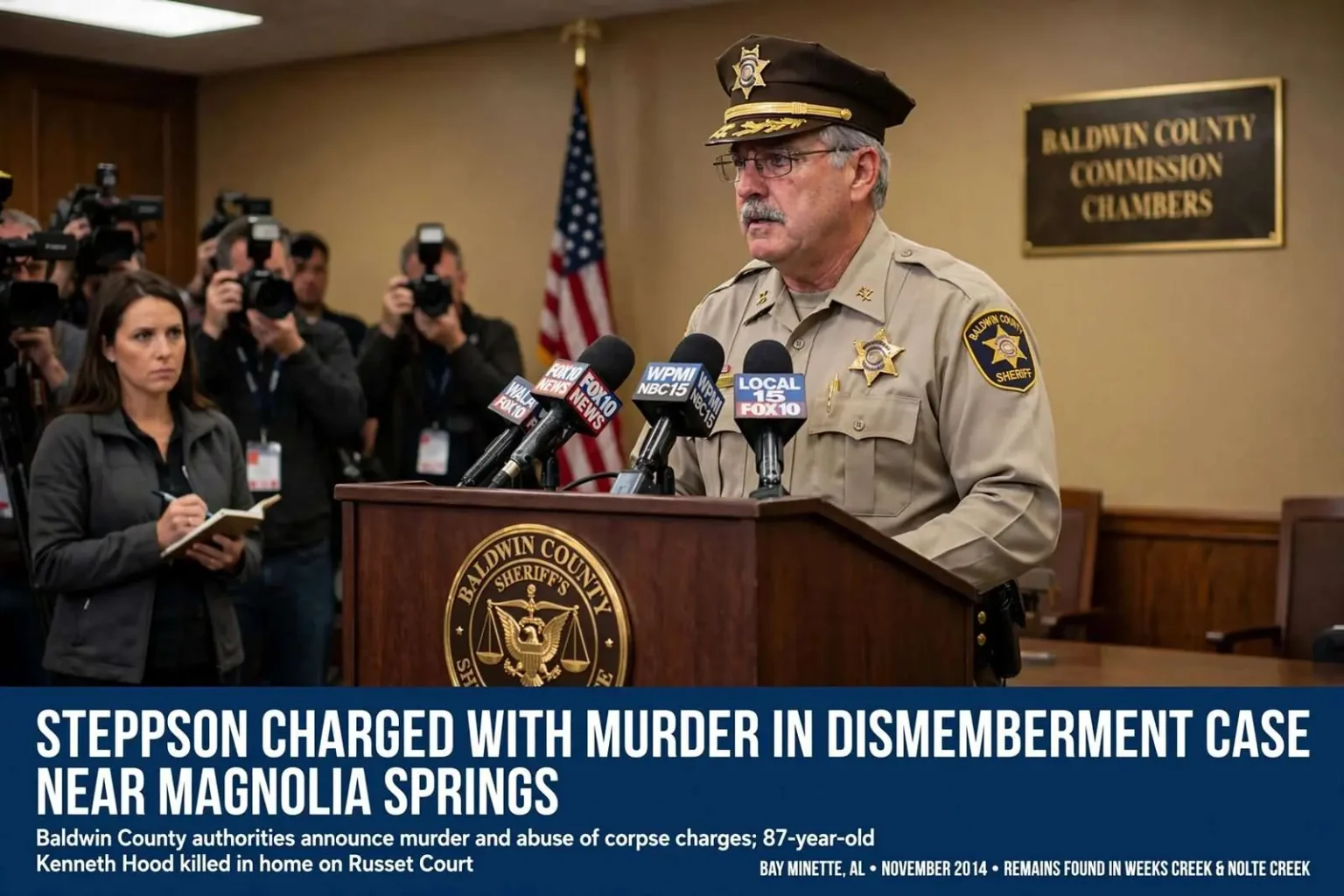
Baldwin County authorities announced murder and abuse of corpse charges against a Bay Minette-area man in November 2014, closing the identification phase of a case that had unsettled the small community around Magnolia Springs for days.
Sheriff Huey “Hoss” Mack told reporters gathered at the Baldwin County Commission chambers in Bay Minette that 87-year-old Kenneth Hood was killed inside a home on Russet Court in the Copperwood subdivision, believed to have died from blunt force trauma to the head, neck and chest. Investigators say the killing happened late on a Thursday night or in the early hours of Friday morning, and that Hood’s body was dismembered inside the residence before the remains were scattered at nearby creeks.
William Minton, 55, Hood’s stepson, faced an arrest warrant on charges of murder, abuse of a corpse and a probation violation tied to a prior conviction. Mack said Minton was expected to be transported back to Baldwin County for booking, with a bond hearing to follow within roughly three days of his arrest.
The case first came to investigators’ attention after a severed arm and hand were discovered at a home on Lipscomb Road. That discovery led searchers to Hood’s torso in Weeks Creek and, a day later, additional remains including the head at Nolte Creek, not far from the Magnolia Springs community. Authorities said at the time that a foot had not yet been recovered.
Baldwin County District Attorney Hallie Dixon described the crime as unusually calculated for a Baldwin County case, saying the effort to dismember the body and transport the remains to water reflected planning that she called deeply disturbing. She said prosecutors were still evaluating whether the case could meet the legal threshold for a capital murder charge under Alabama law, noting that the investigation was still in its early stages.
Mack said Minton and his mother, Carolyn Hood, who was married to the victim, had left the area for Millbrook, where extended family lived, shortly before the arrest. Minton was located at a relative’s home with assistance from the Millbrook Police Department and the Elmore County Sheriff’s Office. Mack said Carolyn Hood, described as a convalescent under family care, was not believed to have played a role in her husband’s death, though investigators had not fully ruled out her involvement at the time.
According to the sheriff, the Hood-Minton household kept largely to itself and was not well known within the close-knit Magnolia Springs area, a detail he said initially complicated efforts to determine where the crime had taken place before evidence led investigators back to the Russet Court home.
The case drew heavy interest across Baldwin County as residents followed each stage of the investigation, from the initial discovery of remains to the identification of both victim and suspect. Prosecutors said the investigation into a possible motive and the exact circumstances inside the home was continuing as charges moved forward.
Baldwin County sits directly east of Mobile County across Mobile Bay and is the largest county in Alabama by land area. It encompasses the Eastern Shore communities of Daphne, Fairhope, Spanish Fort, and Foley and stretches south to the beaches of Gulf Shores and Orange Beach along the Gulf of Mexico.
Long among the fastest-growing counties in the state, Baldwin blends suburban development near the bay with tourism-driven coastal economies. Its proximity to Mobile and its position on the Eastern Shore make it a recurring subject of regional news covering growth, infrastructure, schools, and the balance between development and coastal preservation.
Alabama is a state in the southeastern United States bordered by Tennessee, Georgia, Florida, the Gulf of Mexico, and Mississippi. Often called the Heart of Dixie, it spans Appalachian foothills in the north and flat coastal plains in the south. Its largest cities include Birmingham, Montgomery, Huntsville, and Mobile.
Alabama’s history encompasses Indigenous roots, Spanish and French colonial settlement, a cotton-plantation economy, the Civil War and Reconstruction, and the Civil Rights Movement of the 1950s and 1960s, followed by a shift toward manufacturing, aerospace, and technology. Local news across the state frequently reflects this mix of tradition and change.
Local law enforcement across South Alabama is carried out by municipal police departments, county sheriff’s offices, and state agencies that together cover a mix of urban, suburban, and rural territory. City departments handle policing within municipal limits, while sheriff’s offices provide courthouse security, jail operations, and patrol in unincorporated areas.
Cooperation among these agencies, and with federal partners, is central to tackling problems that cross jurisdictional lines, from drug trafficking to violent crime. Joint task forces that pair federal agents with local officers have become a standard mechanism for sharing information and concentrating resources on threats that no single agency could address alone.
Public-safety agencies in the region also contend with staffing, training, and community-relations challenges common to departments nationwide. How they allocate patrols, respond to calls, and engage neighborhoods is a regular subject of local oversight and news coverage, particularly where residents expect both accountability and visible protection.
Local government in the Mobile area operates through a combination of mayor-council or commission structures at the municipal level and a county commission in Mobile County, with elected officials handling budgets, public safety, infrastructure, and zoning. Baldwin County has its own commission and a collection of incorporated municipalities.
Decisions made in council chambers and commission meetings affect roads, school funding, economic development, and quality of life, which is why coverage of local government is a staple of regional journalism. The interplay between city, county, and state authorities often determines how effectively the area can address shared challenges.
Because many services residents rely on are delivered at the local level, the choices of elected officials have direct, everyday consequences. Budget priorities, in particular, reveal a community’s values and shape the trajectory of growth and public welfare for years to come.
Probate courts in Alabama handle matters distinct from the trial courts that hear criminal and civil cases, including wills, estates, guardianships, and involuntary commitments for mental-health treatment. In Mobile County the probate judge is an elected official with broad administrative and judicial duties.
Cases involving involuntary psychiatric commitment require the court to balance an individual’s liberty interests against concerns for their safety and the safety of others, a sensitive legal threshold that has drawn scrutiny in many jurisdictions. The procedures governing such hearings, including who must appear and testify, are set by state law and local rule.
Disputes over those procedures often surface tensions between healthcare providers, the court, and advocates for patients. Because the stakes involve both liberty and wellbeing, courts and clinicians alike face pressure to honor the law while ensuring that people in crisis receive timely and appropriate care.
The economy of the Mobile region is diversified across shipping and logistics, aerospace and shipbuilding, healthcare, tourism, and manufacturing. The Port of Mobile is one of the nation’s busiest seaports and a cornerstone of the local and state economy.
Major employers in aviation and defense contribute to a skilled workforce, while economic-development organizations aim to attract investment and jobs through incentives and infrastructure improvements. Small businesses, from restaurants to professional services, form the backbone of neighborhood commerce.
The health of the regional economy is a frequent subject of public discussion and reporting. Workforce development, recruitment of industry, and the fortunes of local retailers all feed into a broader picture of how the Gulf Coast competes and adapts in a changing national economy.
The natural environment is central to life on the Gulf Coast, where barrier islands, bays, rivers, and wetlands support fisheries, recreation, and storm protection. Coastal Alabama faces challenges common to low-lying regions, including hurricane exposure, erosion, and the management of fragile ecosystems.
The Mobile-Tensaw Delta, one of the largest river deltas in the country, is a particularly significant natural asset. Conservation efforts, fisheries regulation, and shoreline restoration are frequent points of collaboration among state agencies, federal bodies like the Army Corps of Engineers, and environmental groups.
How the region plans for growth while protecting its natural assets is a recurring theme in local reporting. The tension between development pressure and ecological stewardship plays out in zoning fights, infrastructure projects, and disaster-recovery decisions that shape the coast for generations.
Local journalism serves as the connective tissue of communities like those across South Alabama, informing residents about government, schools, public safety, and the events that shape daily life. Outlets covering Mobile and Baldwin County help hold institutions accountable and give voice to neighborhood concerns larger media may overlook.
In an era of shifting advertising revenue and the rise of digital platforms, community news organizations have had to adapt how they gather and deliver information. The persistence of regional reporting remains important for civic engagement, particularly on issues such as coastal development, education, and local governance that directly affect residents.
The relationship between a local newsroom and its community is reciprocal: readers supply tips, context, and a sense of what matters, while the reporting provides a shared record of decisions and events. That loop is essential to a well-informed public.