North Baldwin Animal Shelter Sees Influx of Puppies in the Days After Christmas
Dogs abandoned days after Christmas are arriving at the North Baldwin Animal Shelter in Bay Minette, where volunteers urge families to adopt instead.
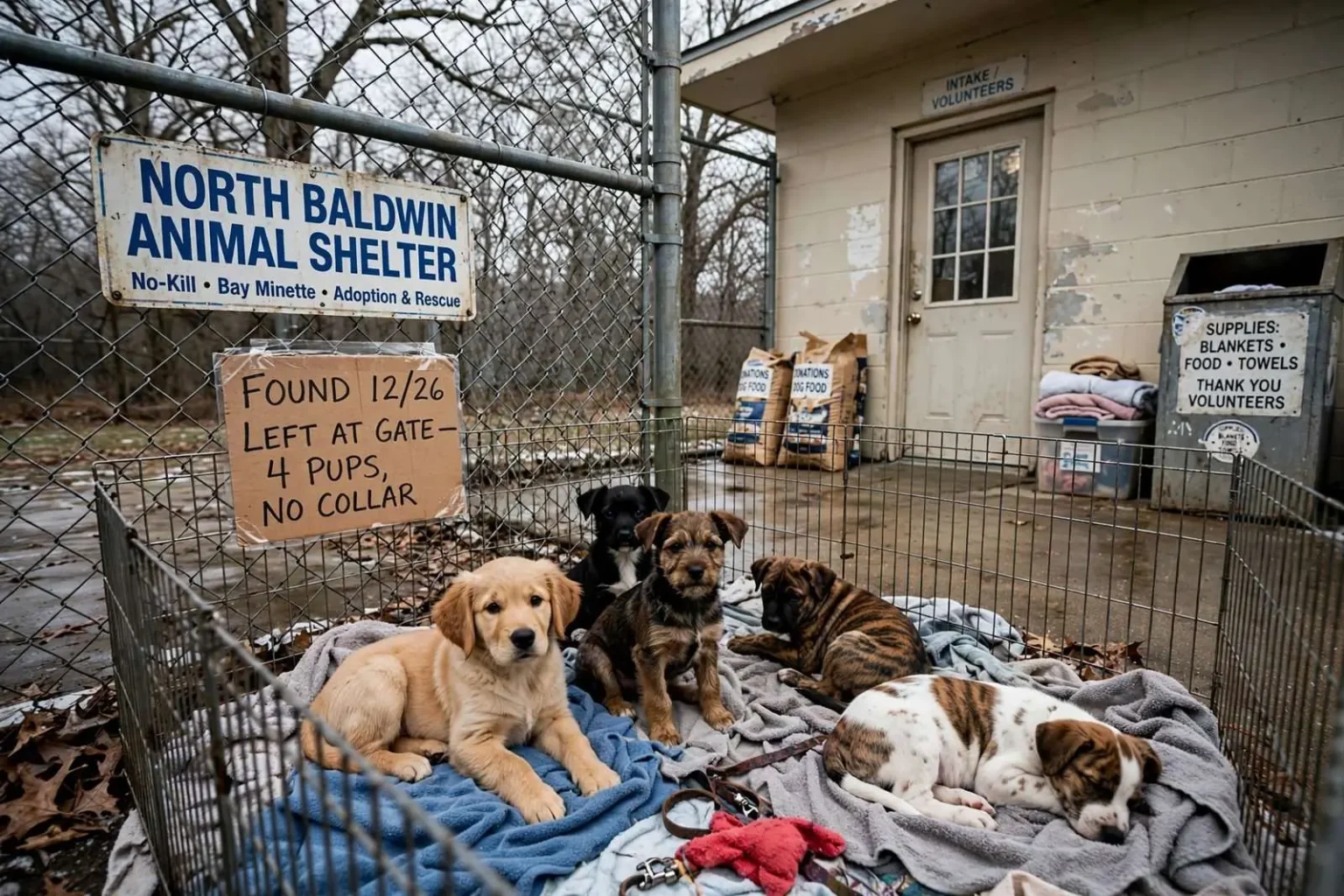
The days just after Christmas bring a sobering rush of new arrivals to Gulf Coast animal shelters, where dogs given as gifts — or simply no longer wanted — are often abandoned within hours of the holiday. At the North Baldwin Animal Shelter in Bay Minette, volunteers say the pattern plays out right at the front gate. On December 26, volunteers found dogs left tied to the fence and waiting at the door, according to shelter volunteer Marilyn Foody.
“We actually got one in on December 26th, and we have a couple right now that we’ve rescued from returned gifts,” Foody said.
The privately operated facility is a no-kill shelter, but space is limited — once it reaches capacity, staff are forced to turn away new dogs. Shelter leaders say the week after the holidays is actually an ideal time for families thinking about adding a pet, since so many animals are in need of homes at once.
The Post-Holiday Pattern
The abandonment of dogs in the days after Christmas is a phenomenon animal welfare workers across Alabama and the Gulf Coast describe with grim familiarity. Puppies and dogs given as gifts sometimes prove to be more work than the recipient expected — a chewed baseboard, housebreaking accidents, a barking dog in an apartment — and within days some of those animals end up outside, tied to fences, left at gates or surrendered in person. Shelters that operate on donations and volunteer labor see their intake spike precisely when their staffing is thinnest, with volunteers traveling or resting during the holidays and cold weather making outdoor abandonment more dangerous for the animals.
At the North Baldwin shelter, the pattern arrives literally at the door. Dogs tied to the fence on December 26 — the day after the holiday — represent a particular kind of abandonment: the owner who drives to the shelter, cannot wait for it to open, and leaves the animal chained where someone will find it. Volunteers arriving that morning found the dogs waiting, unharmed but discarded, a scene Foody described in matter-of-fact terms that shelter workers everywhere would recognize. The animals “rescued from returned gifts” that she cited were, in effect, merchandise returned without a receipt — living creatures treated as disposable once the novelty of a Christmas puppy wore off.
The timing compounds the danger. Late December in south Alabama can bring freezing nights, and a dog left tied at a gate overnight faces cold, hunger and the risks of roadway and other animals before volunteers find it. Shelter advocates use the season to remind the public that abandonment is not only cruel but a legal problem — Alabama law treats animal abandonment and neglect as offenses — and that shelters and rescue groups will generally accept a surrendered animal in person, by appointment, rather than forcing owners to leave pets behind in the cold.
A No-Kill Shelter With Finite Space
The North Baldwin Animal Shelter operates as a private, no-kill facility in Bay Minette, the county seat of Baldwin County and the largest city in its northern reaches. “No-kill” is a commitment with real consequences: the shelter does not euthanize healthy, adoptable animals to make room, which means its kennels, foster homes and capacity for care set a hard ceiling on how many dogs it can take. When that ceiling is reached, the staff must turn animals away — a decision no one at a no-kill shelter makes easily, and one that post-holiday surges force them to confront every year.
Private shelters in Baldwin County operate in a landscape where the alternatives are limited. Municipal animal control handles strays and enforcement, but the county’s population growth — among the fastest in Alabama — has brought both more families and more animals, and privately operated rescues shoulder much of the burden of rehoming. Funding comes from donations, adoption fees and fundraising events rather than a steady tax base, and volunteers do much of the daily work: feeding, cleaning kennels, walking dogs, matching animals with adopters and transporting them to veterinary appointments. A holiday intake spike lands on exactly that volunteer-supported structure, which is why shelter leaders make public appeals during the season when abandonment peaks.
For the dogs arriving in late December, the shelter’s commitment is a lifeline, but the system works only when animals keep moving out. Every adoption frees a kennel for the next arrival, and the week after the holidays — with the shelter holding “returned gifts” and fence-line abandonments simultaneously — is when that turnover matters most.
The Case for Adopting Now
Shelter leaders’ argument that the week after the holidays is an ideal adoption window is more than a fundraising pitch. Families with time off from school and work are home to help a new pet settle in, establish routines and begin housebreaking during the very days when a young dog most needs supervision. And the animals available now are not just the post-holiday surrenders; shelters across the region hold months of waiting dogs whose adoption chances improve every time attention turns to the shelter’s situation. Adopting in the days after Christmas, advocates say, is the practical antidote to the problem the season creates.
Responsible adoption comes with guidance that shelter workers repeat year-round: choose an animal whose energy level and size fit the household, budget for veterinary care and food, and commit to training rather than returning the animal when problems arise. Shelters and rescue groups counsel families honestly about the work involved precisely because their goal is a permanent placement — every “returned gift” that comes back through their door represents an animal who has now lost a home twice. Experts generally advise against giving pets as surprise gifts, recommending instead that families choose a pet together, so the responsibility is shared and understood before the animal comes home.
For the dogs found tied at the gate on December 26, that counsel arrives too late to change how their holiday began. But it is not too late to change how it ends. The North Baldwin Animal Shelter’s message to the community is simple: the kennels are full, the animals are waiting, and the best response to a season of abandonment is a season of adoptions. Families in Bay Minette and across Baldwin County looking for a pet in the new year will find volunteers ready to make a match — and a no-kill shelter whose ability to keep its promise depends, dog by dog, on them.
Prospective adopters sometimes wonder whether a shelter dog that arrived as a “returned gift” carries emotional damage. Volunteers’ experience suggests otherwise: dogs are remarkably resilient, and given structure, routine and a patient family, most settle within weeks regardless of how rough their start was. Puppies that spend their first days in a kennel rather than a home miss some early socialization, which is exactly why foster homes matter so much — a few weeks in a household teaches a young dog the sounds, surfaces and rhythms of family life and makes the eventual adoption far more likely to stick. The shelter’s staff can guide families toward the animal whose temperament fits their situation, which is one more advantage of adopting through a shelter staffed by volunteers who know every dog by name.
How the Community Can Help
Adoption is the most direct way to help, but shelters like North Baldwin’s run on a wider circle of support. Volunteers handle the daily labor of kennel care, and new volunteers — even those who can spare a couple of hours a week walking dogs or socializing puppies — expand the shelter’s effective capacity. Donations of supplies are always in demand: dog food, blankets and towels, cleaning products, leashes and collars. Foster homes, where families temporarily care for animals outside the kennel environment, multiply the shelter’s reach by opening space for the next arrival while giving a stressed dog a chance to decompress in a home setting. Financial contributions fund veterinary care, spay-and-neuter services and the unbudgeted costs that abandoned and surrendered animals inevitably bring.
The shelter’s situation in Bay Minette also reflects the wider Gulf Coast animal welfare picture. Baldwin County’s explosive residential growth has brought puppy-store traffic, backyard breeding and the disposable-pet attitudes that shelters combat year-round, while the region’s mild climate means dogs breed outdoors nearly all year. Animal welfare groups across the area consistently point to spay-and-neuter programs as the long-term fix for the intake problem — fewer unplanned litters means fewer animals given as impulse gifts and fewer fence-line abandonments the week after Christmas.
For Foody and the other volunteers, the days right after the holiday are the hardest of the year: intake up, capacity stretched, and the inbox full of requests to take “just one more.” The dogs found tied to the fence on December 26 were lucky in one respect — they were found. Every shelter worker knows the animals that end up somewhere less visible, and that knowledge is what drives the push each holiday season to remind the public that a pet is a years-long commitment, not a package to be returned. The shelter will keep its no-kill promise as long as the community keeps showing up — adopting, fostering, volunteering and giving — one dog at a time.