Faulkner State Wedding Reception Investigation Grew Into Misconduct Fight Against Baldwin County DA
A wedding catered by Faulkner State students led to criminal charges and, a year later, allegations against Baldwin County's district attorney.
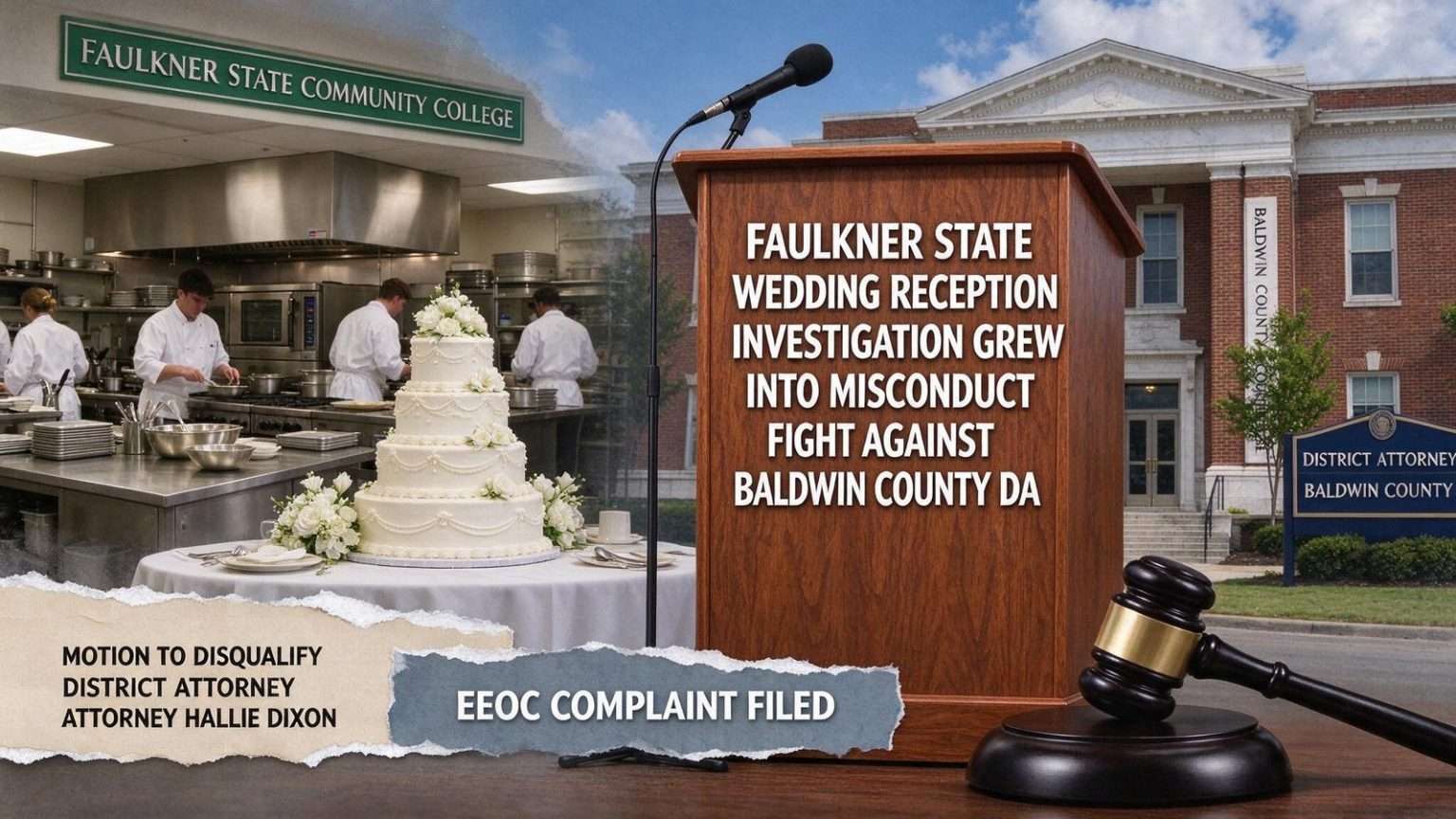
What began as a routine question about whether a wedding reception at Faulkner State Community College was improperly catered using school resources has grown into a much larger legal fight touching the top of the Baldwin County District Attorney’s Office. The dispute now stretches from a college kitchen in Bay Minette to the courthouse in the same town, and it has put both a criminal prosecution and the leadership of the county’s top law enforcement office before a circuit judge at the same time.
Where the Case Began
The origin of the case traces back to an investigation into a wedding reception hosted by the culinary arts program at the Bay Minette-based college. Culinary programs at community colleges routinely cater public events as part of their students’ training — weddings, banquets, civic dinners — and the practice occupies a gray zone that administrators and auditors across Alabama have long had to police: when does a teaching exercise become a private business operating on the public’s dime, using the school’s food, equipment and staff time?
Edward Bushaw, who founded the program, was arrested and later indicted in 2013 on charges including second-degree property theft, evading sales taxes, and using his college position for personal gain. The charges as filed allege more than a one-time misuse of the kitchen: theft charges reach the property itself, the sales tax count alleges that money collected in connection with the events was never remitted to the state, and the use-of-position count is a standard Alabama ethics charge aimed at public employees who convert their office into personal benefit.
A second employee, a chef at the school, pleaded guilty earlier this year to a lesser misdemeanor charge stemming from the same reception. The disparity between the two outcomes — a misdemeanor resolution for one employee and a multiple-count felony indictment for the program’s founder — is the kind of gap that defense attorneys routinely seize on, and it set the stage for the harder fight that followed.
Bushaw has maintained his innocence, arguing in court filings that the event was a teaching opportunity for his culinary students rather than a personal benefit. That argument goes to the heart of how culinary education works. Students in college hospitality programs need real events with real clients to learn on, and instructors have wide discretion in arranging them. Whether the wedding reception was a lesson or a sideline is the factual question on which the whole indictment turns.
The Motion to Disqualify the District Attorney
The case took an unexpected turn this month when Bushaw’s defense attorney filed a motion asking a Baldwin County circuit judge to remove District Attorney Hallie Dixon and her entire office from the prosecution. The filing alleges Dixon used her position improperly in connection with a personal relationship with an employee and retaliated after that relationship ended. Motions to disqualify an entire prosecutorial office are rare anywhere in Alabama — judges almost always expect the office itself to screen out conflicts rather than step aside wholesale — so the filing alone was enough to make the case an outlier in Baldwin County’s circuit court.
Dixon’s office quickly filed a response calling the claims baseless and without legal merit. The speed and flatness of the response signaled that the office intends to fight the recusal motion rather than accommodate it, and that prosecutors view the allegations as an attack on the credibility of the office itself rather than a routine procedural dispute. Under Alabama law, a judge has discretion to disqualify a prosecutor when actual prejudice or a conflict of interest is shown, but the bar for doing so is high, and courts are reluctant to disrupt a prosecution on allegations that remain unproven.
Dixon addressed the controversy publicly for the first time after returning from a family vacation, telling reporters she had never misused her office against any employee but that she was limited in what she could say about an ongoing personnel matter. The distinction she drew — between the criminal case against Bushaw and a separate employment dispute inside her own office — is central to how the fight will be decided. Personnel matters involving office staff are typically handled quietly, in confidentiality protections that prosecutors enjoy and defendants do not.
She confirmed a federal Equal Employment Opportunity Commission complaint had been lodged against her, though she declined to give details, and said she had no plans to step down. An EEOC charge is the required first step toward a federal employment discrimination lawsuit, and its existence — confirmed, but without detail — means the same underlying personnel dispute is now moving on a parallel track in federal channels even as it surfaces in the Baldwin County courthouse. Dixon’s statement that she intends to stay in office sets up a prolonged test of the office’s leadership while its top case is contested in open court.
Two Cases, One Courtroom Question
The dispute now sits before the court alongside the original theft and tax case, with defense attorneys arguing the misconduct allegations are directly relevant to how Bushaw’s prosecution should proceed. The defense theory is straightforward: if the District Attorney’s judgment was compromised by the matters alleged in the motion, then every charging and screening decision made in the Bushaw case is suspect, and the only cure is to hand the prosecution to someone else — a district attorney from another circuit, or the Alabama Attorney General’s Office.
Prosecutors counter that the personnel dispute has nothing to do with the underlying charges and amounts to a distraction. Their argument, in substance, is that the evidence of theft and tax evasion either exists or it does not, and that no allegation about office culture changes what happened at the wedding reception or the paper trail around it. How the judge rules will likely depend on whether the defense can connect the personnel allegations to this prosecution specifically, rather than showing only that difficult things have happened inside the District Attorney’s Office.
If the judge grants the recusal, the case would be reassigned and the timeline reset under new prosecutors — a significant win for the defense, which would gain time and a fresh set of eyes on the evidence. If the motion is denied, Bushaw’s trial path resumes before the same office he sought to disqualify, with the allegations now part of the public record around the case regardless of the outcome.
What It Means for the College
For a community college that trains students across Baldwin County in hospitality and culinary careers, the case has become an unusual entanglement of classroom programming, a criminal prosecution, and now questions about leadership inside the county’s top law enforcement office. Faulkner State — now known by other names after a series of system reorganizations, but in this era a fixture of Bay Minette and the county’s branch campuses in Gulf Shores and Fairhope — built its culinary and hospitality programs to feed the Gulf Coast’s restaurant and tourism economy, from the hotels of the beaches to the banquet halls of the Eastern Shore.
Programs like the one Bushaw founded depend on public confidence. Students enroll expecting a credential that leads to work at resorts and restaurants across Baldwin and Mobile counties; local hotels and eateries hire from the programs and donate equipment and externships; and the college’s administration must show both the state’s two-year college board and local taxpayers that school resources are spent on instruction. A prosecution alleging that a signature program was used for private gain strikes at each of those relationships at once, whatever the ultimate outcome in court.
The case has also been a lesson in the fragility of institutional reputations. Community colleges across Alabama spent the late 2000s under a cloud from a statewide scandal in the two-year college system, and each new prosecution touching a campus program reopens the question of oversight. The kitchen at Bay Minette is, in that sense, a small stage on which a very large institutional question is being rehearsed: who watches the boundary between public programs and private benefit?
What Comes Next
The immediate question is the recusal motion, and the answer will shape everything else. A ruling for the defense removes Dixon and her office and hands the prosecution elsewhere; a ruling for the state lets the original team proceed while Bushaw’s lawyers preserve the issue for appeal. Either way, the underlying felony case — theft, taxes, and use of position — remains to be tried, and the chef’s earlier misdemeanor plea stands as the only completed resolution the affair has produced so far.
Beyond the courtroom, the EEOC matter will run its own course, potentially for years, and its resolution could carry consequences for the District Attorney’s Office wholly independent of Bushaw’s fate. For Baldwin County residents, the affair has been an unlooked-for window into how the machinery of prosecution works — and what happens when the people who run it become parties to the very disputes they are charged with resolving.
How the judge separates the personnel allegations from the theft case will determine what comes next for both Bushaw and the district attorney overseeing his prosecution. Until that ruling comes down, the case that started with a wedding cake remains one of the most closely watched files in the Baldwin County courthouse.