Bay Minette Man Seeks Hearing on Bid to Remove Baldwin DA From His Case
A Bay Minette man facing theft and tax charges wants a hearing on his motion to bar Baldwin County DA Hallie Dixon and her office from prosecuting him.
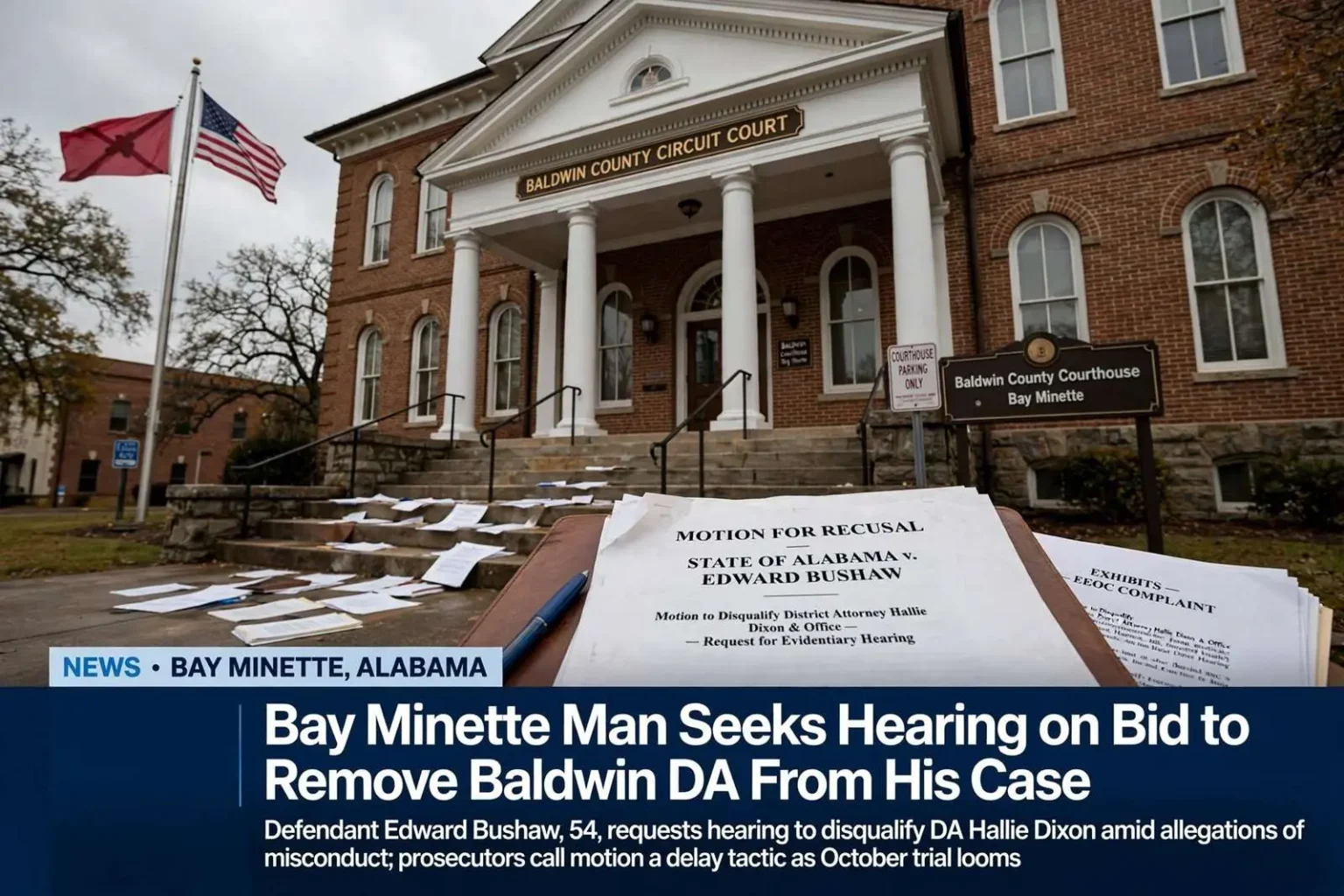
BAY MINETTE, Alabama – A Bay Minette man facing theft and tax charges is asking a Baldwin County circuit judge to hold a hearing on his request to have the district attorney’s office removed from his case, after he accused DA Hallie Dixon of using her position improperly. The fight over who will prosecute him has now become a legal battle of its own, running in parallel with the criminal charges that started it.
Edward Bushaw, 54, filed a motion this week seeking to bar Dixon and her office from prosecuting him, alleging in court papers that she used her role as the county’s chief prosecutor to pursue a personal relationship with an employee and then retaliated against that employee once the relationship ended. The allegations, laid out in filings that have circulated among Bay Minette’s legal community, touch on the conduct of the county’s top prosecutorial office rather than the facts of Bushaw’s own indictment.
Bushaw has now asked Circuit Judge Joseph Norton to schedule a hearing so the allegations in his motion can be argued on their merits, though no date has been set. In asking for the hearing, Bushaw’s lawyers argue that a recusal question of this seriousness should not be decided on paper alone, and that the judge should hear argument and take evidence before deciding whether the district attorney’s office must step aside.
Prosecutors Push Back
Dixon’s office responded this week, calling the motion baseless and asking that it be thrown out. Prosecutors characterized the recusal effort as a delay tactic aimed at a legitimate criminal case, and they urged the court to keep the underlying prosecution on schedule regardless of the allegations lodged against the office itself.
Separately, Dixon has acknowledged that a complaint was filed against her with the U.S. Equal Employment Opportunity Commission, though she has declined to discuss what the complaint alleges. The federal agency handles claims of workplace discrimination and retaliation against employers, and its involvement in a complaint naming the district attorney has added another dimension to a dispute that is already being litigated from several directions.
Legal observers note that recusal motions against an entire district attorney’s office are rare and difficult to win. Courts generally require a showing of a concrete conflict of interest – something more than allegations alone – before disqualifying a prosecutor’s office, and judges often can order a targeted wall between specific prosecutors and a case instead of removing the office wholesale.
Who Is Edward Bushaw
Bushaw is best known locally as the founder of the culinary arts program at Faulkner State Community College. The program grew into one of the coast’s recognized training grounds for aspiring chefs and hospitality workers, drawing students from Baldwin County and beyond and feeding graduates into restaurants across the region. Bushaw’s tenure there made him a familiar figure in Bay Minette, where the college’s campus is a centerpiece of the community.
He was indicted in the spring of 2013 on multiple charges, including second-degree property theft, attempting to evade state sales taxes, and three counts of misusing his official position for personal benefit. Prosecutors have accused him of using school resources for his own gain while running the program, alleging that equipment, supplies and labor connected to the college were diverted to personal projects.
Bushaw maintains he is innocent of the underlying charges and is scheduled to stand trial in early October. His defense has framed the case as a misunderstanding of how the culinary program operated, arguing that activities prosecutors describe as personal benefit were part of legitimate program work. The October trial date has added urgency to every pretrial fight, including the recusal motion now before Judge Norton.
A Case Under Two Microscopes
His attempt to have Dixon’s office disqualified adds another layer to a case that has already drawn attention in Bay Minette’s legal community, where both the culinary school controversy and the DA’s office now face separate scrutiny. Court watchers in the county say they cannot recall a recent case in which the defendant sought to disqualify the entire office of the district attorney who charged him.
The outcome of the recusal fight could shape how the October trial unfolds. If Judge Norton sides with prosecutors and denies the motion, the case proceeds with Dixon’s office at the table. If he finds a conflict, the Alabama Attorney General’s Office or a district attorney from another county would typically be appointed to take over the prosecution, a change that could affect trial timing and strategy on both sides.
How Recusal Fights Usually Unfold
Under Alabama law, a defendant seeking to disqualify a prosecutor must convince the trial judge that a conflict exists that would undermine confidence in the prosecution’s neutrality. Judges weigh sworn statements, the timing of the allegations and whether the claimed conflict touches the case at hand. Motions built on allegations about a prosecutor’s personal conduct face an additional hurdle: the accused conduct, even if true, must be shown to affect the specific prosecution rather than simply embarrass the office.
That is why the hearing Bushaw requests matters so much to his side. An evidentiary hearing would allow his lawyers to put witnesses and documents before Judge Norton, while prosecutors would press the judge to decide the question on the written record without conceding that the allegations deserve weight.
Defense attorneys across Alabama say such motions serve two purposes even when they fail: they preserve the issue for appeal, and they can shift the tone of a case by forcing prosecutors to defend their own conduct under oath. Prosecutors, for their part, argue that defending against recusal motions diverts resources from the prosecution itself and can unfairly delay justice for victims and witnesses.
What Happens Next
For now, the case sits in a holding pattern: prosecutors want the recusal motion dismissed outright, while Bushaw is pushing for his day in court to make the case in person before Judge Norton decides how to proceed. With no hearing date set and the October trial approaching, the clock is a factor for everyone involved.
Judge Norton could rule on the papers, grant a hearing, or fold the recusal question into other pretrial matters already on the docket. Either side’s loss at the trial-court level could be appealed, potentially extending the dispute beyond October if the timing slips.
Meanwhile, the criminal case itself continues to move. Pretrial deadlines, witness lists and evidentiary fights over what prosecutors can present at trial all proceed on parallel tracks, and the court’s calendar in Bay Minette will determine how much room the recusal dispute has to play out before jurors are selected.
The District Attorney’s Office, for its part, has signaled it intends to be ready for trial regardless of how the recusal question is resolved. Prosecutors note that the allegations against Dixon are unrelated to the evidence in the theft and tax case, and they argue that a jury should judge the charges on their merits.
Bushaw’s supporters in the Bay Minette community have watched the case with interest since the 2013 indictment, given his long history with the college and the culinary program he built. Whatever the outcome, the case has already become one of the more closely followed prosecutions in Baldwin County, blending questions about a defendant’s conduct with questions about the conduct of the office prosecuting him.
As October approaches, both sides are expected to file additional motions, and the docket in Judge Norton’s courtroom will show whether the recusal fight gets its hearing. For Bushaw, the stakes could hardly be higher: the outcome will determine not only who prosecutes him, but whether the trial that ends his three-year legal ordeal goes forward as scheduled.
The Broader Stakes for Baldwin County
The dispute lands at a sensitive moment for the Baldwin County District Attorney’s Office, one of the state’s busiest prosecutorial agencies, serving a county whose courts handle one of the largest caseloads in Alabama. The office prosecutes everything from traffic offenses to capital murder across courthouses in Bay Minette, Foley, Fairhope and Daphne, and its leaders have generally enjoyed a reputation for stability through recent transitions.
Allegations involving the office’s leadership, even unproven ones, carry institutional consequences. Defense attorneys throughout the county are certain to reference the dispute in their own cases, and the EEOC complaint ensures that questions about workplace conduct inside the office will be examined through a separate, formal process that unfolds independently of any criminal docket.
The case also highlights the unusual position elected district attorneys occupy in Alabama. As constitutional officers, they answer to voters, yet they also defend their offices in court against challenges like this one. Judges handling recusal motions must balance respect for the electorate’s choice against the defendant’s right to a prosecution free of conflicts – a balance that varies from case to case.
For the culinary program Bushaw founded, the renewed attention is a reminder of how closely his personal legal troubles have become entangled with a program that trained hundreds of students. College officials have previously declined to comment on the litigation, and the school has moved forward with its own hospitality and culinary offerings in the years since his departure.
The next filing in the case will likely come from Judge Norton’s courtroom, and everyone involved – prosecutors, defense counsel and the community watching from the gallery – will be looking at whether the recusal fight gets its hearing before the trial clock runs out.