Baldwin County Education Coalition Tours District Ahead of March Tax Vote
Baldwin County Education Coalition is holding community summits across the district to explain a $350 million capital plan ahead of a March tax vote.
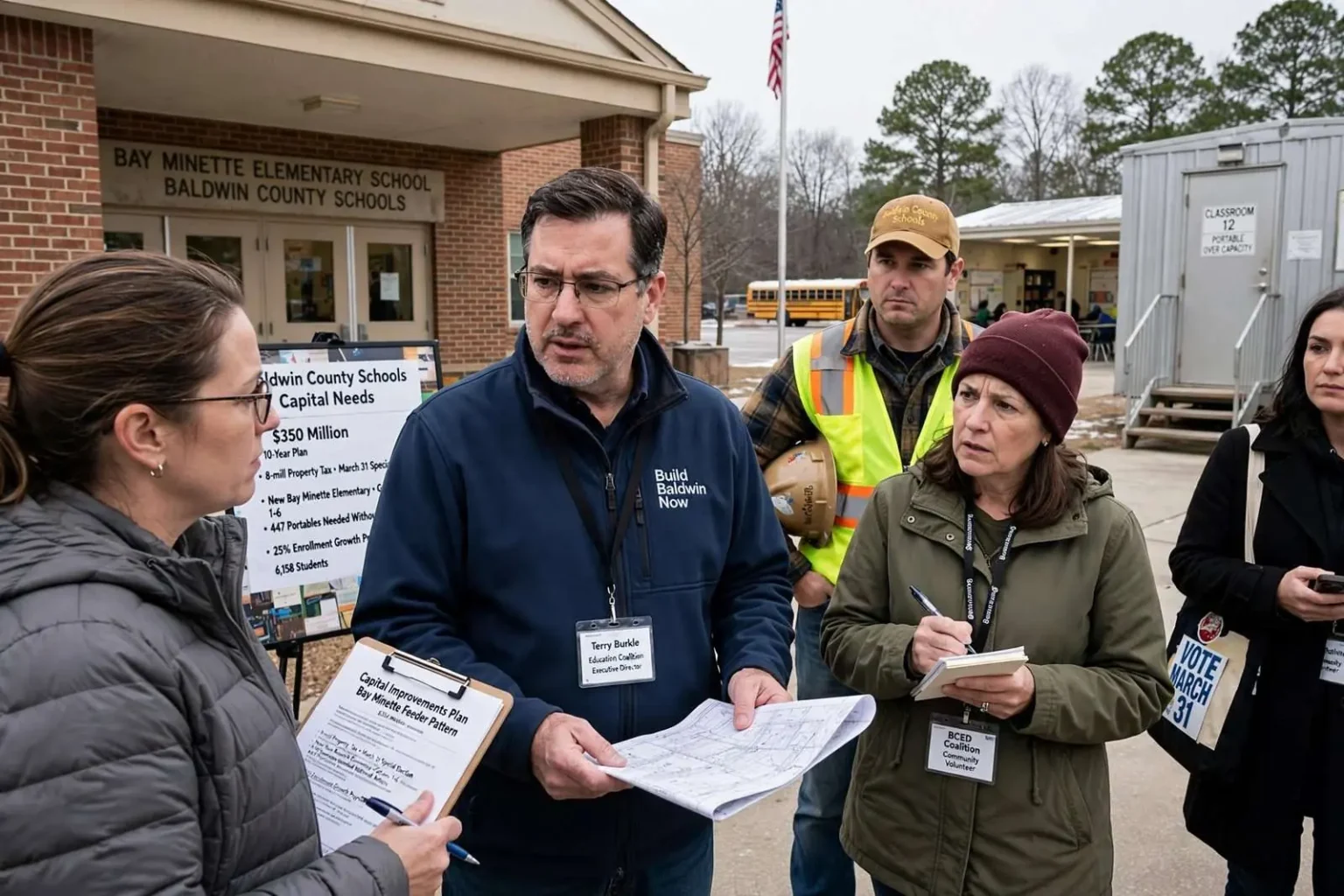
A series of community meetings is underway across Baldwin County as local advocates work to explain a proposed $350 million, decade-long capital improvements plan to voters ahead of a March 31 special election.
The Baldwin County Education Coalition has been holding summits at each of the district’s seven high school feeder patterns to walk residents through the scope of the school system’s facility needs and the proposed 8-mill property tax increase that would help pay for them. The next presentation, focused on Baldwin County High School and its feeder schools in the Bay Minette area, is scheduled for 6 p.m. Jan. 26 at Bay Minette Elementary School. That plan places a new elementary school for grades 1-6 in Bay Minette among its top priorities.
The feeder-pattern format is deliberate. A school district the size of Baldwin County’s is really a collection of communities — Bay Minette, Foley, Daphne, Fairhope, Gulf Shores, Spanish Fort, Robertsdale — each with its own schools, its own growth pressures and its own reasons to support or question the plan. Taking the presentation to each feeder pattern lets voters see exactly which projects are proposed for their own part of the county rather than one countywide list.
A Campaign Takes Shape
Terry Burkle, executive director of the Education Coalition, said supporters have organized a campaign called “Build Baldwin Now” aimed at turning out voters and making the case for additional school funding. The coalition, a community-based advocacy organization that works alongside — but independent of — the school board, has taken on the public education role that district officials cannot legally fill themselves with tax dollars.
Remaining summits are planned for the Foley High feeder pattern on Jan. 27 at Foley Middle School, the Daphne High School feeder pattern on Feb. 24 at Trojan Hall, and the Gulf Shores High School feeder pattern on Feb. 26 at a location still to be announced. Each session begins at 6 p.m. Summits for the Fairhope High feeder pattern and the Spanish Fort High feeder pattern have already taken place, in December and Jan. 20 respectively.
The schedule puts the bulk of the persuasion work in the six weeks before the March 31 vote. Organizers are using each session to present the same countywide figures while tailoring the project discussion to local schools, a structure designed to counter the most common objection to countywide tax votes: that voters in one community will be asked to pay for schools in another.
The Numbers Behind the Ask
According to figures presented at a countywide education summit in November, district officials say the capital plan is driven by overcrowding across Baldwin County’s 45 schools, 24 of which are already over capacity. Enrollment projections show the district could grow by 25 percent over the next decade — roughly 6,158 additional students — and officials estimate 447 more portable classrooms would be needed county-wide if new permanent buildings aren’t constructed.
Portables are the visible symptom of the district’s arithmetic. A school built for 600 students that enrolls 800 does not stop needing space; it adds portable classrooms, which cost money to lease, maintain and secure, and which put cafeteria schedules, restrooms and core facilities under strain no portable can relieve. Twenty-four over-capacity schools means the strain is not concentrated in one fast-growing corner of the county — it is spread across every feeder pattern, which is the central argument the coalition carries into each summit.
The school system has already spent about $250 million on growth-related construction over the past 14 years and continues to make debt payments on a $150 million bond used to build or renovate 11 schools between 2002 and 2010. That history cuts both ways in the campaign: it demonstrates that Baldwin County has kept building to meet growth, and it explains why the district cannot simply build its way out of the current shortfall without new revenue — the existing debt service already claims a share of every dollar available for construction.
An 8-mill property tax increase would raise the district’s capital capacity for a decade, allowing it to borrow and build against a dedicated revenue stream. For property owners, the cost lands on assessment notices; supporters argue the tax also protects property values, because school capacity and quality are among the first questions families ask before moving into a county.
The Election Itself Has a Price Tag
Baldwin County Probate Judge Tim Russell has estimated the cost of holding the special election itself at roughly $175,000. Special elections outside the regular cycle carry their own expenses — poll workers, machines, notices and absentee processing — all borne by the county regardless of the outcome.
The push comes on the heels of other recent school-finance moves in the county, including the board’s decision earlier this month to refinance $89.4 million in 2007 construction bonds, a step expected to save the district about $10.4 million.
The refinancing is the kind of housekeeping that rarely makes headlines but matters in a district carrying construction debt. Lowering the interest burden on 2007-era bonds frees roughly $10 million over the life of the debt, money that stays available for facilities. Campaign supporters point to it as evidence that the board squeezes what it can from existing resources before asking voters for more.
What Happens If It Fails
District leaders say that if the March referendum fails, overcrowding pressures are likely to intensify as Baldwin County’s student population continues to grow. A failed vote would not stop the enrollment projection — families keep moving to Baldwin County regardless of the tax question — and district officials would face the same facility needs with the same revenue, deferring more projects and leaning harder on portables while land and construction costs rise.
Why a Special Election
The March 31 date puts the decision on its own ballot rather than waiting for a regular election cycle. Special elections shorten the time between the district’s identified need and the voters’ answer, and they allow supporters to organize around a single question. The trade-off is turnout: a standalone ballot draws fewer voters than a general election, which puts a premium on each side’s ability to identify and mobilize its voters — precisely what the Build Baldwin Now campaign structure is designed to do.
School tax votes are demanding campaigns even for proposals with broad support. An 8-mill increase is a significant ask, and history across the state shows school tax referenda failing when supporters assume the numbers speak for themselves. The coalition’s feeder-pattern summits are built on the opposite assumption: that every vote must be explained, asked for and counted in advance.
What the Summits Actually Cover
Attendees at the coalition’s sessions hear the countywide case — the overcrowding figures, the 25 percent growth projection, the 447 portable classrooms — and then the local picture: which schools in that feeder pattern are over capacity, which projects the capital plan places there, and what the tax would mean for property owners at given assessed values. The format leaves substantial time for questions, which is where the campaign expects to face its hardest queries: about portables, about growth management, about whether the state should fund more of the cost.
The answer supporters give on that last question is rooted in how Alabama funds school construction. The state contributes through various capital programs, but local systems bear the primary burden for building capacity, and fast-growing districts like Baldwin County’s consistently outpace what state money and existing local debt can deliver. That is the structural reason so many Alabama districts end up at the ballot: growth is local, and so is the bill for it.
The Countdown to March 31
With the Bay Minette summit opening the second half of the schedule, the coalition enters the final stretch with three meetings left before early voting preparations begin. The sequence — Bay Minette, Foley, Daphne, Gulf Shores — closes the loop on every feeder pattern that had not yet hosted a session, giving organizers a complete countywide canvass in the six weeks before Election Day.
For the district, the stakes extend past the election. Baldwin County’s classrooms will fill this fall whether the referendum passes or not, and every year of delay compounds both the overcrowding and the cost of catching up. Construction costs do not stand still while campaigns run; land along the growth corridors appreciates each year, contractors’ bids rise with demand across the Gulf Coast, and the portable classroom leases the district already pays for renew at rates that make permanent buildings more attractive with every cycle.
The coalition’s case to the summits is built on that urgency: the growth is already here, the schools are already over capacity, and the plan on the March 31 ballot is the district’s answer to both. Supporters leave each session with talking points, yard signs and dates for their neighborhoods’ own get-out-the-vote efforts, the ground game that decides low-turnout special elections across Alabama.