Baldwin County School Board Refinances 2007 Bonds, Saving $10.4 Million
Baldwin County school board refinanced $89.4 million in bonds, saving $10.4 million, while also setting the 2015-16 calendar and coaching moves.
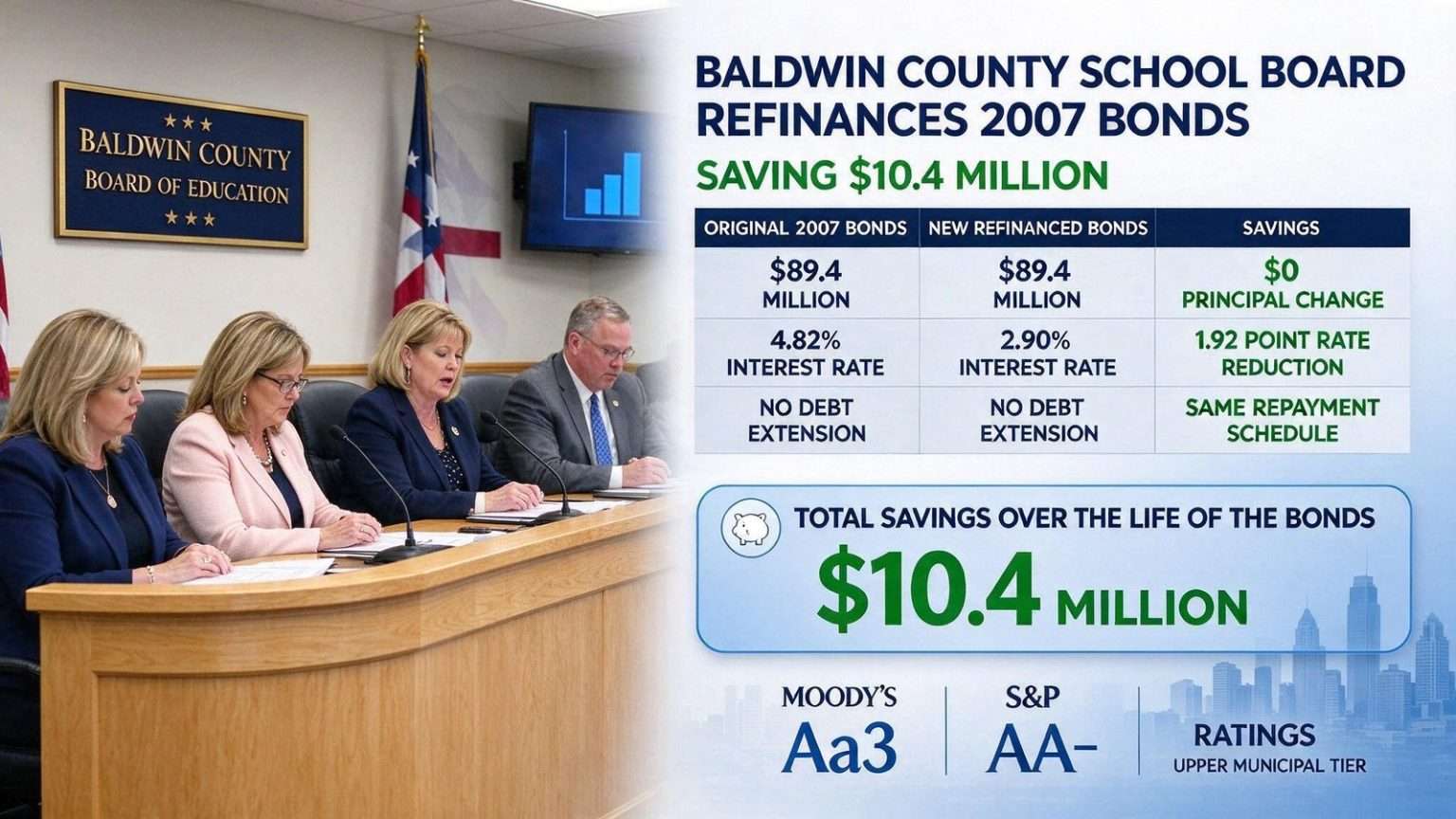
The Baldwin County Board of Education voted Thursday to refinance $89.4 million in construction bonds originally issued back in 2007, a move district officials say will save local taxpayers roughly $10.4 million over the life of the loan.
Chief Financial Officer John Wilson told board members the original bonds carried an interest rate of 4.82 percent. With tax-exempt interest rates sitting near historic lows, the district was able to refinance the debt this week at a rate of just 2.90 percent — a difference of nearly two full points on a debt load the county’s property owners will be paying down for years to come.
Wilson noted the refinancing does not increase the school system’s overall debt load or extend how long it will take to pay off the bonds — it simply locks in a lower rate on money the district already owed. In municipal finance, that kind of transaction is known as a refunding, and it works much like a homeowner refinancing a mortgage: the district replaces an older, more expensive bond issue with a cheaper one covering the same remaining obligation, and the savings flow back to the taxpayers whose property taxes service the debt.
The refinanced bonds received strong marks from national rating agencies, coming in at Aa3 from Moody’s and AA- from Standard & Poor’s. Those ratings sit in the upper tier of the municipal scale, one notch below the top Moody’s category, and translate directly into borrowing costs because stronger-rated districts can sell their bonds at lower interest rates. According to information presented to the board, Moody’s review found the Baldwin County school system’s overall financial position to be healthy heading into the new year.
A fast-growing district financing rapid growth
Baldwin County’s public schools serve one of the fastest-growing student populations in Alabama. The county, stretching from the Mobile Bay shoreline across communities including Bay Minette, Daphne, Fairhope, Spanish Fort, Foley, Gulf Shores and Orange Beach, has absorbed wave after wave of new residents drawn by the coast’s economy, its beaches and its reputation, and classroom capacity has struggled to keep pace with the rooftops.
The 2007 bonds being refinanced were part of the construction program that era of growth demanded, funding new buildings and additions across a district that spans more than 1,500 square miles of south Alabama from north Baldwin down to the Gulf. A generation of Baldwin County students has attended classes in buildings paid for by those bonds, and Thursday’s vote effectively reduced the long-term price tag on that construction without touching a single program.
School officials have repeatedly warned in recent years that the district’s finances are stretched between explosive enrollment growth on the coast and a tax structure that has not kept up with it. Against that backdrop, a refinancing that saves $10.4 million is meaningful money — funds that remain with local taxpayers rather than bondholders, at no cost to the classroom.
The 2015-16 calendar
Board members also handled a full slate of other business during Thursday’s meeting. They approved the 2015-16 academic calendar, which was chosen through a vote of teachers and school personnel — a process the district has used to give staff a direct voice in how the school year is structured, particularly on questions like when breaks fall and when each semester ends.
Under the new calendar, classes will begin Aug. 13, with a full week off for Thanksgiving break Nov. 23-27 and the fall semester wrapping up Dec. 18. Students return Jan. 6, get a day off for the Martin Luther King Jr. holiday on Jan. 18, and two days off for Mardi Gras Feb. 8-9 — a recognition that in south Alabama, the Carnival season is treated as a regional holiday even in public schools. Spring break falls March 28 through April 1, with the last day of classes set for May 26 and graduation ceremonies scheduled for May 18-19.
The calendar’s structure follows the pattern Baldwin and other coastal Alabama districts have settled into: an early-August start that lets the first semester close before the Christmas holidays, a mid-winter Mardi Gras pause, and a spring break timed near Easter. Districts across the region coordinate loosely on those anchor dates because families, coaches and employers cross district lines constantly along the densely settled Eastern Shore.
The staff vote is also a small piece of workplace culture in a district that employs thousands of teachers, aides, bus drivers and support workers across an unusually spread-out county. Because Baldwin’s campuses range from bayfront suburbs to beach towns to rural north Baldwin communities, a single calendar has to serve markedly different communities, and the district has found that letting employees decide among competing drafts heads off much of the friction a top-down calendar can generate.
Coaching changes and a land deal near Foley
In personnel moves, the board approved several teacher transfers, most notably shifting Gulf Shores High School head football coach Ben Blackmon into the same role at Spanish Fort High School. The move ripples through two of the county’s most followed athletic programs. Gulf Shores, on the island at the county’s southern end, loses the coach who led its football program, while Spanish Fort — one of the Eastern Shore’s fastest-growing schools — gains a head coach with Baldwin County roots to lead a program that has been among the most competitive in south Alabama in recent seasons.
Coaching moves of this kind carry weight in Baldwin County beyond the athletic department. High school football is a civic institution in the county’s communities, drawing crowds that rival any other public gathering in towns like Foley, Spanish Fort and Gulf Shores, and a head coaching vacancy sets off speculation that reaches well past the locker room. For the students involved, the transfer means a new staff taking over both programs with the season ahead.
The board also gave school officials the green light to begin negotiating a land purchase near Foley High School, though that deal hinges on voters approving the property tax measure district officials have been promoting to fund new construction. Foley and the surrounding south Baldwin communities have been among the fastest-growing parts of an already fast-growing county, and Foley High’s enrollment pressures have made additional land — and the construction that could follow — a standing item in the district’s long-range facility planning.
That contingency is why the referendum matters to nearly every item on the board’s capital wishlist. Without new revenue, the district has little capacity to buy sites or build schools in the corridors where students are arriving fastest, and board members have said repeatedly that the choice about Baldwin County’s school buildings belongs to the county’s voters.
Why the timing favored a refinancing
District officials have watched interest rates fall for years while weighing whether to re-enter the bond market, and the window that produced a 2.90 percent rate is not guaranteed to last. Municipal bond yields had drifted down to historic lows as investors sought tax-exempt income, and school districts across Alabama with callable bonds from the mid-2000s have taken advantage in recent years to refund older debt. Baldwin County’s strong ratings and healthy financial review made it an attractive borrower when the deal came to market.
The board’s vote puts real numbers behind that opportunity: $89.4 million refinanced, an interest rate cut from 4.82 to 2.90 percent, and $10.4 million that stays in the pockets of Baldwin County property owners over the remaining life of the debt. The savings accrue gradually, embedded in the annual debt service paid from property tax collections, rather than arriving as a lump sum, but over years they compound into one of the larger cost reductions the district has achieved through a single financial transaction.
For board members, the vote was the rare item on a school agenda that draws no opposition — no redistricting, no attendance zones, no calendar complaints. It reduces costs for every property taxpayer in the county, requires no change in the classroom, and was validated by two national rating agencies whose assessments gave the district a clean bill of financial health heading into the new year. The harder choices on the agenda — a land purchase awaiting a tax vote, and a growing enrollment that keeps demanding more of everything — remain ahead.
Thursday’s meeting captured, in miniature, the balancing act Baldwin County’s school board performs on a regular basis: stewarding taxpayer money carefully on one item while asking taxpayers for more on the next. Officials argued the two are connected — the better the district manages its existing debt, the stronger its case to voters that new money will be handled just as carefully when the referendum reaches the ballot. The board did not set a date for that vote on Thursday.