Mobile BayBears Owe City $150,000 in Back Rent for Hank Aaron Stadium
City officials confirmed the Mobile BayBears owe roughly $150,000 in unpaid rent for Hank Aaron Stadium as the council weighs new stadium upgrades.
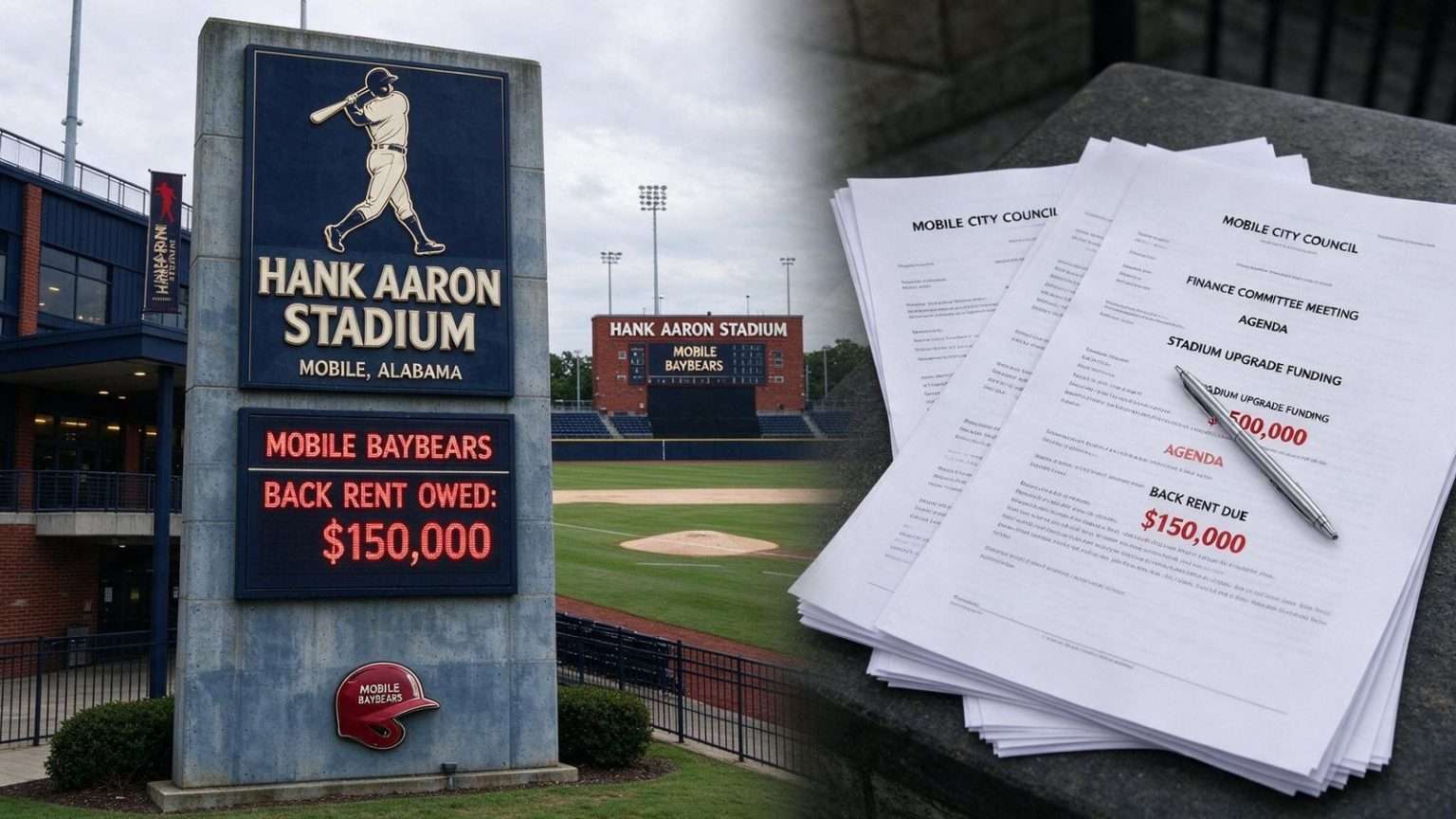
The Mobile BayBears owe the city of Mobile roughly $150,000 in unpaid rent for their use of Hank Aaron Stadium, city officials confirmed during a recent Mobile City Council finance committee meeting, reigniting questions about the team’s long-running lease arrangement with the city. According to the mayor’s chief of staff, the figure represents unpaid rent dating back to September 2013.
The disclosure came as the finance committee considered a separate request from Mayor Sandy Stimpson to transfer nearly $500,000 in excess park funds toward stadium upgrades, including improved lighting, an updated audio system and new field rail padding ahead of the 2015 season, which was slated to open in mid-April. The committee voted to recommend the funding transfer, sending the measure to the full council for consideration.
The juxtaposition was hard to miss. In the same meeting where the city prepared to put public money into the ballpark, officials acknowledged the ballpark’s tenant had fallen half a year behind on rent. City officials said they would like to see the BayBears’ contract with Mobile renegotiated as soon as possible to resolve the back-rent issue, calling it an important matter to settle.
How the Lease Got Here
Under the team’s current agreement, negotiated in 2011 and running through 2022, the BayBears pay a sliding rent tied to gross revenues rather than the fixed annual fee used previously. That arrangement set expected payments at roughly $100,000 a year, split into four quarterly installments.
The 2011 deal was itself a compromise born of a longer history. It also forgave an earlier debt of roughly $820,000 in back rent and interest that had accumulated after the team stopped making full rent payments in 2006 and made no payments at all starting in 2009. Wiping that debt clean gave the franchise a fresh financial start; in exchange, the team agreed to replace a leaky roof over the stadium’s offices and concession areas.
City officials said this week that while the team has reported the roof work is complete, no documentation has been submitted verifying it. The 2011 contract gives the organization until 2022 to finish any remaining roof repairs, meaning the city’s leverage on that obligation stretches over years, but the pattern, obligations reported done but undocumented, was precisely what the back-rent disclosure reignited.
The sliding-scale rent structure reflects a common arrangement for minor league ballparks, in which a city owns the stadium and a team pays rent calibrated to its ability to pay. The theory is that tying rent to revenues protects a franchise in lean years while giving the city a share of good ones. The practical risk, as Mobile has now seen twice in a decade, is that when revenues disappoint, the rent quietly stops.
The Stadium and the Franchise
Hank Aaron Stadium, named for the baseball legend who grew up in Mobile, has been home to the BayBears since the mid-1990s and remains one of the city’s most visible sports venues. The ballpark sits along the city’s western corridor and hosts the Double-A franchise that has carried the Southern League banner in Mobile for a generation.
Aaron’s name gives the park a significance beyond baseball. The Mobile native, who broke Babe Ruth’s all-time home run record in 1974, remains the city’s most celebrated athlete, and the stadium bearing his name is part of a civic landscape that also honors other Mobile baseball greats. Maintaining the venue is therefore about civic pride as much as municipal accounting.
The City’s Balancing Act
The renewed attention to the team’s finances comes as the city simultaneously moves forward with public investment in the stadium’s infrastructure, underscoring the balancing act Mobile officials face in supporting a beloved local franchise while protecting taxpayer interests.
The case for the upgrades is straightforward. Improved lighting, an updated audio system, and new field rail padding are the kind of facility investments that keep a 20-year-old ballpark functional for fans and compliant with league standards. Minor league baseball has repeatedly raised its facility requirements over the years, and cities that want to keep affiliated baseball must keep their parks up to date. The nearly $500,000 transfer the mayor proposed would come from excess park funds rather than the general fund, a sourcing designed to soften the political cost.
The case for caution is the ledger. A team that owed $150,000 in back rent, on top of a franchise history that included more than $800,000 in forgiven debt just a few years earlier, did not present the profile of a tenant the city could fund unconditionally. Council members weighing the transfer had to weigh the alternative: a deteriorating stadium, an unhappy league, and the possibility that professional baseball leaves Mobile altogether.
Minor league teams occupy a peculiar position in municipal finance. They are private businesses operating in public ballparks, generating private revenue from public land, but they also anchor summer entertainment, draw foot traffic to surrounding areas, and give a city a claim to major league-affiliated baseball. When a team struggles, the city feels pressure to help; when the team’s finances falter, the city’s exposure grows, since a departed franchise leaves behind a stadium with few replacement tenants.
What Comes Next
The council was expected to take up the stadium funding transfer at a subsequent meeting, with the back-rent issue remaining a separate point of negotiation between the team and the city. That separation was deliberate: the capital investment serves the facility the city owns, while the rent dispute is a contract matter between landlord and tenant.
City officials’ stated preference, a renegotiated contract resolving the back rent, signals the direction they want to take. A renegotiation could restructure the payment schedule, tighten documentation requirements for team obligations, or adjust the rent formula itself, and it would give the Stimpson administration a chance to fix provisions that have allowed debts to accumulate silently. The current agreement’s 2022 expiration date gives both sides a long runway, but officials’ comments suggested they do not intend to wait that long.
For fans, the immediate stakes are simpler. The 2015 season was set to open in mid-April with better lights, better sound, and safer rail padding, and the BayBears’ offseason financial disclosures, however unwelcome, did not threaten the season itself. Double-A baseball returned to Hank Aaron Stadium on schedule, as it had through rent disputes, lease renegotiations, and forgiven debts for two decades before.
The longer question, whether Mobile can craft an arrangement that keeps affiliated baseball in a stadium named for its greatest athlete without repeating the cycle of unpaid rent and forgiven debt, remained open, and the finance committee’s votes set the two threads, investment and arrears, on parallel tracks for the council to untangle.
The stadium’s history explains why the facility needs work. Built in the mid-1990s as part of the wave of new minor league parks that swept through baseball in that decade, Hank Aaron Stadium is old enough by modern minor league standards that its systems, lighting, sound, seating, and the much-discussed roof, have aged into a steady maintenance schedule. Ballparks of that era were built for the expectations of the 1990s; today’s fans, and today’s leagues, expect more.
The roof repairs agreed to in the 2011 contract targeted the stadium’s offices and concession areas, the working spaces that fans rarely see but staff depend on daily. A leaking roof over concessions is not merely an inconvenience; it threatens inventory, equipment, and the revenue operations that generate the very gross revenues the city’s sliding rent depends on. That interdependence is why the missing documentation of the completed roof work mattered beyond paperwork: the city had traded $820,000 in forgiven debt for that repair.
The finance committee’s role in the process is worth understanding for Mobile residents following the issue. The committee reviews financial matters, from routine transfers to major contracts, before they reach the full council, and its votes serve as a first test of whether an item has support. The unanimous recommendation of the park fund transfer indicated the upgrades had broad backing despite the rent dispute, while the committee’s parallel confirmation of the $150,000 arrears kept both facts on the public record.
Mayor Stimpson’s administration had made fiscal housekeeping a signature theme, pressing departments on budgeting and pushing departments and boards to document obligations. The back-rent disclosure fit that pattern: an inherited arrangement, a debt accumulated over multiple years, and an administration insisting it be settled rather than carried forward. The chief of staff’s decision to state the figure plainly in committee reflected that governing style.
Across minor league baseball, cities have wrestled with the same arithmetic. Ballparks built with public money require upkeep that teams rarely fund fully, while teams argue that they anchor development and provide community value no lease payment can capture. The result is a continuous negotiation between cities and franchises, conducted in lease clauses, forgiveness of old debts, and funding transfers like the one Mobile’s council was asked to approve.
The BayBears’ situation was further complicated by the franchise’s repeated ownership changes over the years, a common feature of minor league baseball that complicates financial continuity. Each new ownership group inherits the stadium lease and its obligations, and each renegotiation resets expectations, which is why city officials emphasized getting the current contract’s issues resolved now rather than letting arrears accumulate toward the 2022 expiration.
For the council, the sequencing ahead was clear: approve or amend the park fund transfer, let the capital work proceed before opening day, and direct staff to open contract discussions on the back rent. The two matters would remain linked in the public’s mind, a city investing half a million dollars in a stadium whose tenant owes it $150,000, and council members knew the comparison would frame every future conversation about the BayBears’ lease.