Mobile City Council Approves Overhaul of Police, Fire Promotion Process
Mobile City Council approved a new promotion testing contract for police and fire departments and debated a residential road closure request.
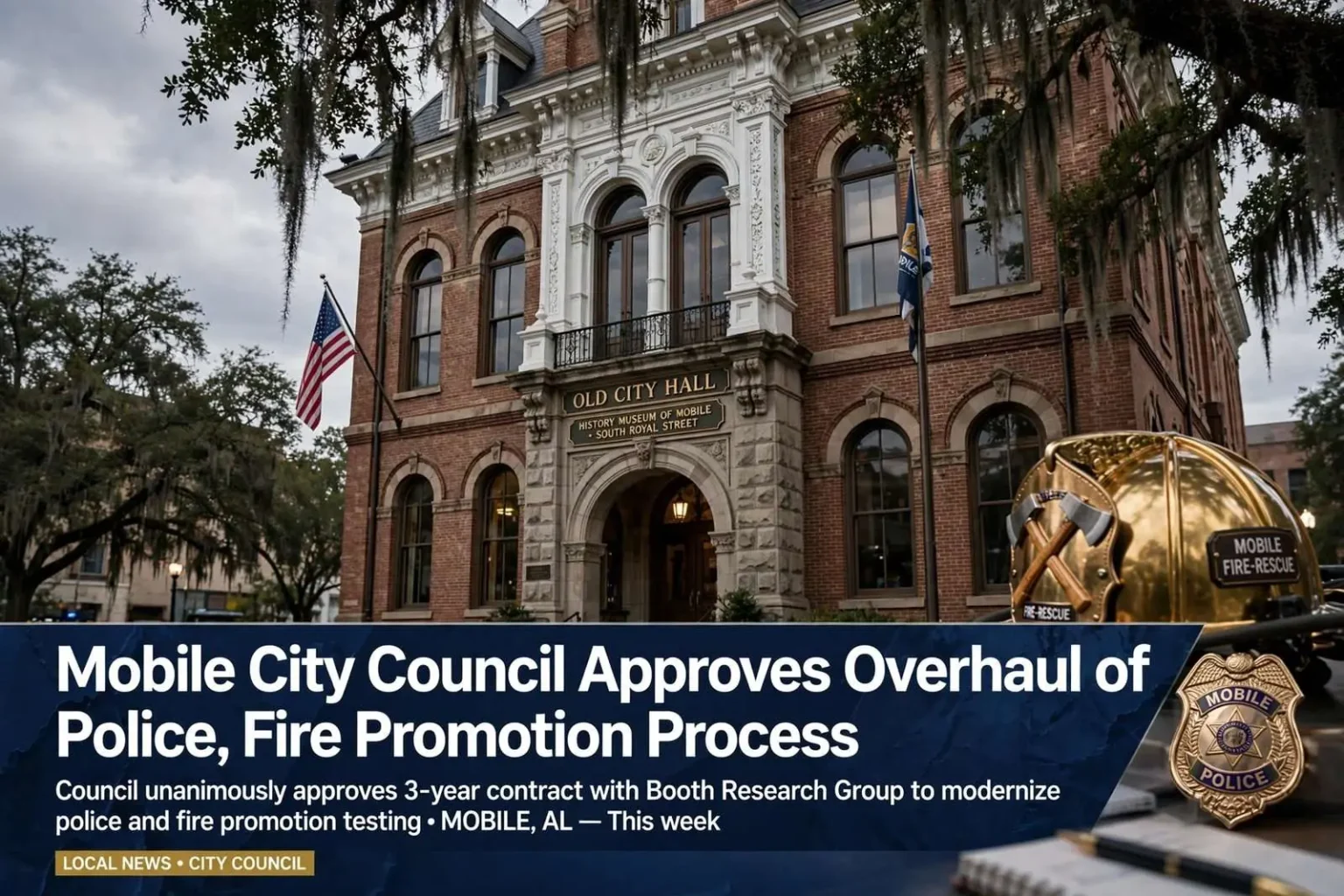
The Mobile City Council took a significant step this week toward changing how police officers and firefighters climb the ranks in Mobile, voting unanimously to authorize a new outside contract intended to modernize the promotional testing procedures for both public safety departments. The vote came during a regular council meeting held at Old City Hall, the historic downtown building that houses the History Museum of Mobile on South Royal Street, where the council has long conducted its formal business. By approving the agreement, council members signaled broad support for a change that Police Chief James Barber had personally petitioned the council to make.
The measure authorizes a three-year professional services agreement with Booth Research Group Inc., a firm based in Parker, Colorado, worth up to $514,570 over the life of the contract. Barber argued before the council that bringing in an outside testing specialist would improve both the efficiency and the diversity of promotions within the Mobile Police Department and the Mobile Fire-Rescue Department. Departments across the country have increasingly turned to specialized assessment firms to design and score promotional exams, on the theory that professionally developed testing can measure command skills, legal knowledge and decision-making more consistently than internally built processes, and can reduce the kinds of disparities that have historically limited the advancement of minority officers.
The new arrangement is expected to gradually replace the promotional testing system currently administered through the Mobile County Personnel Board. That board has overseen advancement exams for public safety employees in the city for decades, operating under Alabama’s civil service framework for municipal police and fire personnel. Under the current structure, officers and firefighters seeking promotion to sergeant, lieutenant, captain and higher ranks have taken competitive examinations administered through the Personnel Board, with scores determining eligibility lists for open positions. Moving that function to a private contractor will unfold over time rather than immediately, allowing the city and the board to wind down their existing arrangement as new testing cycles begin.
Why the city is changing its promotional process
Promotional testing is one of the most consequential personnel functions in any police or fire department. The exams determine who leads shifts, manages investigations, commands fire companies and eventually competes for the department’s top ranks, so the design of the tests shapes the leadership pipeline for years at a time. When testing processes are slow, outdated or vulnerable to challenge, departments can be left with unfilled supervisory positions and promotion lists that expire before they are exhausted, a problem that has affected public safety agencies across Alabama and the Gulf Coast.
Chief Barber’s pitch to the council centered on both speed and fairness. A specialized firm such as Booth Research Group can build validated exam content, run structured assessment centers, and score candidates against job-related criteria in a way that is easier to defend if a promotion decision is ever contested. Advocates for modernized testing have also pointed to the potential for a wider pool of candidates to succeed when exams measure contemporary policing skills, community-oriented problem solving and incident command alongside traditional legal and procedural knowledge.
The cost of the contract, up to $514,570 spread across three years, covers the professional services the firm will provide to both the police and fire departments. Council members weighing the agreement had to balance that expense against the operational cost of the status quo, including vacancies in supervisory ranks and the administrative burden of administering large-scale testing in-house through the Personnel Board. With the unanimous vote, the council effectively endorsed the idea that modernized, outside testing is worth the investment for departments that protect a city of nearly 200,000 residents.
Council debates a request to close a portion of Montclaire Way
Promotions were not the only contentious item on the agenda. Council members also spent significant time debating a request from residents of the Airmont subdivision to close a portion of Montclaire Way near its intersection with Airmont Drive, a west Mobile neighborhood issue that drew passionate comments on both sides. Eaton Barnard, president of the Airmont Property Owners Association, told the council that cut-through traffic on the residential street had contributed to a spike in crime, citing 36 reported incidents among the neighborhood’s 26 households over the past year.
District 5 Councilman Joel Daves, who represents the area, said the neighborhood near Azalea and Cottage Hill roads had struggled with cut-through traffic for years. His argument echoed a familiar complaint in older Mobile subdivisions, where streets were laid out in a grid pattern decades before the arterial network reached its current volume, and neighborhood streets were never designed to handle the traffic that now uses them as shortcuts between busy commercial corridors. When drivers bypass congestion on collectors like Azalea Road or Cottage Hill Road by cutting through quiet residential blocks, residents often report everything from speeding and noise to more serious safety concerns.
Not all council members were convinced that a street closure was the right remedy. District 2 Councilman Levon Manzie voiced concern that granting the Airmont request could invite similar petitions from neighborhoods across Mobile, noting that many residents in his own district and elsewhere have dealt with cut-through traffic in their areas for years. A closure approved for one subdivision, in other words, could become a template for dozens of follow-on requests, each of which affects emergency response routes, delivery traffic and the connectivity of the city’s street grid.
Under Mobile’s rules, requests to close or abandon public rights-of-way go through careful review because a closure affects more than the people who petition for it. City staff and council members typically consider whether emergency responders would lose a direct route, whether traffic would simply shift onto equally fragile parallel streets, and whether property owners along the closed segment retain access. Those questions are why closure proposals are usually studied in committee before reaching a final vote, and why the council’s decision to reject even a committee referral here marked an unusually firm end to the Airmont petition.
Ultimately, a motion to send the closure request to committee failed, as did the underlying motion to approve the closure itself. The double defeat left the Airmont request dead for the time being, though disputes of this kind tend to resurface as traffic volumes grow. The debate also illustrated a recurring tension in city government between the desire of a single neighborhood to seal itself off from through traffic and the broader public interest in keeping streets open, connected and available to emergency vehicles.
Technology grant and a new downtown tradition
Elsewhere in the meeting, Mayor Sandy Stimpson recognized the city’s technology task force for its work procuring a new Tyler Technologies system. Tyler Technologies is one of the nation’s largest providers of software and technology services for the public sector, and cities use its platforms to modernize everything from permitting and code enforcement to payments and records management. The mayor credited the task force’s diligence in shepherding the procurement, a process that typically involves months of evaluating vendors, negotiating contracts and planning how data migrates from aging legacy systems.
Stimpson also highlighted a recent grant from Bloomberg Philanthropies worth as much as $1.65 million over three years to support neighborhood revitalization and economic development efforts. Bloomberg Philanthropies, the charitable foundation founded by former New York Mayor Michael Bloomberg, has made competitive grants to cities of all sizes a signature part of its work, funding data-driven initiatives in city halls around the world. For Mobile, the three-year award represents an infusion of outside money aimed at strengthening neighborhoods, the kind of funding that can support planning capacity, pilot projects and staff work that general fund dollars rarely cover.
The mayor also announced that the city’s first Food Truck Friday would debut Dec. 19 in Bienville Square, with plans to make it a recurring event. Bienville Square, the leafy downtown park at Dauphin Street near the heart of the central business district, has long served as a gathering place for lunch crowds, festivals and public events, and a regular food truck day fits a pattern that has proven popular in cities across the region. Stimpson encouraged attendees to bring canned goods for the Bay Area Food Bank or the Salvation Army, tying the new downtown gathering to the coast’s ongoing charitable needs during the holiday season.
District 1 Councilman Fred Richardson also used the meeting to present a newly created Good Shepherd Award to resident Irene Anton, praising her ongoing volunteer efforts looking out for her neighborhood. The award’s creation gives the council a formal way to recognize residents whose quiet, consistent service — checking on neighbors, reporting problems, organizing where they live — rarely makes headlines but shapes daily life in Mobile’s communities. With the promotional contract approved, the street closure debate settled for now, and a slate of civic announcements on the record, the meeting offered a wide view of the issues moving through city government this season.